

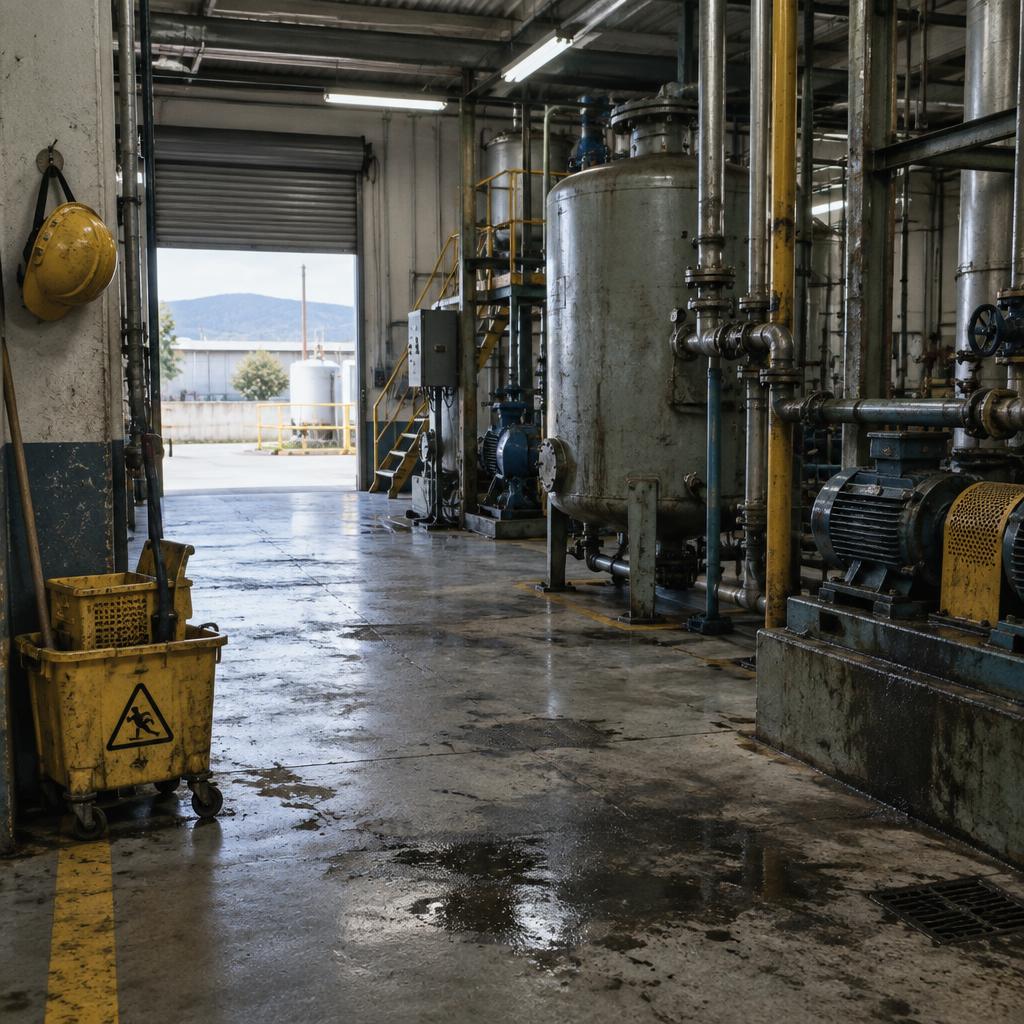
- The client and the personnel’s employer coordinate their safety obligations.
- For an unknown spill: report it, do not improvise.
- Identify permits, PPE, and authorizations before the first shift.
The short answer
Before the provider enters the plant, document: (1) which areas it will clean and how often; (2) who authorizes entry to each; (3) what PPE and training your workplace requires; (4) what to do in the event of a spill or incident and whom to notify; (5) which tasks require a specific permit and who issues it; and (6) the work schedule and coordination with production. What is left "understood" is what causes problems later.
Who defines what
Responsibilities are coordinated, not transferred. The host facility communicates site hazards and rules. The provider, as the employer of its personnel, must also identify task-related hazards, train personnel, provide the PPE for which it is responsible, and supervise its use. Both parties coordinate PPE selection and supply; the contract does not eliminate their legal obligations.
Occupational safety and health standards reinforce this approach. NOM-017-STPS-2024, *Personal protective equipment—Selection, use, and handling in workplaces* (published in the DOF on March 28, 2025, effective since September 2025 according to the official standards catalog), establishes that the employer identifies risks by job and area and determines PPE based on that analysis. It also provides for the employer to have PPE available for visitors, such as providers, who enter areas where its use is mandatory and, for specialized services, to ensure that contracted personnel know the risks, safety measures, and required PPE, and to supervise compliance. PPE selection must begin with a risk analysis by job and area and coordinate the responsibilities of the employer and the host facility.
The safety and health obligations of each party when contractors are involved are a question for your Occupational Safety and Health and Legal departments; this guide does not resolve it.
Zone matrix
Use this as a starting point. The risks are typical and general; your plant may have others. Adjust each row based on your risk analysis.
| Zone | Typical risk for cleaning personnel | Who must authorize entry | What must be agreed on beforehand |
|---|---|---|---|
| Administrative | Pedestrian traffic, wet floors, and access to information; risk level based on the site assessment | Site Administration / Facilities | Schedules, access, information security, wet-floor signage |
| Production | Operating or energized machinery, forklift traffic, surfaces with product on them, noise, temperature | Production and Occupational Safety and Health | Which machines may be running, prohibited areas, PPE specified by the workplace, who provides an escort, scheduled shutdowns |
| Raw materials warehouse | Stored chemicals, spills, forklifts, stacked materials | Warehouse and Occupational Safety and Health | What may and may not be touched, safety data sheet locations, compatibility of cleaning products with stored materials, traffic routes |
| Waste area | Hazardous or special-handling waste, containers, odors, contact with materials | Environmental lead / EHS | Who handles waste and who only cleans the surrounding area; clear separation; PPE; where waste generated by cleaning is disposed of |
| Restrooms and locker rooms | Slippery surfaces, exposure to biological agents, use of disinfectants | Facilities / Human Resources | Frequency, schedules that do not disrupt shift changes, supplies, sanitary waste handling |
| Outdoor areas | Vehicle traffic, weather, drains, loading areas | Site Security and Occupational Safety and Health | Pedestrian routes, schedules coordinated with loading docks, which areas are designated for maneuvering |
If a zone involves confined spaces, work at height, equipment with hazardous energy, or special substances, treat it as work requiring a specific permit (see below).
Spills and special cleaning
Distinguish between two situations.
Routine cleaning. Scheduled work within the contracted scope.
Spill or nonroutine cleaning. A product, oil, or chemical spill in production or a warehouse is generally not routine cleaning. Agree in writing on:
- Who responds first. Normally, trained personnel designated by the workplace, according to its procedure. The provider must not act on its own initiative on an unknown spill.
- Whom cleaning personnel notify and by what means (name, radio, extension).
- When the provider may intervene and under what conditions: only if your procedure allows it, with PPE you have specified, the safety data sheet available for reference, and personnel trained for the task.
- Who covers the cost of nonroutine cleaning: define it in the contract as an additional service, not after the event.
- What happens to the waste generated. Hazardous waste is identified under NOM-052-SEMARNAT-2005 (*Establishing the characteristics, identification procedure, classification, and lists of hazardous waste*, published in the DOF on June 23, 2006; the official catalog lists it as current). Deciding what constitutes hazardous waste and how it is disposed of is the responsibility of your environmental lead, not the cleaning provider.
This guide does not describe how to contain or neutralize substances: that depends on each product and your procedures.
- STEP 01
Detect
Do not touch the substance or attempt to identify it by testing.
- STEP 02
Notify
Use the site’s emergency channel.
- STEP 03
Authorized response
The designated trained team responds.
- STEP 04
Determine scope
The provider acts only if authorized and trained under the applicable procedure.
Work permits
A work permit is the written authorization your workplace issues for nonroutine activities. The provider does not define permits: it requests them and complies with them. Ask Occupational Safety and Health which apply to cleaning; for example, work in confined spaces, at height, near equipment with hazardous energy, with ignition sources, or in classified areas.
Agree on three things:
- Which cleaning activities require a permit at your plant (a defined list, not the judgment of whichever supervisor is on duty).
- Who issues and closes it, and how far in advance it must be requested.
- What the provider verifies before starting: that the permit is valid, assigned personnel are those named in it, and the described conditions match what is observed on site. If they do not match, work does not start and the discrepancy is reported.
Coordination with production
Coordination with Production is part of risk control and compliance with the cleaning program.
- A shared calendar of shutdowns, maintenance, and product changeovers.
- One contact per shift, from the plant and from the provider, with a name and phone number.
- Schedules and shift changes. Define which areas are cleaned during production, which only during shutdowns, and which at shift changes.
- Site-specific hygiene rules (clean areas, food safety, pest control), provided in writing.
- Notice of changes to areas or risks, with confirmation from the provider.
What documents to request
Request and retain what your procedure requires. As a baseline:
- Safety data sheets (SDS; FDS/HDS in Spanish) for the cleaning products the provider will bring into the plant, so Occupational Safety and Health can verify compatibility with materials in each zone. NOM-018-STPS-2015, *Harmonized system for identifying and communicating hazards and risks from hazardous chemicals in workplaces* (current according to the official standards catalog), establishes that safety data sheets must be prepared in Spanish and that the employer must have them available for the substances it handles.
- Product list, with labeled containers.
- Training records required by your plant.
- Personnel roster of those entering, to control access and permits.
- The provider’s incident procedure, to compare with yours.
Define the required PPE by zone and document who provides it, without replacing the legal obligations of the employer or the host facility.
Common mistakes
- Treating the entire plant as one zone. Each area has its own authorization.
- Leaving orientation to whichever supervisor is on duty. It must have defined content and a record.
- Not defining what happens when a spill occurs. The first event becomes a hard lesson in defining the procedure.
- Changing personnel without notice. Each new assignment must go through orientation and registration.
Warnings
Pre-start orientation and coordination checklist
*Use: complete this before the first shift and repeat it whenever the scope, a zone, or personnel change.*
Complete each item with your team and retain the supporting documentation.
- Cleaning areas defined by zone, with frequency and scheduleEvidence: Documentation: Signed scope · Responsible: Operations / Procurement
- Entry authorizer identified for each zoneEvidence: Documentation: Completed zone matrix · Responsible: Occupational Safety and Health
- PPE defined by zone and supply coordinated between employer and host facilityEvidence: Documentation: PPE list by zone · Responsible: Occupational Safety and Health
- Provider product safety data sheets received and reviewedEvidence: Documentation: Safety data sheet file · Responsible: Occupational Safety and Health
- Products and containers labeled and checked for compatibility with stored materialsEvidence: Documentation: Product list · Responsible: Occupational Safety and Health
- Roster of assigned personnelEvidence: Documentation: List with job titles · Responsible: Provider / Operations
- Training records required by the plantEvidence: Documentation: Training records · Responsible: Provider
- Safety orientation delivered and recordedEvidence: Documentation: Signed record · Responsible: Occupational Safety and Health
- Routes, exits, restricted areas, and assembly points shownEvidence: Documentation: Documented walkthrough · Responsible: Occupational Safety and Health
- Spill or incident procedure: whom to notify and howEvidence: Documentation: Instructions provided · Responsible: Occupational Safety and Health
- Activities requiring a work permit and who issues itEvidence: Documentation: Activity list · Responsible: Occupational Safety and Health
- Handling defined for waste generated by cleaningEvidence: Documentation: Written agreement · Responsible: Environmental lead
- Contact for each shift (plant and provider), with phone numberEvidence: Documentation: Contact directory · Responsible: Operations
- Shutdown and changeover calendar sharedEvidence: Documentation: Calendar · Responsible: Production
- Rules for adding and removing personnel (prior orientation)Evidence: Documentation: Procedure · Responsible: Occupational Safety and Health / Provider
Print it for your next review.
A good plant startup comes down to assigning an owner to each zone, having PPE and permits defined by those who understand the risks, and ensuring Production and the provider know when and how to coordinate. Start by completing your plant’s zone matrix and use it as the basis for orientation.
Sources
Use this guide for your next decision.
To learn how SELIMEX serves industrial facilities, visit the industrial sector page; to request a proposal, use the quote page.