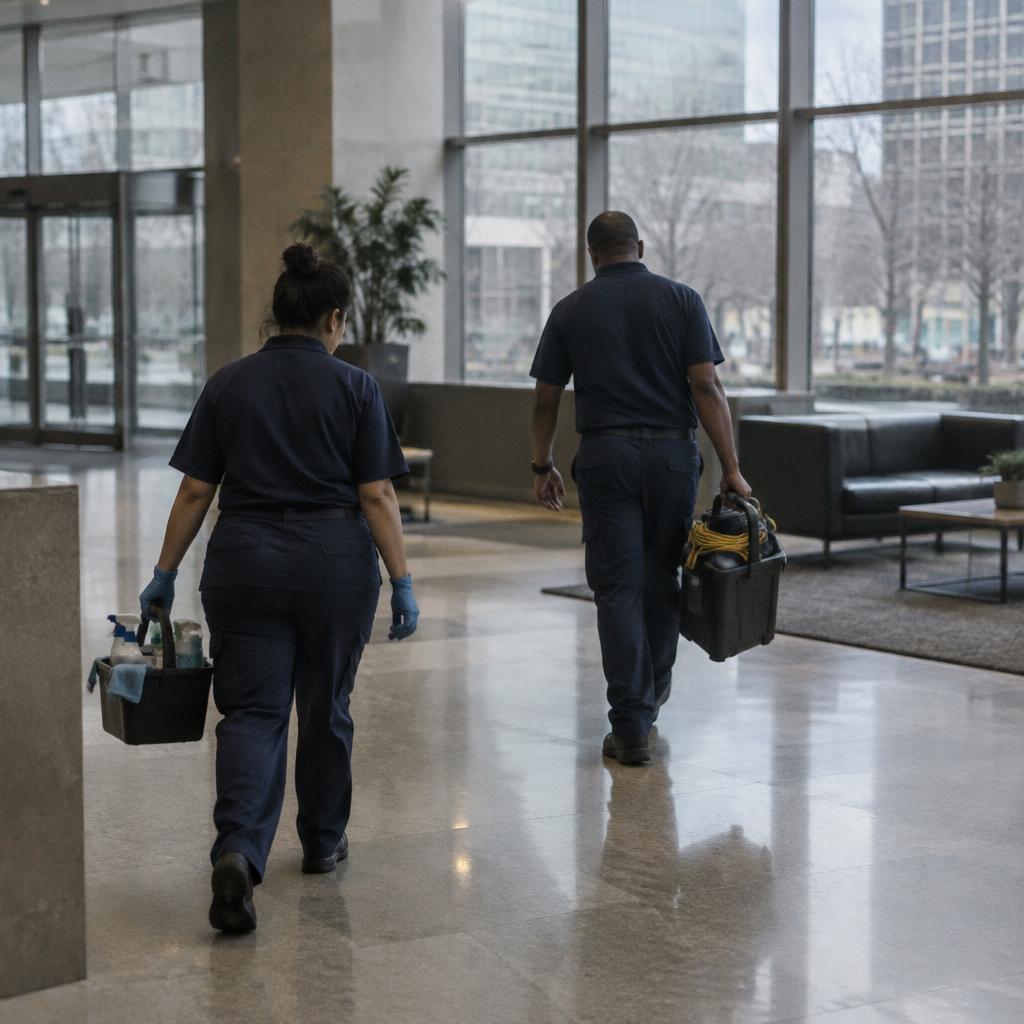

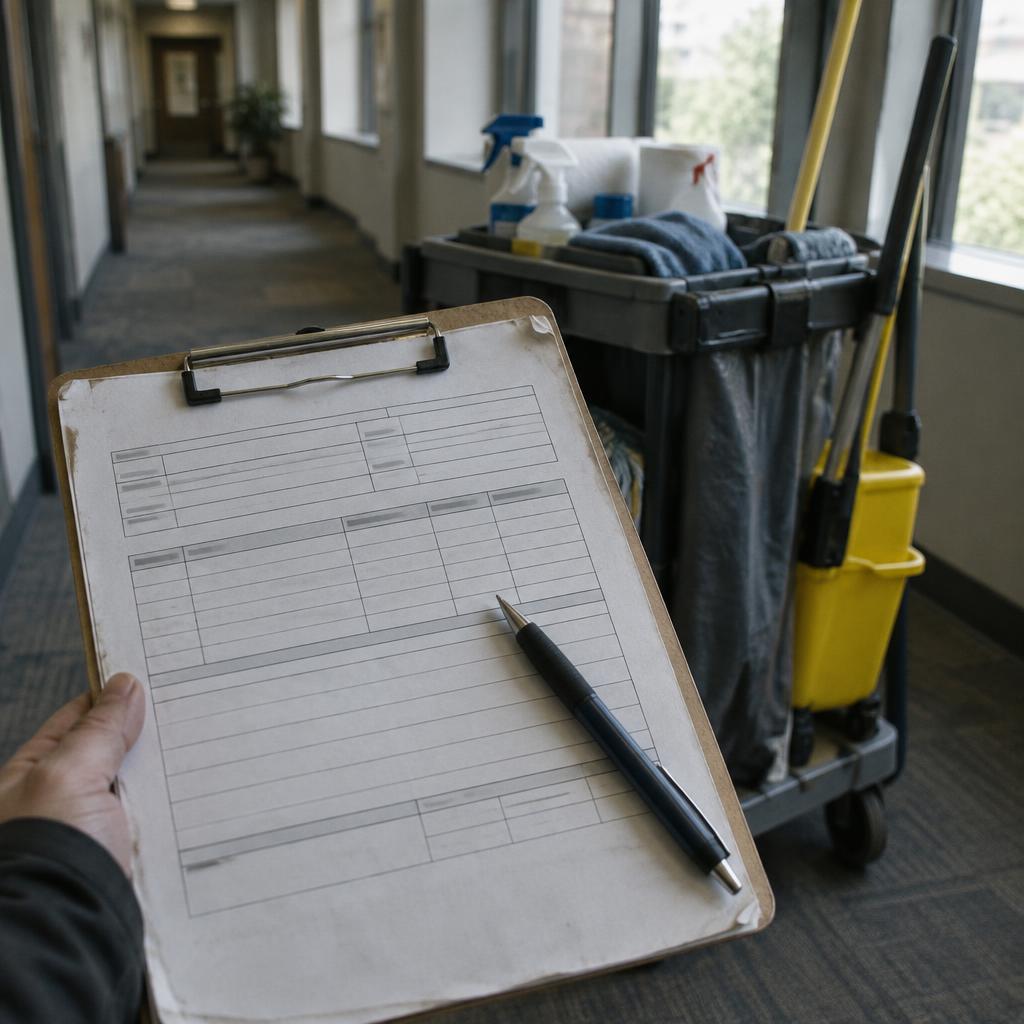
- The same scope and assumptions for every provider.
- Compare the cost of a service, not the supply of personnel.
- Normalize frequencies, extras, and VAT before adding them up.
The Short Answer
A comparable RFQ has five characteristics: (1) it describes the scope with measurable data (square meters, areas, frequencies, schedules); (2) it sets the assumptions everyone must use (shifts, headcount or workdays, whether supplies are included); (3) it requests the compliance documentation your company requires; (4) it requires a single response format, with itemized pricing; and (5) it includes a site visit and a deadline for questions, with answers shared equally with everyone.
- STEP 01
Prepare
Areas, tasks, frequencies, and shared assumptions.
- STEP 02
Validate On-Site
Walkthrough and restrictions under agreed conditions.
- STEP 03
Resolve Questions
Share the same clarifications with everyone.
- STEP 04
Compare
A consistent monthly basis without double-counting included items.
- STEP 05
Decide
Eligibility requirements and predefined criteria.
Why Quotes Are Not Comparable
An unclear scope is a common cause of differences; it does not imply bad faith:
- "Office cleaning" may mean daily sweeping or may also include windows, restrooms, kitchenettes, and waste collection.
- Undefined frequencies. One provider quotes monthly "deep cleaning," while another quotes it quarterly.
- Different schedules. Nighttime and daytime service involve different working hours, supervision, and logistics.
- Staffing and supervision. One provider quotes three people and another five; without a shared baseline, you cannot tell whether the lower price means less coverage.
- Supplies and equipment. It is unclear who provides paper, soap, bags, machinery, or carts.
When the scope is vague, the provider fills in the gaps with its own assumptions.
What the RFQ Should Include
1. Requester and Process Details
Legal business name, site or sites, contact for questions, question deadline, visit date, submission deadline, and proposal validity period.
2. Facility Description
Approximate floor area by area type (offices, restrooms, warehouse, loading docks, dining areas, outdoor areas), flooring type, number of floors, access points, site operating hours, and restrictions (product zones, restricted areas, entry protocols).
3. Service Scope
For each area: tasks, frequency (daily, weekly, monthly, per event), and expected standard (what "clean" means and how it is verified). Separate recurring work from periodic work (deep cleaning, windows, waxing) and as-needed work.
4. Operations and Schedules
Service days and hours, number of shifts, whether holidays are covered, and how to request additional service.
5. Staffing and Supervision
Ask each provider to state its proposed headcount per shift, working hours, and whether it includes on-site supervision or supervisory visits (and how often). Set a baseline scenario ("quote this scope, frequencies, and service windows with a justified staffing estimate") and request the alternative the provider recommends separately.
6. Supplies, Equipment, and Consumables
Define who provides cleaning supplies, consumables (paper, soap, bags), machinery, and protective equipment.
7. Safety and Compliance
Ask the provider to submit safety data sheets for the chemicals it will use. NOM-018-STPS-2015, sections 6.3, 6.4, and 6.6, regulates safety data sheets for hazardous chemicals and mixtures, their availability, and information provided to workers and contractors. Your Safety team must determine which products and tasks fall within its scope. For any high-risk task (work at height, electrical work, confined spaces), require the provider to identify the trained personnel who would perform it and the procedure they would follow; do not accept it as a generic line item.
On labor matters, the Federal Labor Law (LFT, arts. 12–15) prohibits subcontracting personnel, permits subcontracting specialized services that are outside the contracting company's corporate purpose and primary economic activity, and requires the contractor to be listed in the STPS public registry and the contract to be in writing, stating the purpose of the service and the approximate number of workers. That is why the RFQ should request the REPSE registration number and validity period, and your team should verify them in the STPS registry, where the search shows the registration number, validity period, and authorized services. In addition, the Federal Tax Code (art. 15-D) makes the tax treatment of these payments conditional on the contractor being registered and meeting income tax (ISR) and VAT requirements; your tax team is responsible for interpreting this for your company. For verification details, see the REPSE guide.
8. Commercial Terms
Request itemized pricing (see format), billing method, payment frequency, proposal validity period, price adjustment clauses, and termination process. State whether prices should be quoted before VAT.
9. Evaluation Criteria
State from the outset what will be evaluated and how it will be weighted (for example, documentation compliance as an eligibility requirement, followed by scope, operations, verifiable experience, and price). Your company decides the weights; they must be the same for everyone and documented before bids are received.
RFQ Template (Copy and Use)
Copy the table, fill it out with your site details, and send the same version to every provider.
| Field | What to Enter | Your Information |
|---|---|---|
| Requester / Site(s) | Legal business name, address, operating hours | |
| Contact and Dates | Contact, visit date, question deadline, submission date, proposal validity period | |
| Floor Area by Area Type | Approximate m²: offices, restrooms, warehouse, loading docks, outdoor areas | |
| Flooring and Finish Types | Concrete, tile, carpet, etc. | |
| Tasks by Area | Task list for each area | |
| Frequencies | Daily / weekly / monthly / per event, by task | |
| Standard and Verification | What is "acceptable" and how it is checked (inspection, log, report) | |
| Days and Hours | Days, hours, shifts, holidays | |
| Baseline Staffing Scenario | Headcount per shift to quote; required supervision | |
| Provider Alternative | Space for a different, justified proposal | |
| Supplies and Consumables | Who provides each item; list with estimated quantities | |
| Machinery and Equipment | Who provides them; quantities | |
| Periodic Services | Deep cleaning, windows, waxing, etc., with frequency | |
| High-Risk Services | Work at height, electrical work, or other tasks: trained personnel and procedure | |
| Chemical Safety | Product safety data sheets | |
| Documentation | REPSE registration number and validity period; compliance opinions; sample contract | |
| References | Verifiable contacts, if the provider chooses to share them | |
| Price | Single format (see next section) | |
| Commercial Terms | Billing, payment, adjustments, termination | |
| Evaluation Criteria | Eligibility requirements and weights |
How to Request Responses: One Format
Ask every provider to respond using the same structure, with these items listed separately:
- Monthly price for the base service (baseline scenario), before VAT.
- Cost of periodic and as-needed services, with their frequency.
- Consumables: included or unit price.
- Machinery and equipment: included or cost.
- Supervision: included or cost.
- Comparable monthly total (sum of the preceding items).
- Assumptions and exclusions, listed.
- Recommended alternative, with its price, if any.
Proposal Comparison Table
Fill in one column per provider using the information in its response. Mark "not specified" when information is missing; an empty cell in a proposal is an unanswered question.
| Criterion | Provider A | Provider B | Provider C |
|---|---|---|---|
| REPSE: registration number, validity period, and authorized services verified in the registry | |||
| Dated compliance opinions submitted | |||
| Covers all areas in the RFQ | |||
| Proposed vs. requested frequencies | |||
| Schedules and shifts | |||
| Headcount per shift (baseline scenario) | |||
| Supervision: type and frequency | |||
| Consumables: included / unit price | |||
| Machinery and equipment | |||
| Periodic services: cost | |||
| Safety data sheets submitted | |||
| High-risk services: personnel and procedure | |||
| Comparable monthly total (before VAT) | |||
| Exclusions and assumptions | |||
| Payment and price adjustment terms | |||
| Outstanding questions | |||
| Score based on evaluation criteria |
How to Interpret the Differences
Normalize before comparing. If one provider excludes consumables and another includes them, add or subtract to reach the same scope, or ask for a revised quote.
- Ask about outliers. A price far below the rest is a reason to ask what is not included; it is not, by itself, proof of noncompliance. Also ask about the highest price: it may include supervision or equipment others left out.
- Do not decide on price alone. The provider meeting eligibility requirements and submitting a clear proposal matters as much as the monthly total.
Common Mistakes
- Describing the scope differently to each provider and then comparing.
- Asking for "a price" without a breakdown or baseline scenario.
- Skipping the site visit.
- Changing the criteria after receiving bids.
Cautions
A comparable quote is built before you receive it. When you describe the same scope, set a baseline scenario, request itemized prices, and require the same documentation, differences between proposals stop being a mystery and become decisions you can explain: what each includes, what it excludes, and what risk you assume.
Sources
Use This Guide for Your Next Decision.
Use the template for your next request for quotation. To request a quote from SELIMEX, visit the quote page; for more information on compliance, see the compliance section.