Summary
A cleaning service incident is easier to manage when the protocol is agreed on before it happens. This guide proposes six steps (respond, notify, document, escalate, correct, and close), severity levels defined by each client, and a report template. It also explains what to verify with Safety and Health and the legal department when a workplace accident occurs, because official notifications have their own deadlines.
The Short Answer
First, protect people and secure the area. Then notify the appropriate person, document what happened using facts (not blame), escalate based on the agreed severity level, define a corrective action with an owner and deadline, and close the case in writing with both parties' agreement. If none of this is written down beforehand, it will be written in a rush during the first incident.
What Counts as an Incident
An incident is any unplanned event during service that affects people, facilities, property, or the client relationship. Five common types:
| Type | Example |
|---|---|
| Accident or injury | Fall, cut, contact with a product |
| Spill or product exposure | Spilled or improperly stored product |
| Damage to facilities or equipment | Floor, furniture, or glass damaged during cleaning |
| Missing item or suspected loss | An item that cannot be found after service |
| Service complaint | Area not serviced, inappropriate conduct, missed schedule |
An event can fall into several categories (a spill that causes a fall); address anything affecting people first.
The Six-Step Workflow
(See flowchart, visual V1.)
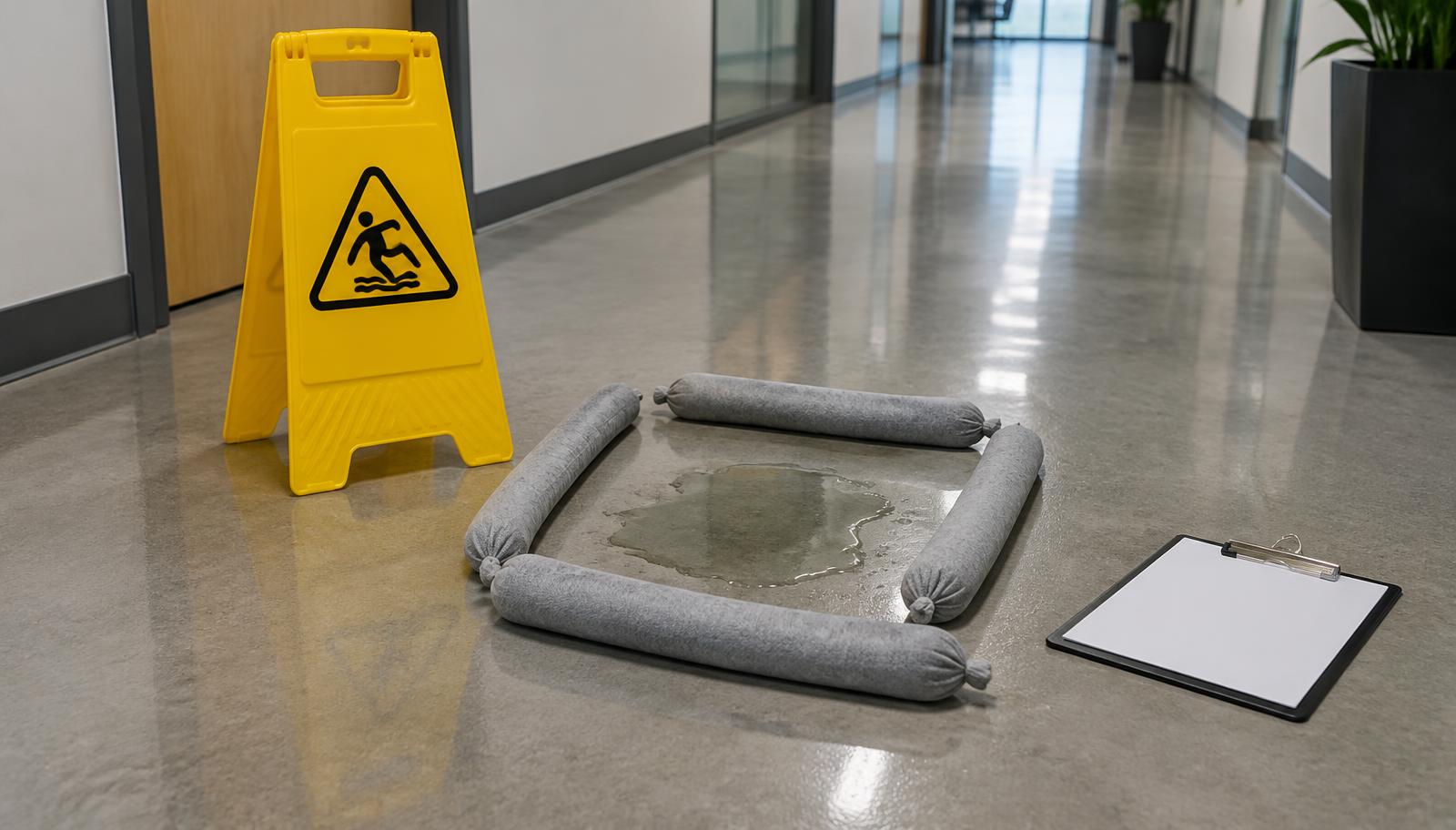
- Respond and contain. Protect people, post signs or isolate the area, and prevent the event from escalating. Only trained personnel with appropriate equipment should act. If someone is injured, first activate medical care and first aid under site procedures.
- Notify. The provider's supervisor immediately informs the site contact through the agreed channel (call, message, radio). The initial notification is brief: what happened, where, when, whether anyone was affected, and what was done. Details come later.
- Document. Complete the incident report (template below) with observable facts, time, witnesses, and photographs when possible, without photographing injured people. Separate what was observed from what is assumed.
- Escalate. Depending on the agreed severity level, escalate the case to Operations, Safety and Health, the legal department, the insurer, or management. Agree in advance on who notifies whom and within what timeframe.
- Correct. Identify the probable cause, the immediate action, and the action to prevent recurrence, each with an owner and deadline.
- Close. Verify that the action was completed, sign off on closure, and review the case at the regular follow-up meeting (see the supervision guide).
Severity and Escalation: Defined by the Client
There is no universal severity scale for cleaning services, and this guide does not impose one. Each company defines it according to its operations: an office is not the same as a CEDIS (distribution center) or a plant with sensitive processes. The recommendation is for the client and provider to agree on three or four levels described using observable criteria, for example:
| Level | Criterion (to be defined by the client) | Who to Notify | Notification Timeframe |
|---|---|---|---|
| 1 · Minor | No injuries or significant property damage; resolved on-site | Supervisor and site contact | To be agreed |
| 2 · Moderate | Limited property damage or a formal complaint; requires corrective action | Above + provider's account manager | To be agreed |
| 3 · Major | Injury requiring medical attention, hazardous product spill, or significant damage | Above + client's Safety and Health, legal department, and management | To be agreed |
| 4 · Critical (optional) | Event involving serious risk, multiple people affected, or legal implications | Management of both parties | To be agreed |
Each company sets timeframes with its provider; they are intentionally left open here. Consider including this table as a contract appendix (see the minimum contract clauses guide).
When Someone Is Injured
This is where the operating protocol intersects with official obligations. The following is general guidance, not legal advice.
- Who notifies. For a workplace accident, official notifications are the worker's employer's responsibility. If the cleaning personnel are employed by the provider, the provider must fulfill these requirements; the client should verify and coordinate this. Confirm with your legal department how this applies to your case.
- Notification to STPS. The STPS Workplace Accident Notification System (SIAAT) states that the employer or its designated representative submits the notification online only, within 72 hours after the accident (and in the event of death, as soon as it becomes known). According to the same page, accidents must be reported even if IMSS has not classified them as work-related injuries.
- IMSS. IMSS explains that form ST-7 is the notification of initial medical care and assessment of a probable workplace accident, and that the insured person or a family member handles the assessment process, preferably with the reverse side completed by the employer. The deadlines for the employer's notification to IMSS and the relationship between the two notifications should be confirmed with a social security specialist: the official page we reviewed does not detail them and was last updated in 2019.
- Contractors at the workplace. The Federal Occupational Safety and Health Regulations establish employer obligations concerning contractors working at their facilities, including ensuring that they comply with safety measures. Have Safety and Health review how this applies at your workplace.
- Joint and several liability. Article 14 of the LFT (Federal Labor Law) provides that parties engaging specialized services are jointly and severally liable to workers if the contractor fails to meet its labor obligations. That is why the client is not detached from the provider's compliance (see the provider documentation file guide).
When a Spill or Chemical Is Involved
A cleaning product spill should not be handled "with whatever is available." The reference in Mexico is NOM-018-STPS-2015, which addresses hazard identification and communication for hazardous chemicals. According to its text in the DOF (October 9, 2015), employers must have safety data sheets (SDS) for the substances handled, make them permanently available to workers, and train those who handle them.
In practice, this means three protocol rules:
- The SDS governs. Each product's containment and cleanup procedure is in its safety data sheet and the site's Safety and Health procedures, not in this guide.
- Only trained, equipped personnel intervene. If the person detecting the spill does not know what product it is or lacks the equipment, isolate the area, post signs, and notify the appropriate contact.
- Do not mix products to "fix" the problem. Never combine cleaning products or improvise neutralization procedures.
If someone was exposed (skin, eyes, inhalation), activate the site's medical response and bring the product's SDS.
Damage, Missing Items, and Complaints
Facility damage. Photograph the damage before moving anything, record what activity was underway and who was present, and check the contract for who is responsible and how to file a claim (deductible, provider's insurance, direct repair).
Missing item. This is a suspicion, not an accusation. Record what is missing, when it was last seen, who had access, and what records exist. Investigation belongs to whoever has that role at the site; avoid naming individuals in open communications.
Complaint. Record the date, area, and description, confirm receipt to the person who submitted it, and classify it. If the complaint recurs in the same area, it stops being an isolated complaint and becomes a supervision program issue.
Common Mistakes
- Not having a protocol before an incident.
- Delaying notification to gather "all the information." The first notification is brief; details follow.
- Mixing facts with blame in the report.
- Closing without verifying corrective action.
- Handling a spill without consulting the SDS or without trained personnel.
- Leaving notification timeframes implicit. If they are not written down, each party assumes a different deadline.
- Assuming the other party submitted the notification. Client and provider must confirm in writing who submits what.
- Not reviewing trends at the monthly meeting.
Warnings
Protocol and Incident Report Template
A. Protocol details (agree before startup)
| Field | Content |
|---|---|
| Site / area | |
| Site contact (client) and alternate | |
| Provider supervisor and alternate | |
| Immediate notification channel | |
| Safety and Health contact | |
| Legal / insurance contact | |
| Who submits official notifications in the event of a workplace accident |
B. Severity levels and timeframes (defined by the client)
| Level | Criterion | Who to notify | Agreed notification timeframe |
|---|---|---|---|
| 1 | |||
| 2 | |||
| 3 | |||
| 4 (optional) |
C. Incident report
| Field | Content |
|---|---|
| Reference number and event date / time | |
| Exact location | |
| Type (accident, spill, damage, missing item, complaint) | |
| Severity level | |
| Description of facts (what was observed) | |
| People involved and witnesses | |
| Product or equipment involved (and its SDS, if applicable) | |
| Immediate actions taken | |
| Time and person who made the initial notification; recipient | |
| Evidence (photos without injured people, records) | |
| Is official notification required? Who submits it and when? | |
| Probable cause | |
| Corrective action: owner and deadline | |
| Preventive action: owner and deadline | |
| Closure: date, verification, client and provider signatures |
How to use: share it with your provider before startup, complete fields A and B together, and rehearse a simulated case.
Conclusion
A good protocol does not prevent every incident, but it does reduce confusion when one occurs: everyone knows who notifies whom, with what information, and when the case is considered closed. The key is to put it in writing before you need it.
Next Step
Choose an incident type, complete sections A and B with your provider, and simulate the workflow once. For documentation matters, visit the compliance section, learn how we work, or request a proposal on the quote page.
Sources
Bring this guide to your next provider review.
To get a quote from SELIMEX, use the quote page; for more information, see the compliance section.