
Summary
There is no inherently superior cleaning schedule. Night shifts protect occupants' concentration and allow noisy or wet work; daytime cleaning provides visibility, immediate response, and supervision during the client's working hours; hybrid cleaning allocates tasks according to their impact. The differences go beyond a rate: they include premiums and shift structure, transportation, security and access, supervision, and disruption to work.
The Short Answer
Choose nighttime if your operation depends on quiet, privacy, or unoccupied areas, or if deep floor cleaning requires clear spaces. Choose daytime if you want immediate response in restrooms and common areas, supervision during your working hours, and fewer hours keeping the building open solely for cleaning. Choose hybrid when your building combines both needs: light maintenance during the workday and heavy work outside it. A good starting point is to divide by task, not by building: what can be done with people present and what cannot.
What Changes Between Models
Both models deliver the same service with different trade-offs. US industry sources agree on the essentials, although they describe a different context:
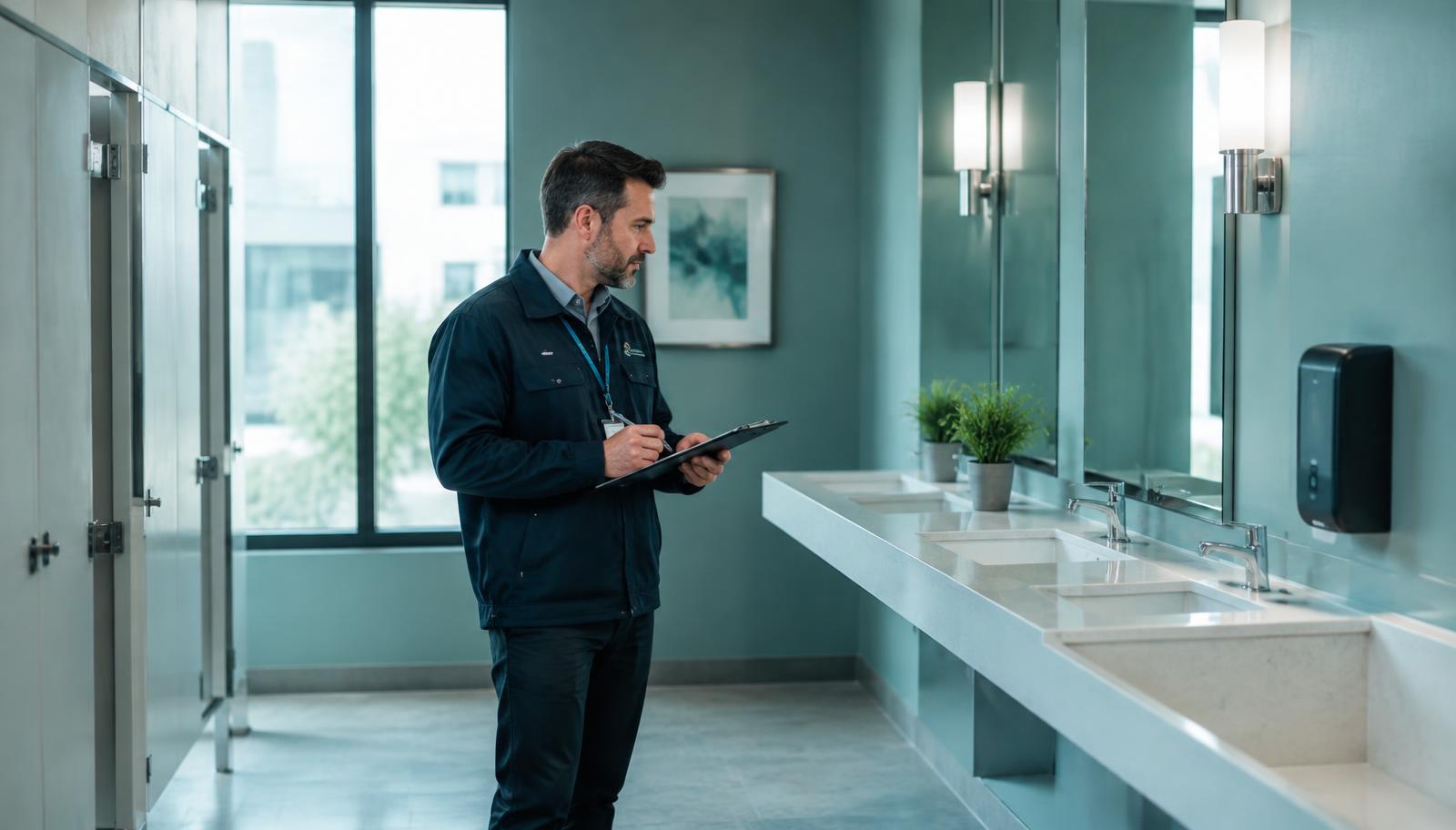
- Daytime. According to CleanLink, cleaning during occupied hours allows occupants to give immediate feedback and building management to direct personnel in real time. Challenges include equipment noise, work disruption, and privacy in sensitive areas; suggested mitigations include low-noise vacuums, communicating zones and schedules, and training personnel to be discreet.
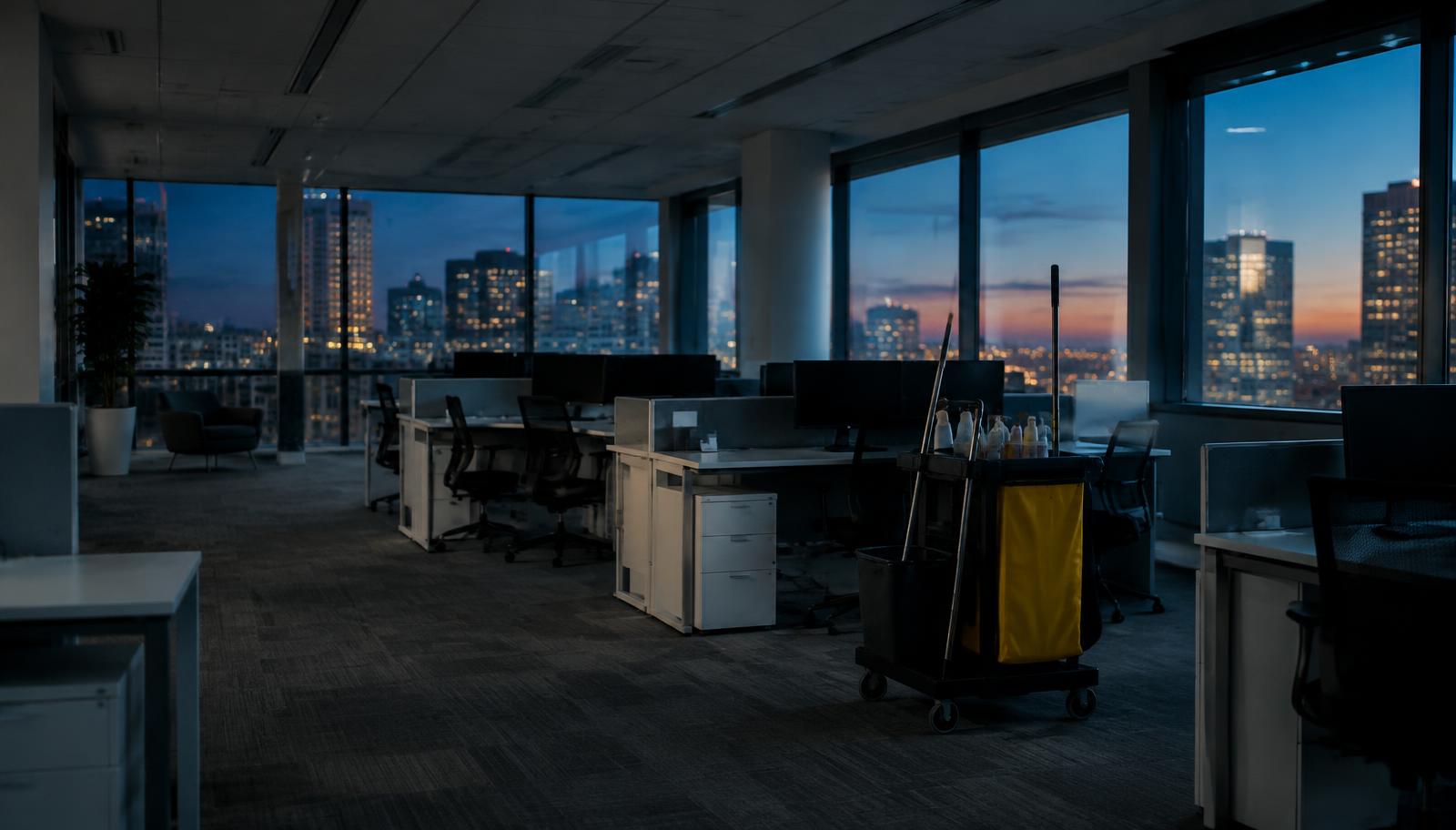
- Nighttime. The same publication notes that noisy equipment, such as vacuums and scrubbers, is generally avoided during office hours, equipment cords create trip hazards when occupants are present, and freshly mopped floors are slippery (CleanLink, "Benefits and Tradeoffs"). Conversely, that article warns that someone cleaning alone for hours may be isolated and a medical emergency in the early morning may take time to detect.
One caveat: these are industry media articles based on interviews, not studies with measurements; the BUILDINGS article (2014) acknowledges this. Use them as a list of factors, not as evidence of outcomes.
Labor Framework: What the LFT Says
The schedule changes the provider's personnel shifts, which affects the service structure. Based on the current LFT (Federal Labor Law) text (latest amendment indicated: 05-14-2026), here is what we reviewed:
- Shift types (Art. 60). Daytime runs from 6:00 a.m. to 8:00 p.m.; nighttime from 8:00 p.m. to 6:00 a.m.; a mixed shift combines both periods and is considered nighttime if the nighttime portion reaches three and a half hours or more.
- Daily duration (Art. 61). Eight hours for daytime, seven for nighttime, and seven and a half for mixed shifts.
- Weekly duration (Art. 59). The current text sets forty hours per week as the maximum regular workweek, under an amendment published in the DOF on 05-01-2026. The workweek reduction is implemented gradually under the decree's transitional provisions; confirm the exact timeline with legal counsel.
- Overtime (Art. 66). Paid at a one hundred percent premium over regular hours and limited to twelve hours per week, distributed over up to four hours daily for a maximum of four days.
- Sunday (Art. 71). Anyone working on Sunday is entitled to a premium of at least 25% over the wage for regular workdays.
The practical implication for a facility manager is not to calculate these items, but to know what to ask: how the provider structures shifts to cover your service window, whether it relies on overtime, and how this is reflected in the proposal. A nighttime shift shorter than a daytime shift means the same coverage may require different staffing; that is a service design question, not something this guide can quantify.
In addition, the reform provides for electronic working-time records beginning January 1, 2027, according to Garrigues, a law firm; confirm the scope with your legal department. Remember that responsibility for personnel's working conditions does not disappear through outsourcing: review provider documentation verification in the compliance section.
Cost Components That Change
We do not quantify costs: they depend on the building, city, and provider. Ask for the proposal to show these components separately so you can compare models (the comparison approach is in the service pricing guide):
| Component | What May Change Between Daytime and Nighttime |
|---|---|
| Shift structure and premiums | Shift duration, potential overtime, Sunday or rest-day work; ask how your window is covered |
| Personnel transportation | Availability of public transit or nighttime transportation; does the provider cover it? |
| Security and access | Opening the building after hours, security staffing, key control, access logs |
| Supervision | Whether the provider's supervisor and your team work the same hours; who can inspect quality the next day |
| Building utilities | Lighting and climate control needed for an after-hours shift; BUILDINGS attributes some daytime-shift savings to utilities, although it presents this as a qualitative estimate |
| Disruption | Occupants' lost time, postponed tasks, complaints; this is a cost to you, not an invoice line item |
| Supplies and equipment | Quiet or battery-powered equipment for daytime; more frequent restroom supply replenishment |
CleanLink (November 2025) states that second and third shifts typically cost providers and clients between 50 cents and 2 dollars more per hour in the United States. This is a reference from another country and wage structure; do not use it as a benchmark for Mexico.
Risks of Each Model
| Daytime | Nighttime | |
|---|---|---|
| Noise and disruption | High risk with conventional equipment | Low |
| Privacy / sensitive information | Personnel accessing occupied areas; requires agreements | Clear desks and after-hours access |
| Personnel safety | Less isolation | Working alone; emergency and communication protocol |
| Building security | Arrivals and departures within normal traffic | Access points open after hours |
| Floors and equipment | Wet floors and cords with occupants present | More freedom for heavy work |
| Supervision | During the client's working hours | Reviewed afterward, based on results |
| Incident response | Immediate | Not until the next day, unless on-call coverage is available |
Agreements with Occupants
Changing schedules is as much a communication project as a contractual one. BUILDINGS suggests notifying occupants about 30 days in advance and providing a feedback channel, and recommends rewriting the contract scope before making the change. The practical list of agreements is in the resource below; contractual adjustments are supported by the minimum clauses guide and subsequent monitoring by the supervision and indicators guide.
The Hybrid Model
CleanLink and BUILDINGS agree that many facilities end up with a hybrid approach: routine daytime tasks (restrooms, supply replenishment, spills, common areas) and after-hours deep cleaning. To define it properly:
- List each task and classify it as "compatible with occupants" or "requires an unoccupied area."
- Set windows by zone (for example, restrooms at agreed times).
- Define who authorizes window changes and how much advance notice is required.
- Agree on what happens if an area is occupied at service time.
Common Mistakes
- Deciding based on a single cost. Compare components, not just the total.
- Changing schedules without notifying occupants. Most complaints arise from surprise.
- Assuming daytime cleaning is quiet. It depends on the equipment and assigned tasks.
- Neglecting the night shift just because no one sees it. It requires results-based supervision and a contact protocol.
- Applying one model to the entire building. An executive meeting room and a lobby do not have the same needs.
- Not reviewing the model afterward. Run a pilot with a review date.
Warnings
Practical Resource: Decision Table and Occupant Agreements
A. Decision table (mark the column that best matches your situation)
| If Your Situation Is... | Generally Best Suited |
|---|---|
| Areas requiring concentration, frequent calls, and little tolerance for noise | Nighttime (or daytime with quiet equipment and agreed zones) |
| Restrooms and dining areas with heavy daytime use | Daytime or hybrid (maintenance rounds) |
| Floors requiring scrubbing, waxing, or treatment in an unoccupied area | Nighttime or weekends |
| Confidential information on desks or restricted areas | Nighttime with controlled access, or daytime with excluded areas |
| Building without after-hours security or access control | Daytime or hybrid |
| Need for immediate response to spills or requests | Daytime or hybrid |
| FM team that can only supervise during office hours | Daytime or hybrid, or nighttime with results reviewed the next day |
| Limited nighttime transportation availability for personnel | Daytime or hybrid; confirm with the provider |
| Zones with different sensitivity levels | Hybrid, with windows by zone |
B. Occupant agreements (review before startup or the change)
- Notify occupants sufficiently in advance (BUILDINGS suggests about 30 days) and provide a channel for questions.
- Zone map with service schedules.
- Excluded areas or areas with conditional access (executive offices, archives).
- Rule for posting signs in an occupied space.
- Clear-desk policy where applicable.
- Single channel for requests and complaints, with a response timeframe.
- Noise rules: which equipment at which times.
- Wet-floor signage and cord management.
- Person responsible for opening, closing, and keys after hours.
- Emergency protocol for lone work.
- Trial period with a review date and success criteria (complaints, compliance, disruption).
How to use: bring it to the meeting with your provider and occupant representatives before deciding.
Conclusion
The right question is not "day or night?" but "what conditions does each task need?" With that list, a component-based cost approach, and clear occupant agreements, the decision becomes verifiable and can be tested through a pilot before committing the entire service.
Next Step
Classify your building's tasks as "compatible with occupants" or "require an unoccupied area," complete table A, and propose a zone-based pilot. Explore the approach for corporate offices or request a proposal on the quote page.
Sources
Bring this guide to your next provider review.
To get a quote from SELIMEX, use the quote page; for more information, see the compliance section.