
Summary
A remodeling project does not end when the general contractor packs up their tools; it ends when the space is ready for occupancy. Post-construction cleaning is typically divided into three phases: a rough clean that removes debris and leftover materials, a detail (or fine) clean that addresses finished surfaces, and a final handover walkthrough with a punch list sign-off. What creates the most friction is rarely the cleaning itself, but rather that no one defined in advance who handles what, in what sequence, what level of care each finish requires, and what acceptance criteria determine completion. This guide structures those decisions and includes a handover checklist.
The short answer
Before construction wraps up, define three items in writing: the scope of each stage (what is cleaned and what is excluded), the responsible party for each (the general contractor or the cleaning contractor), and the handover criteria (what must be visible and verified for acceptance). Schedule the detail cleaning after the rough clean and only after airborne dust has had adequate time to settle. Protect delicate finishes from day one of construction, and consult each surface manufacturer before approving any cleaning method. Conclude with a joint walkthrough and a signed report with photos. Specific cleaning procedures are determined by the cleaning contractor, manufacturer technical sheets, and specialists when applicable; this guide does not prescribe tactical cleaning procedures.
Why this differs from routine maintenance cleaning
Routine maintenance cleaning repeats standard procedures on surfaces already in service. Post-construction cleaning confronts residues that were not previously there: drywall or cement dust, paint splatters, adhesives, sealants, protective films, and surplus materials. Moreover, it takes place in an environment where multiple trades overlap under tight deadlines, and where every newly installed finish carries its own warranty and maintenance restrictions. An incorrect method can permanently damage a new surface, and that damage often turns into a dispute among three parties: the facility manager, the general contractor, and the cleaning contractor.
The stages and what defines each one
There is no universal nomenclature. Training materials from the U.S. construction industry (such as NCCER) describe four phases: preparation, rough clean, deep clean, and touch-up. Other industry sources group them into three. The terminology matters far less than ensuring your contract explicitly details what each phase includes. Here, we outline three:
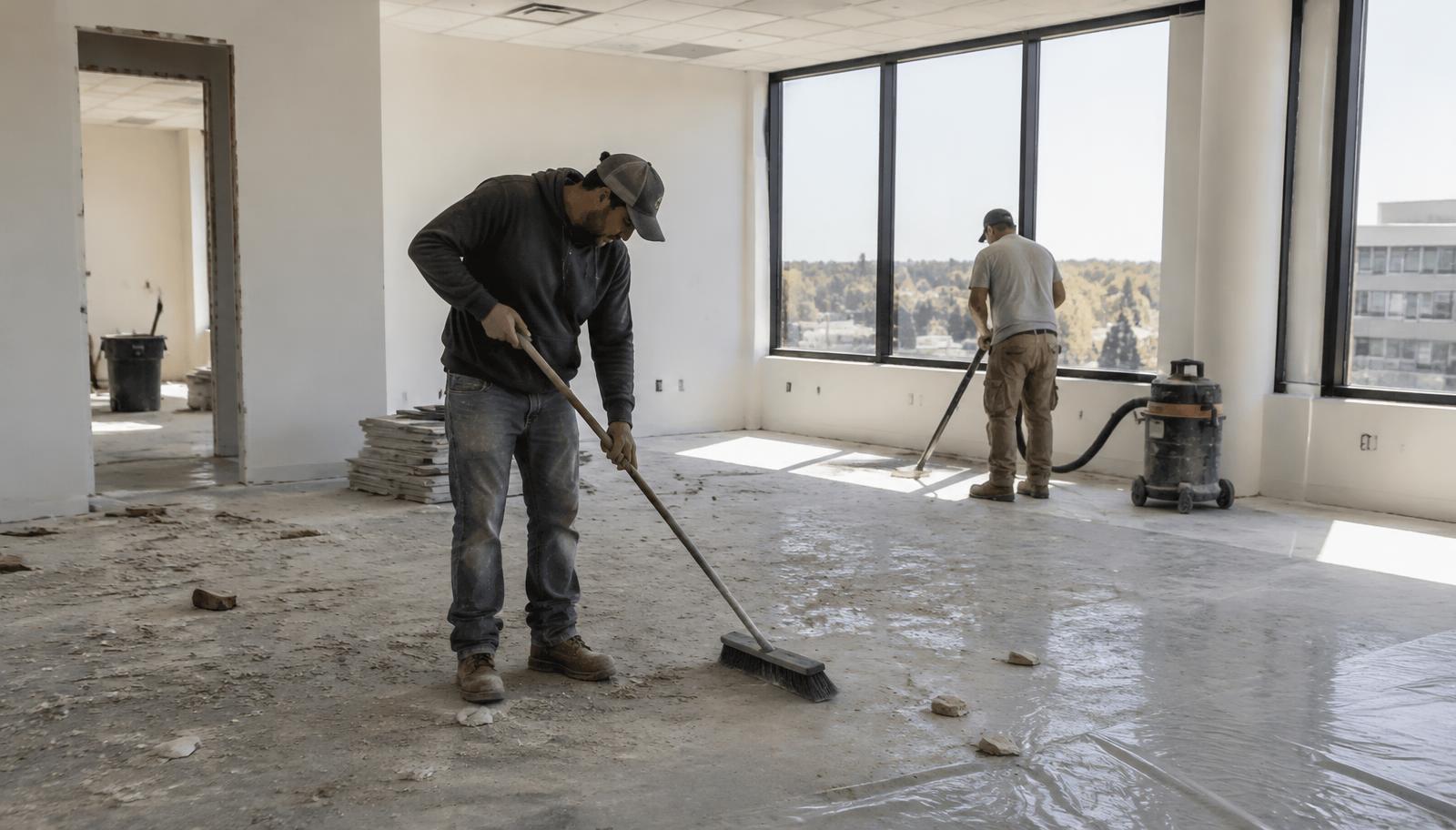
1. Rough clean. Removes rubble, surplus construction materials, packaging, and visible interior and exterior debris, clearing heavy dust without targeting a final finish. NCCER describes this as a phase without a detailed focus. It sets the baseline for subsequent work: as long as construction materials remain on-site, detail cleaning is counterproductive. Operationally, this phase is typically the general contractor's responsibility, as it directly stems from their work and waste; confirm this in your construction contract.
2. Detail (fine) clean. Targets completed surfaces: glass and frames, flooring, millwork, restrooms, light fixtures, visible supply grilles and ducts, and architectural hardware. NCCER recommends separating this from the rough clean by at least one day and scheduling touch-ups several days later, as airborne dust takes time to settle (referencing roughly a week). Treat this as a benchmark rather than an absolute rule: settlement times vary depending on the scope of work, ventilation, and the materials disturbed.
3. Handover. The joint walkthrough, including targeted touch-ups and formal documentation. This is primarily a verification milestone rather than a cleaning phase. NCCER suggests, where feasible, turning on the HVAC system to ensure supply grilles are not blowing dust; this operational decision must be made by Facilities Maintenance, as running systems prematurely can pull fine construction dust into ductwork and coils.
NCCER also notes that responsibility for detailed cleaning prior to building turnover generally falls on the construction firm. That is a broad reference point from a U.S. source, not a Mexican statutory requirement: in your facility, the construction contract and the mutually defined scope govern responsibility.
Coordination with the general contractor
Most disputes arise at the operational boundary between construction and cleaning. Key decisions to establish before starting:
- Who hauls what. Rubble, packaging, leftover paint, and demolition debris must be agreed upon with the general contractor. Detail cleaning begins only after the contractor formally declares their scope complete, supported by a formal memo or a joint preliminary walkthrough.
- Phased scheduling windows. If trades still have punch-list items pending (paint touch-ups, light fixture installations, carpet laying), fine cleaning must follow those activities; otherwise, work will have to be repeated.
- Access and permits. The cleaning contractor enters an active or recently active job site: define access points, working hours, freight elevators, restricted areas, and who authorizes them. NOM-031-STPS-2011 (the Mexican construction safety standard issued by the STPS, Secretariat of Labor and Social Welfare) requires informing contractors and service providers about site hazards relevant to their phase, issuing work permits, and establishing access and control protocols (sections 5.18, 5.22, and 9.2, with 5.18 applying to medium and large projects). Check with your safety specialist to confirm whether your remodel falls within the standard’s scope: the standard excludes maintenance that does not require building permits or regulatory notices, meaning minor renovations may be exempt.
- A single point of contact per side. One designated representative from Projects or Construction, and one on-site supervisor from the cleaning contractor. Direct instructions to cleaning staff must flow exclusively through their supervisor. This aligns with the principles outlined in our guides on health and safety and service supervision, and should be reviewed by your legal counsel.
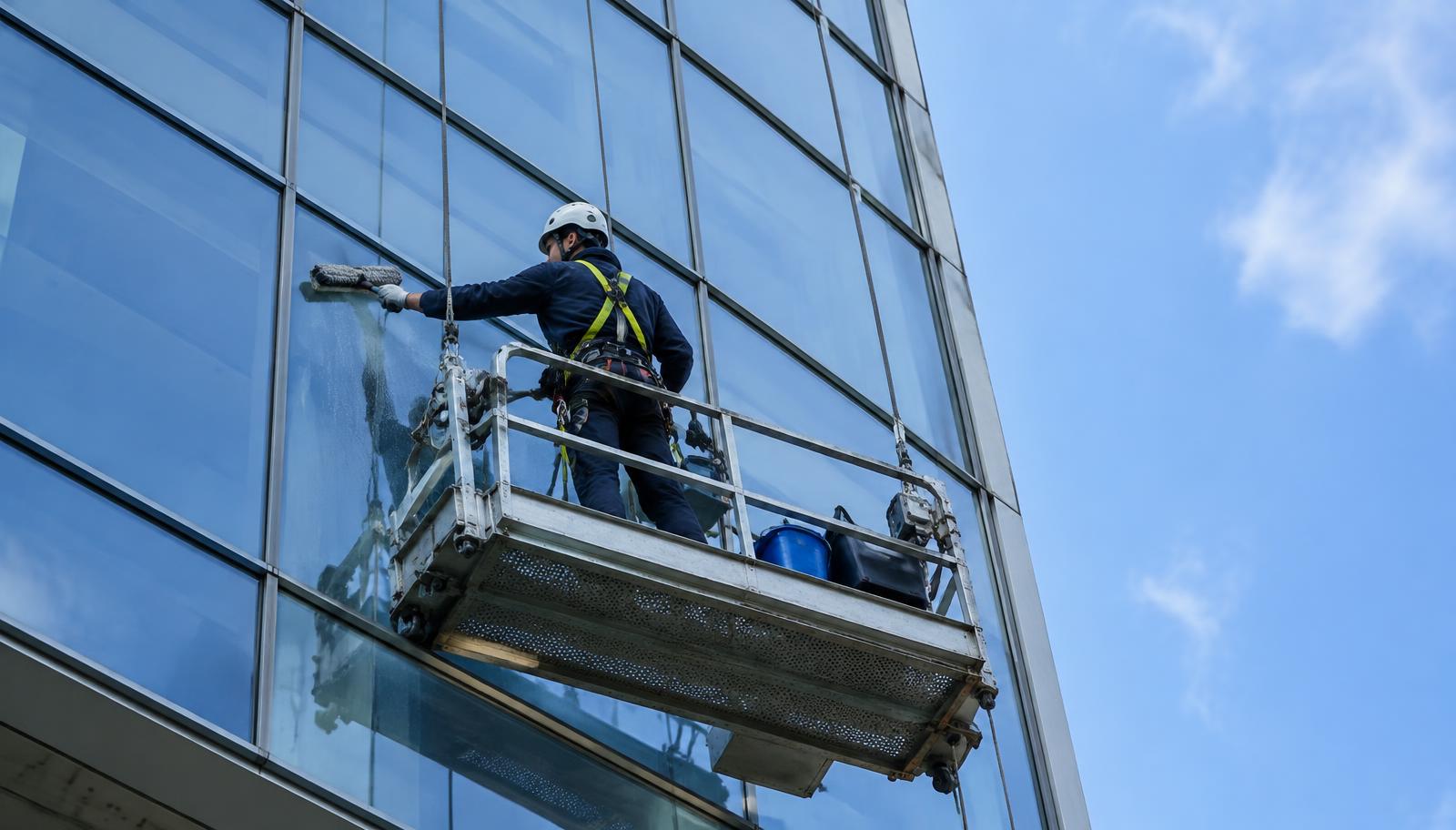
- Work at height. Facades, high-bay lighting, or exterior architectural glass require specialized safety protocols; consult our guide on work at height in cleaning services.
- Scope in the request for proposal. Specify square meters, surface types, the physical state of the space, and expected deliverables in your RFQ so that vendor proposals can be compared on an equal basis.
Surfaces that require specialized care
Every architectural finish carries manufacturer-specified care instructions. The fundamental rule: do not approve a cleaning method without reviewing the surface manufacturer's technical data sheet or guidelines, and always test on an inconspicuous area first when the contractor proposes a process.
- Glass. Technical bulletins from the Glass Association of North America (GANA, in cooperation with IWCA) emphasize that architectural glass must be protected from construction debris across all project phases, that temporary protective films must be removed according to the manufacturer’s schedule, and that scrapers or razor blades can scratch glass and must never be used on coated glass. They advise direct communication among responsible parties before employing aggressive techniques, consulting the glass manufacturer, and engaging specialists experienced in construction glass cleaning for non-routine conditions. Coated, low-E, or laminated glass often carries strict cleaning restrictions.
- Flooring. Every material (ceramic, natural stone, hardwood, resilient vinyl, polished concrete) demands distinct care, and several require surface protection throughout construction. For industrial or coated floors, review our guide on deep cleaning for industrial floors. Ask installers about mandatory curing or dwell times before allowing foot traffic or wet cleaning.
- Stainless steel and architectural metals. Stainless steel, anodized aluminum, and hardware can be permanently etched by acidic chemistries or abrasive pads. Request the finish specification and the cleaning contractor's proposed product data sheets.
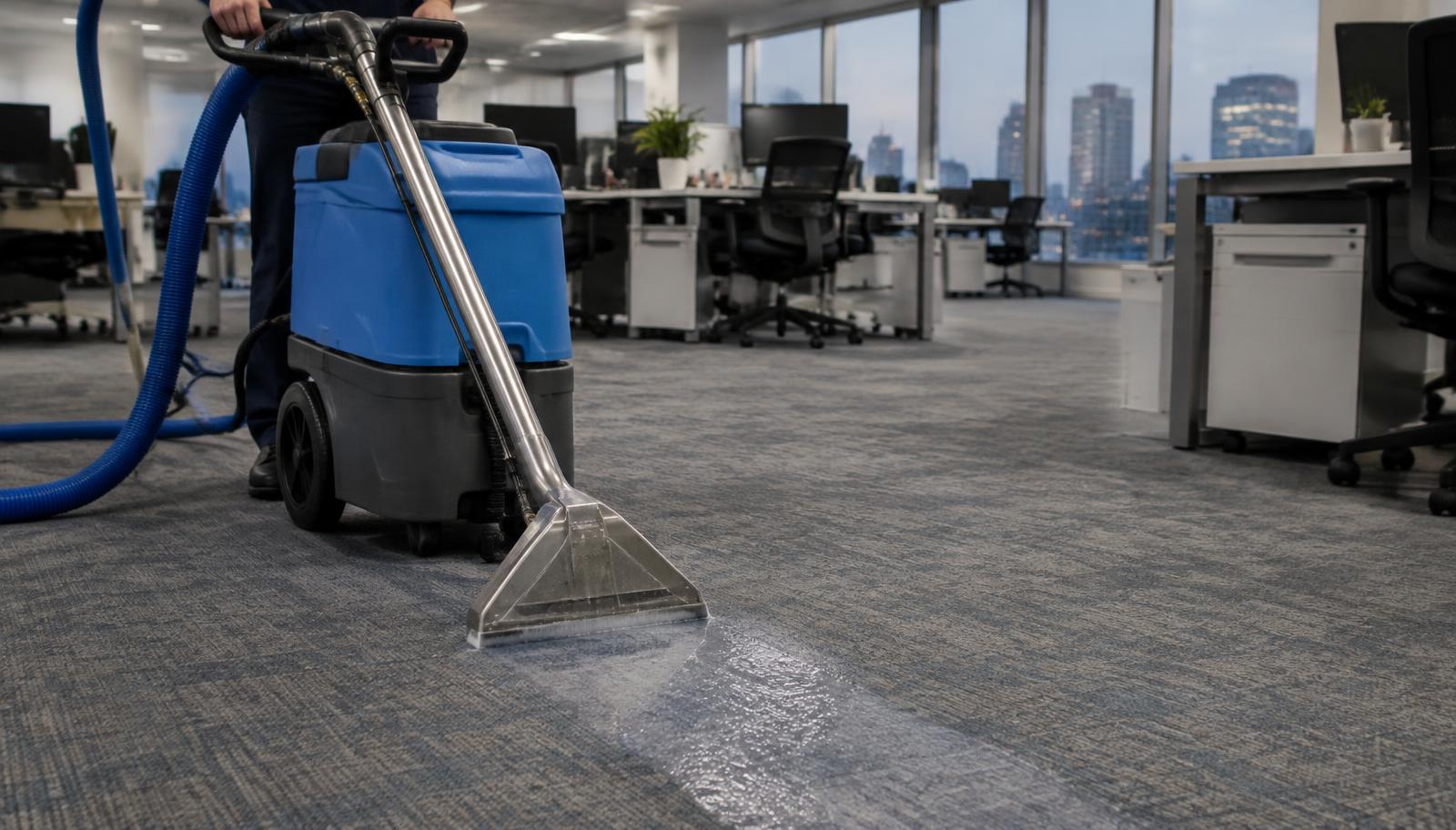
- Carpet. Construction grit and fine particulate settle deep into carpet fibers. Installation sequencing and extraction methods must comply with manufacturer guidelines; consult our guide on deep cleaning commercial carpets.
Fine dust and debris: key coordination points
This guide does not prescribe particulate containment tactics or waste disposal procedures; those are established by the contractor and, where required, an environmental specialist. What the facility manager must explicitly align is the following:
- Particulate control. Establish the operational sequence (top-to-bottom, determining what must be cleaned before other trades re-enter) with the contractor and cleaning vendor. Agree on which zones must be sealed or partitioned to avoid migrating dust into occupied areas, and coordinate with Facilities Maintenance on when to inspect or change HVAC filters and grilles, as fine particulates can damage mechanical equipment. If adjacent spaces are occupied, communicate schedules in advance.
- Waste handling. Mexico's General Law for the Prevention and Comprehensive Management of Wastes (*Ley General para la Prevención y Gestión Integral de los Residuos*) classifies "construction, maintenance, and general demolition waste" as special handling waste (*residuos de manejo especial*, Art. 19, Section VII). Article 9, Section III empowers state authorities to regulate and authorize the management of these waste streams. In practice: establish in writing who is the legal generator, who hauls the waste, where it is disposed of, and maintain the disposal manifests required by your state. Local municipal and state regulations vary and should be vetted with your environmental or legal team.
- Chemical management. If the cleaning contractor introduces chemical agents, request their Safety Data Sheets (SDS) before authorizing use on-site (see our guide on health and safety requirements). Industry training materials from NCCER caution that wastes such as paints, adhesives, or suspected asbestos-containing materials must be handled under applicable environmental regulations—never poured down municipal drains or discarded in standard trash. If the remodel generated regulated materials, engage a qualified specialist prior to cleaning.
Handover criteria and sign-off report with photos
A handover criterion is an objectively observable condition. Establish these benchmarks before work begins and integrate them into the contract or service proposal. Examples of objective criteria include:
- Free of visible construction residue (paint overspray, plaster, adhesive, tape, labels) across all surfaces listed in the scope.
- Glass free of scratches, adhesive residue, or expired protective films, inspected under natural daylight from two distinct angles.
- Floors free of chemical staining, haze, or scratches attributable to cleaning operations, verified during the joint walkthrough.
- Air grilles, light diffusers, and built-in casework free of visible dust buildup.
- Pre-existing site defects documented and signed off prior to work commencement to prevent misattributed liability.
The handover report (Acta de entrega). Must document the date, inspected zones, designated representatives, operational observations, tagged photographs cross-referenced to floor plans, outstanding punch-list items with completion deadlines, and formal signatures of acceptance. Conduct comprehensive photographic documentation before (initial baseline, highlighting pre-existing damage) and after. Establish a clear window for reporting punch-list deficiencies following handover; the existence and duration of any cleaning warranty depend on contractual terms rather than a statutory standard. For surface damage or safety incidents, follow your standard incident reporting protocol.
Decision table by stage
| Stage | What defines it | Items to agree upon in advance | When to advance to next stage |
|---|---|---|---|
| Rough Clean | Removal of rubble, surplus materials, and bulk dust | Responsible party (contractor vs. cleaning vendor), waste haulage destination, site access | When all construction materials are cleared from the zone and the general contractor formally signs off |
| Detail (Fine) Clean | Architectural finishes: glass, floors, metals, carpet, grilles | Manufacturer data sheets, approved chemical SDS, mock-up test areas if needed | After all other trades complete work and sufficient time has passed for airborne dust to settle |
| Handover | Walkthrough, spot touch-ups, photo report | Acceptance criteria, deficiency reporting window | Once the handover report is signed with clear owners and dates for punch-list items |
Common mistakes
- Assuming "construction includes cleaning" by default. Without an explicit contractual clause, each party assumes the other is responsible.
- Executing fine cleaning before other trades finish their punch lists. Dust generated by follow-up work forces costly re-cleans.
- Approving cleaning chemistries without consulting finish manufacturers. This remains the leading cause of preventable surface damage.
- Failing to document initial site conditions. It becomes impossible to distinguish pre-existing construction damage from cleaning errors.
- Leaving protective films on surfaces past their manufacturer-rated removal window. Sun exposure and time can bake adhesives onto glass and frames.
- Conflating construction turnover with cleaning turnover without independent acceptance criteria.
- Neglecting to define legal waste disposition. Liability surfaces later during internal audits or municipal inspections.
- Giving direct operational instructions to the vendor’s frontline staff. Direct all requests exclusively through the cleaning supervisor.
Disclaimers
Not legal, environmental, or engineering advice. Regulations are updated periodically, and waste management mandates vary by state and municipality in Mexico. Validate your scope with your occupational health and safety specialist, environmental team, and legal counsel.
>
No procedural instructions. This guide does not specify chemical dilutions, application methods, or hazardous waste handling protocols. Those parameters are governed by safety data sheets, finish manufacturers, and certified specialists.
>
External references. Cleaning stages and dust-settling timeframes referenced herein draw from U.S. construction training materials; they serve as operational benchmarks, not Mexican regulatory mandates.
Handover checklist
| ☐ | Verification Item | Evidence | Responsible Party | Date |
|---|---|---|---|---|
| ☐ | Scope per stage and assigned responsibility (contractor / cleaning vendor) documented in writing | Contract, proposal, or exhibit | ||
| ☐ | Photographic survey of initial site conditions and pre-existing damage | Dated, location-tagged photos | ||
| ☐ | Construction waste disposition and responsible hauler formalized | Manifest, contract, or memo | ||
| ☐ | Site access, operational hours, and safety permits issued for cleaning staff | Kickoff sign-off | ||
| ☐ | Manufacturer maintenance data sheets for new finishes provided to vendor | Archived data sheets | ||
| ☐ | Chemical SDS approved prior to introduction on-site | Archived SDS | ||
| ☐ | Rough clean completed and formally confirmed by general contractor | Turnover memo | ||
| ☐ | Subcontractor punch-list activities fully completed prior to detail clean | Project schedule | ||
| ☐ | Protective films removed within manufacturer's recommended timeframe | Inspection log | ||
| ☐ | Joint handover walkthrough conducted against objective criteria | Walkthrough checklist | ||
| ☐ | Final photographic documentation compiled | Location-tagged photos | ||
| ☐ | HVAC supply grilles and return air filters inspected with Facilities Maintenance | Maintenance sign-off | ||
| ☐ | Punch-list deficiencies logged with assigned owners and deadlines | Handover report | ||
| ☐ | Formal handover document signed by all authorized parties | Executed sign-off |
*Application: Review this checklist during the project kickoff meeting with Project Management, the general contractor, and the cleaning vendor, updating it whenever scope changes occur.*
Next step
Take your remodeling floor plan, list all newly installed finishes, and assign an explicit owner to each cleaning phase. Using that defined scope, solicit standardized, comparable proposals (consult our guide to procuring commercial cleaning services) via our request a quote page, and review our compliance section for mandatory vendor documentation.
A successful post-construction cleaning project is determined before physical work begins: establishing the scope of each phase, defining who is accountable for what, identifying the specialized care each finish requires, and detailing how space readiness will be measured. When these parameters are locked in early, the final turnover is reduced to an objective walkthrough and an operational sign-off, rather than a contentious debate.
Sources
- NCCER, "How to properly clean a site post construction"
- GANA/IWCA, Proper Procedures for Cleaning Architectural Glass Products
- NOM-031-STPS-2011, texto (DOF)
- NOM-031-STPS-2011, ficha de vigencia (PLATIICA, Economía)
- Ley General para la Prevención y Gestión Integral de los Residuos (Cámara de Diputados)
Use this checklist in your next quote or renewal.
To get a quote from SELIMEX, use the quote page; for more information, see the compliance section.