Summary
Office carpet accumulates soil gradually, mostly in traffic areas. It is therefore useful to combine frequent vacuuming, scheduled interim cleaning, and deep (restorative) cleaning when interim cleaning no longer restores appearance. Choose the method based on carpet type, soil level, and the available work window; drying time depends on the method, equipment, ventilation, and building humidity, so there is no universal figure. This guide explains the criteria and includes a decision table and a checklist for requesting and accepting the service.
The Short Answer
Vacuum traffic areas daily and the rest regularly, remove spots immediately, schedule interim cleaning in high-wear areas, and reserve deep cleaning for when interim cleaning no longer restores appearance or the manufacturer recommends it. For deep cleaning, hot-water extraction is the restorative method most often cited in industry literature; low-moisture methods are primarily used for interim maintenance. Drying can take a few hours to more than a day, depending on conditions: request the provider's drying plan and confirm which methods the carpet manufacturer's warranty accepts.
Interim vs. Deep Cleaning: What Sets Them Apart
Interim cleaning is scheduled soil removal in traffic areas before excessive buildup occurs. It uses less water and detergent and employs methods such as dry extraction, brushing and encapsulation, or rapid low-moisture extraction, as described by the ISSA association's magazine (ISSA, 2017).
Deep or restorative cleaning is reserved for carpet with accumulated soil. According to the same source, it uses a professional dry extractor or a hot-water extractor approved by the Carpet and Rug Institute (CRI). The article also notes that today's carpets are designed to hide soil amounting to 7 to 15 times their own weight, so appearances can be misleading: a carpet may look acceptable while already holding a heavy soil load.
When to Deep Clean
There is no single schedule. The references consulted agree on the approach, though not on the numbers:
- ISSA states that interim cleaning of traffic areas is performed 2 to 24 times a year, with restorative cleaning as needed.
- Mannington Commercial, a commercial carpet manufacturer, recommends in its maintenance guide quarterly low-moisture interim cleaning for light traffic, every two to three months for moderate traffic, and monthly for heavy traffic, plus wet extraction or restorative cleaning quarterly or annually (Mannington Commercial, 2020). This is a manufacturer's recommendation for its products.
- A 2005 article attributes to IICRC a recommendation for deep cleaning three times a year, with interim cleaning between those services (CleanLink, 2005). This is an older, secondhand source; treat it as historical context, not a rule.
This suggests a practical approach: frequency is determined by traffic, carpet color and construction, appearance expectations, and manufacturer instructions. A lobby and an elevator access hallway are not cleaned like a lightly used private office. Signs that deep cleaning is due include darker traffic lanes, rough or sticky fibers, persistent odor, or interim cleaning that no longer improves appearance. Do not wait until the carpet looks dirty, either: the 2005 article itself warns managers against waiting until that point to schedule service.
Which Method to Use
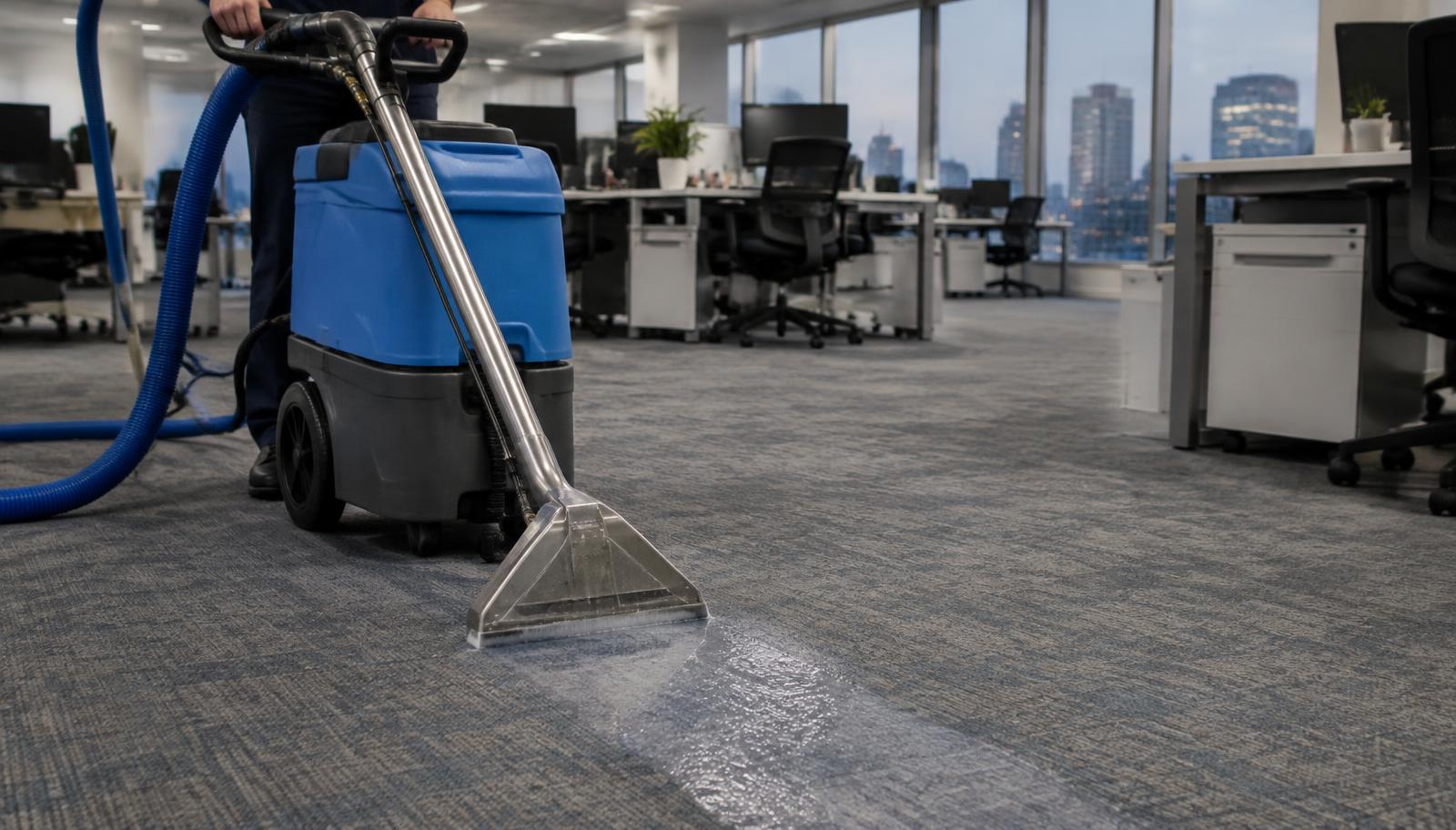
Hot-water extraction (sometimes called "steam cleaning"). Solution is applied and agitated, then water and soil are extracted. Mannington describes a process involving prespray, extraction, and thorough rinsing because remaining residue attracts more soil. This is the most frequently cited restorative method. CRI evaluates extractors through its Seal of Approval program for soil-removal effectiveness, surface appearance change, and residual moisture (CRI, Seal of Approval program); using extractors from that program is a verifiable hiring criterion.
Low-moisture methods. These include counter-rotating brush cleaning and crystallization or encapsulation. Used primarily for interim maintenance, they consume less water and dry faster. Mannington describes using a counter-rotating brush followed by vacuuming once the carpet is dry.
Bonnet cleaning (rotary pad). This is a traditional maintenance method, but some manufacturers advise against it. Mannington expressly states it will not honor warranty claims for damage resulting from this method. Review your carpet warranty before accepting it in a proposal.
Solution, equipment, and provider. CRI maintains a recognition program for solutions, extractors, vacuums, deep and interim cleaning systems, and service providers (CRI, Seal of Approval program). Its provider program recognizes those using products and equipment bearing that seal (CRI, providers). This is a voluntary program and, as far as we could verify, US-based: it is a technical reference, not a legal requirement in Mexico.
Reference standard. ANSI/IICRC S100 (seventh edition, 2021) covers professional commercial and residential carpet cleaning: methods and systems, pre- and post-cleaning inspections, and spot treatment (IICRC). Access requires payment; we mention it only as a framework a provider may cite, not as a requirement.
How Long Drying Takes
The honest answer is that it depends on the method, equipment, ventilation, ambient humidity, and product. The sources consulted show why there is no single figure:
- For restorative cleaning, ISSA recommends aiming for drying within 2 to 4 hours using the HVAC system, fans, and dehumidifiers to limit allergen growth.
- A Cleaning & Maintenance Management article (2016) quotes a technician who says properly extracted carpet dries "in a few hours," and in extreme conditions within 12 to 24 hours (CMM/CleanLink, 2016). The same article emphasizes that fans work when indoor relative humidity is low and that outside-air ventilation helps if that air is drier than indoor air.
- The 2005 article mentions 12 to 24 hours for hot-water extraction and about 20 minutes with forced air in a tested low-moisture system. These are older figures from a specific case: do not use them as a commitment.
What you can request: a drying plan (number and placement of fans or exhaust fans, HVAC use, start time), a check before reopening (carpet does not feel damp and has no odor), and provider confirmation of expected times with the carpet and solution manufacturers. Extended drying invites odors and new soil adhesion; schedule enough buffer before staff return.
Decision Table
| Situation | Suggested method (general reference) | Expected drying | What to confirm beforehand |
|---|---|---|---|
| Heavy traffic, carpet still looks acceptable | Low-moisture interim cleaning in traffic areas | Shorter than extraction; depends on equipment and ventilation | Manufacturer acceptance of the method |
| Dark traffic lanes, rough fibers, interim cleaning no longer helps | Deep cleaning with hot-water extraction | A few hours to more than a day, depending on ventilation and humidity | Drying plan and work window |
| Recent isolated spot | Immediate spot treatment with an appropriate product | Localized and brief | Product safety data sheet (SDS) |
| Carpet under an active warranty | Manufacturer-specified method | As specified by the manufacturer | Warranty and method in writing |
| Continuously occupied office | Interim cleaning by zone, deep cleaning by section after hours | Must fit within the available window | Ventilation, access, and reopening |
| Persistent odor or preexisting moisture | Investigate the cause before cleaning (do not treat only the symptom) | Not applicable | Technical assessment of the moisture source |
| Carpet without manufacturer information | Test in an inconspicuous area and obtain technical guidance | To be determined | Identify fiber and construction |
How to Plan Service in an Occupied Office
- Divide into zones and sections. Clean in sections so the entire floor is never out of use.
- Schedule after hours when drying requires it, and allow a buffer: drying time takes priority over cleaning time.
- Post signs and protect the area. Damp carpet requires restricted access, signage, and furniture protection.
- Define acceptance criteria beforehand: appearance, no odor, and carpet dry to the touch. To turn this into a review process, see the supervision guide.
- Include the scope in the request for quotation (square meters, carpet type, access). See the request for quotation guide and, to document the scope, the minimum contract clauses guide.
Common Mistakes
- Waiting until it looks dirty. Carpet hides soil; cleaning then comes too late.
- Using only deep cleaning with no interim cleaning. Interim maintenance reduces soil buildup between deep cleanings.
- Comparing proposals without comparing methods. Equipment, water use, and drying differ; prices per meter are not comparable when methods differ.
- Not reviewing the manufacturer's warranty before accepting a method (for example, bonnet cleaning).
- Insufficient rinsing. Solution residue attracts soil.
- Promising a single drying time. It depends on ventilation and humidity.
- Cleaning without identifying the cause of an odor or preexisting moisture.
- Failing to document acceptance criteria in writing.
Warnings
Service Checklist
Before
- Carpet fiber type and construction identified.
- Warranty and manufacturer-authorized method documented in writing.
- Square meters by zone and traffic level.
- Proposed method and rationale (interim or deep).
- Product SDS available on-site.
- Drying plan: equipment, ventilation, schedule.
- Work window and zones divided into sections.
- Acceptance criteria agreed on.
During
- Pre-vacuuming.
- Test in an inconspicuous area if uncertain.
- Signage and furniture protection.
- Thorough extraction or rinsing, depending on the method.
- Fans and HVAC operating according to plan.
After
- Touch and odor check before reopening the area.
- Record of date, method, zones, and equipment.
- Date of the next interim cleaning.
- Incidents and corrective actions, with owners and deadlines.
Conclusion
Deep carpet cleaning is a decision about method, scheduling, and drying, not just cleaning. An interim maintenance program, a warranty-compatible method, and a drying plan agreed on in advance deliver better appearance with fewer interruptions. What no guide can provide is a universal drying time: request it, along with its conditions, from the company doing the work.
Next Step
Identify the three highest-traffic carpet areas, review the manufacturer's warranty, and document acceptance criteria. With that, you can request a comparable proposal on the quote page, learn about the corporate office approach, or review how we work.
Sources
Bring this guide to your next provider review.
To get a quote from SELIMEX, use the quote page; for more information, see the compliance section.