Summary
In a cleaning proposal, "cleaning," "sanitizing," and "disinfecting" often appear as if they were interchangeable. They are not: cleaning removes dirt; sanitizing and disinfecting use chemicals for distinct antimicrobial purposes, and both depend on what each product's label specifies. This guide explains the differences, provides a decision table for restrooms and high-touch surfaces, outlines which documents and logs to request, and identifies phrases that should neither be accepted nor written into a proposal. It does not prescribe products, dilutions, or procedures—those are determined by the product label, the safety data sheet (SDS / HDS), and your site specialist.
The short answer
Cleaning is foundational and must always be performed; disinfection is an additional step decided based on risk, traffic, and your site's specific requirements, not out of habit. A dirty surface cannot be properly disinfected, and a clean surface is not automatically disinfected. To contract effectively, require in writing what will be done on each type of surface and at what frequency, which products will be used (accompanied by labels and SDS in Spanish), that the label's specified contact time will be respected, and what service records will be kept. Be skeptical of proposals that promise absolute microbiological outcomes.
Three words, three distinct things
In Mexico, as far as we have verified, there is no single official regulatory webpage defining these three terms specifically for commercial cleaning services; the clearest authoritative reference we reviewed is from the U.S. Environmental Protection Agency (EPA), which distinguishes them as follows:
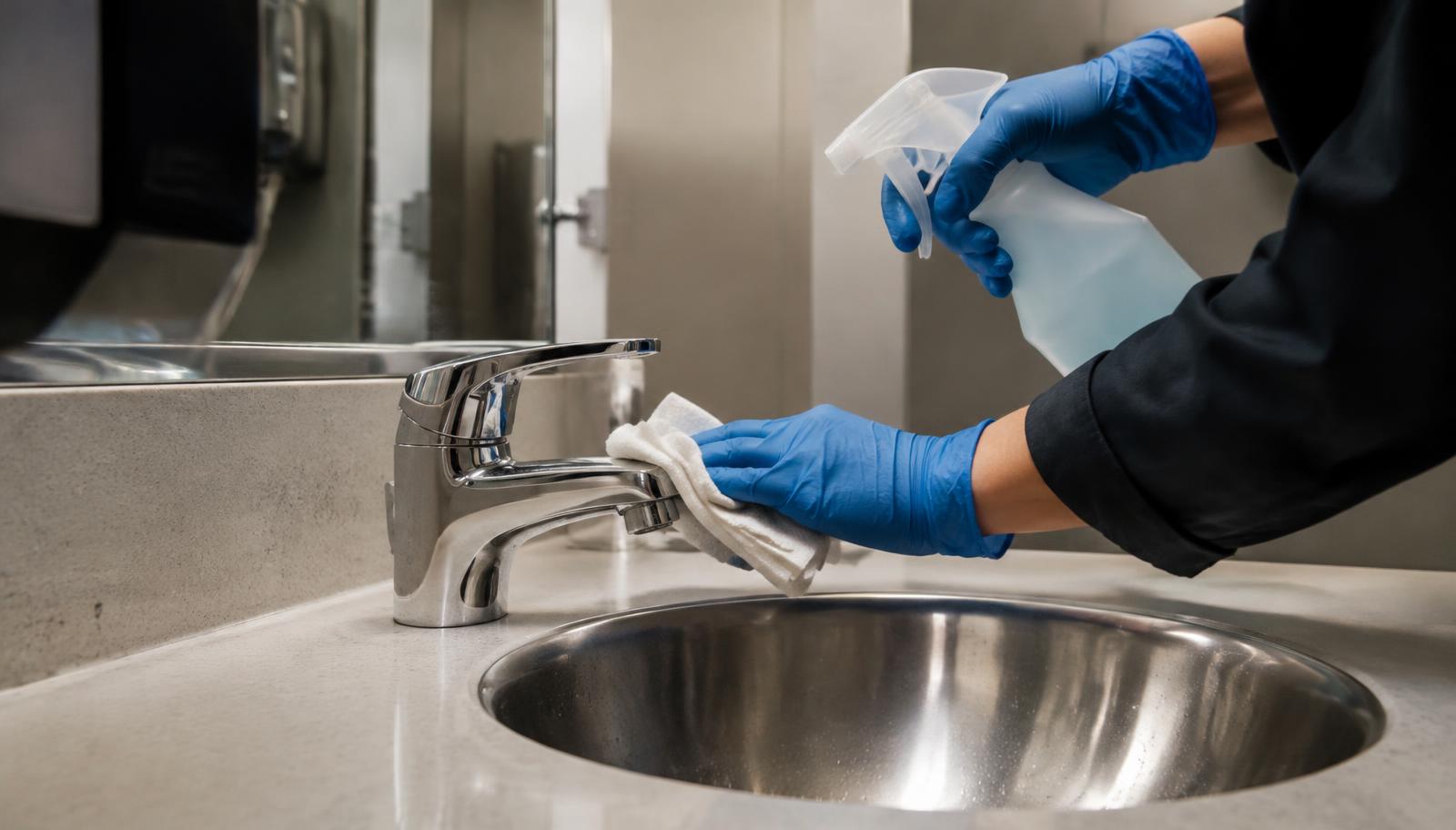
- Cleaning removes dirt and organic matter from surfaces using soap or detergent.
- Sanitizing kills bacteria on surfaces using chemicals; the EPA clarifies that it is not intended to kill viruses.
- Disinfecting kills viruses and bacteria on surfaces using chemicals.
The EPA guidance adds that when using registered products, the label must always be followed, paying special attention to contact time. Meanwhile, guidance from the U.S. Centers for Disease Control and Prevention (CDC) defines cleaning as the removal of foreign material (such as soil and organic matter), typically with water and detergent, noting that residual soil can interfere with the efficacy of subsequent disinfection processes. That guidance originates from healthcare settings; we reference it here to support the "clean first" principle, not as an enforceable standard for general office environments.
Two practical consequences arise from this. First: "sanitizing" is not merely a milder version of "disinfecting" suitable for every application; in regulatory use, it has a distinct scope, yet in Mexico, the word is often used colloquially for almost any chemical application. Demand that the proposal specify what the process actually achieves. Second: detergents and cleaners—even enzymatic ones—are not disinfectants (as explicitly noted in the CDC cleaning guidelines). A product that "smells clean" does not count as disinfection.
What a high-touch surface is and why frequency matters
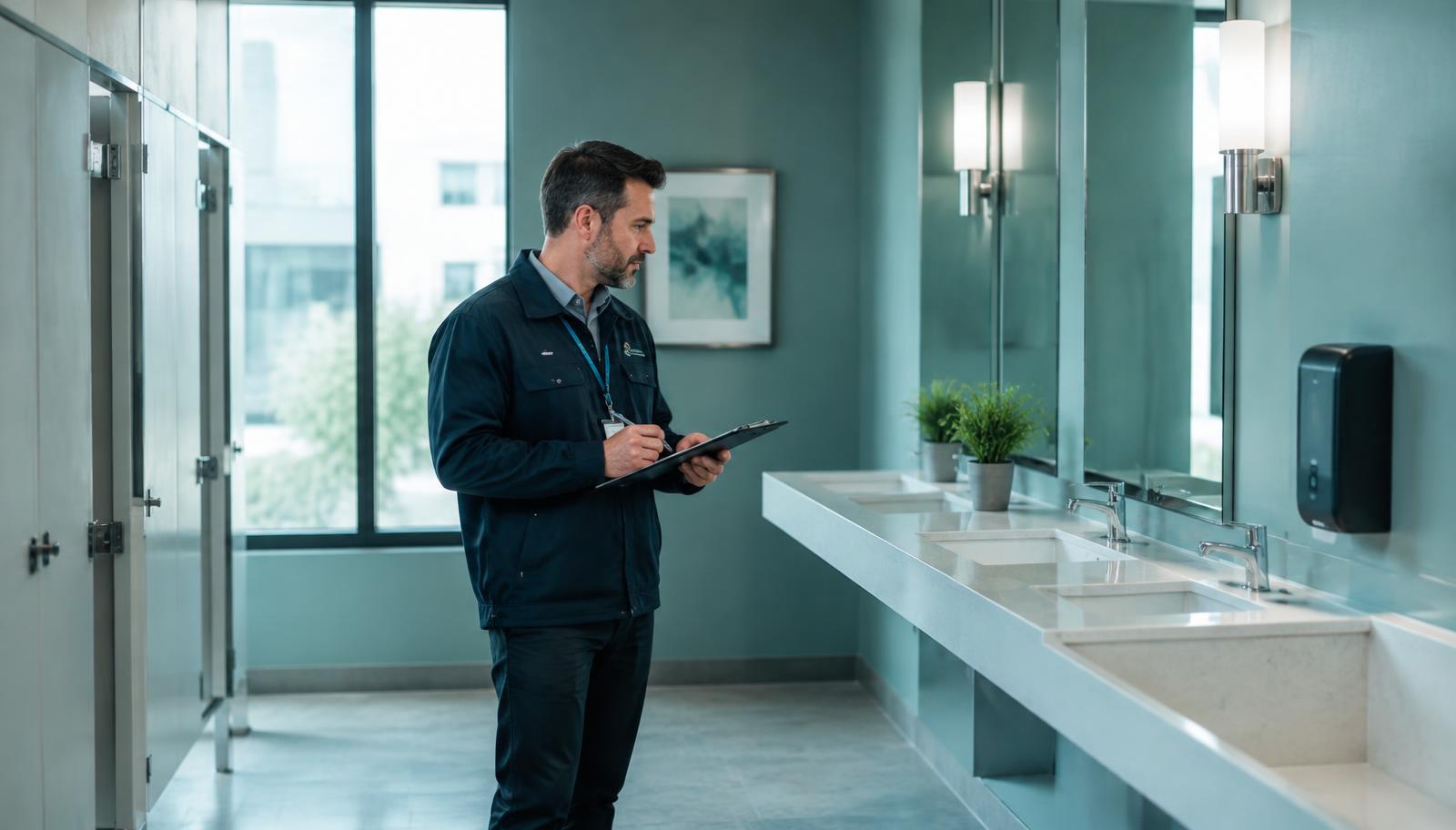
In facility service terms, high-touch surfaces are those touched by multiple people throughout the day: door handles and push bars, elevator buttons, light switches, restroom faucets and dispensers, stall latches, handrails, shared tables, and buttons on shared machinery or equipment. Identifying which surfaces qualify at your facility is your operational decision, not an item selected from a vendor's catalog; it depends on occupant foot traffic and workflow. A plant restroom serving continuous shifts requires a different approach than a rarely used boardroom.
The cleaning frequency for these surfaces can be increased relative to surrounding areas without needing to apply a disinfectant every single time. Establishing a two-tiered scope (frequent routine cleaning for contact points and scheduled or event-driven disinfection) is generally clearer and more cost-effective than attempting to disinfect everything, continuously. For guidance on setting frequencies across shared areas, see cleaning of common areas.
Decision table
This table serves as a criteria guide, not a formal sanitary protocol. The exact requirements for your site should be defined by your occupational health, safety, and environmental (EHS) team and, where applicable, the regulations governing your specific industry.
| Scenario | Baseline Action | When to Add Disinfection | What Does NOT Substitute for What |
|---|---|---|---|
| Daily-use restrooms (offices, plant, distribution center) | Cleaning at the agreed frequency: floors, fixtures, sinks, urinals, toilets, and consumable restocking | If your site policy requires it, under high traffic, or after an incident (see below). Define it in writing | Disinfecting without cleaning first does not leave the surface in better condition; soil shields pathogens from the chemical |
| High-touch surfaces (handles, buttons, handrails, switches) | More frequent cleaning than general areas | Scheduled, if site policy establishes it; or event-driven | A damp microfiber cloth is not disinfection; a disinfectant does not wipe away visible grime |
| Body fluid spill or biohazard incident | Notify the contractor's supervisor; act according to site protocol and SDS | Yes, following site protocol and using authorized products; this is a specialized procedure. See incidents | Never improvise with unauthorized chemicals or unauthorized product mixtures |
| Areas with specific regulatory sanitary mandates (kitchens, cafeterias, medical rooms, healthcare areas) | As dictated by industry regulations or your industry specialist | In accordance with those specific regulations | This guide does not cover specialized clinical or food-grade environments |
| Low-traffic areas (warehouses, infrequently used corridors) | Routine general cleaning at standard intervals | Generally unnecessary; decide based on risk assessment | Routine blanket disinfection throughout the building increases chemical exposure without necessarily improving quality |
| Disease outbreak or public health alert | Follow directives from health authorities or your designated EHS specialist | According to those specific directives | Do not invent proprietary protocols or make unsubstantiated health claims |
Contact time: what the label says
Contact time (or dwell time) is the duration a chemical product must remain wet on the surface to achieve its rated efficacy. According to the EPA, the surface must visibly remain wet for the entire duration; if it dries before that time elapses, it must be reapplied. Dwell times vary significantly between products and target organisms, and they are stated explicitly in the label's directions for use. If a product label does not include directions for a specific pathogen or use scenario, the EPA notes that it has not evaluated the product for that application.
As a facility manager, you do not need to memorize dwell times. You simply need to ensure the proposal includes a binding commitment to adhere to the contact time specified on each product's label, and that the vendor provides the product label or technical data sheet upon request. Never accept a blanket generic time "for all disinfectants": if the contractor cites a specific dwell time, verify that it matches the label of the actual chemical used on-site.
For U.S. products, the EPA indicates that the registration number on the label is the definitive way to identify a registered product. In Mexico, commercial cleaning products are governed by national labeling frameworks (such as NOM-189-SSA1/SCFI-2018 for domestic cleaning formulations, as referenced in state health guidelines), and determining the appropriate sanitary notification (*aviso de funcionamiento*) or sanitary registration (*registro sanitario*) for professional-grade chemicals should be validated with health authorities (COFEPRIS) or your site's regulatory compliance team. We do not treat that determination as finalized here.
What to ask from your provider
- Detailed scope by surface and area. A clear matrix: which specific surfaces, at what frequency, and whether the task requires cleaning only or cleaning followed by disinfection.
- Approved chemical list detailing trade names, manufacturers, and intended applications, along with labels and SDS (Safety Data Sheets / HDS) in Spanish submitted prior to initial use on-site. Mandatory contractor obligations regarding SDS and PPE are covered in our guide on cleaning staff occupational safety and health and are not repeated here.
- Commitment to follow label instructions, including required contact times, and an explicit prohibition against mixing chemicals unless expressly permitted by the manufacturer's label. Your role is to require this commitment and inspect compliance; specific application procedures are dictated by the chemical manufacturer.
- Service logs: date, area, chemical applied, and the responsible technician, recorded in an agreed-upon format. Key performance indicators and inspection routines can be found in our guide to cleaning service supervision.
- Staff training records demonstrating personnel have been trained on the specific chemicals they handle, supported by formal training certificates (*constancias de competencias laborales*). Verification methods are detailed in the occupational health and safety guide.
- Contingency protocol for special events (spills, accidents, reported infectious outbreaks): reporting hierarchy and authorized emergency chemicals. See incidents.
- If the vendor offers standalone "sanitization services", request regulatory substantiation: in 2020, COFEPRIS (Mexico's Federal Commission for Protection against Sanitary Risks) issued official communiqués concerning commercial establishments providing sanitization services; its current applicability should be confirmed with the authority before incorporating it as a mandatory requirement.
All these elements should be formally integrated into the service contract or its technical annex and filed within the contractor compliance file. As the client, your role is to verify compliance and demand supporting documentation; you should not give direct operational instructions to the contractor's staff (all operational instructions must be routed through the vendor's supervisor; see our safety piece and master contract guides).
What not to promise or accept
- Guarantees of absolute microbiological outcomes (e.g., "eliminates 99.9% of all germs," "100% virus-free," "sterilized facility"). There is no legal or scientific basis to support such claims in surface cleaning services.
- Claims of "permanent disinfection" or "extended residual efficacy" unless explicitly stated and substantiated on the manufacturer's registered product label.
- Efficacy against specific pathogens if the label does not explicitly list them. Per the EPA, a product lacking instructions for a specific pathogen has not been evaluated for that use.
- Treating sanitizing as equivalent to disinfecting, or assuming either replaces thorough physical cleaning.
- Assuming chemical disinfection replaces basic hygiene fundamentals: handwashing, stocked consumables (soap, paper towels), adequate mechanical ventilation, and preventive building maintenance.
- Misting, fogging, or space spraying presented as an automatic substitute for direct surface contact. We do not evaluate the efficacy of these specialized dispersion techniques here; if your vendor proposes them, request written manufacturer validation and require a formal review by your EHS specialist.
If you are responsible for drafting internal communications for facility occupants, apply the same precision: state what processes are being performed ("scheduled cleaning and label-compliant disinfection of high-touch surfaces"), rather than guaranteeing absolute clinical outcomes.
Common mistakes
- Using "sanitize" and "disinfect" interchangeably in the service contract, scope of work, or proposal.
- Disinfecting without cleaning the surface first.
- Mandating blanket facility-wide disinfection at all times, without risk assessment or operational necessity.
- Accepting arbitrary contact times without validating them against the product's actual label directions.
- Failing to mandate physical SDS on-site or accepting versions not translated into Spanish.
- Equating chemical fragrance with efficacy. A strong perfume does not indicate effective disinfection.
- Failing to maintain written service logs, leaving the facility without documentary evidence during internal audits or tenant disputes.
- Making absolute claims regarding pathogen elimination in communications to occupants or clients.
- Issuing direct operational orders to third-party cleaning staff rather than directing requirements through the vendor's designated supervisor.
Warnings
This document does not constitute health, regulatory, or legal advice. The definitions cited originate from U.S. regulatory authorities; the specific sanitary registrations or operating notices applicable to each product and service under Mexican law must be verified directly with COFEPRIS or your organization's legal/regulatory counsel.
>
No chemical recipes or procedures. This guide does not specify products, concentrations, dilution ratios, or chemical pairings. Cleaning chemicals must never be mixed unless explicitly authorized by the manufacturer's label. Always consult the product label, SDS, and chemical manufacturer.
>
Healthcare and food production environments. Commercial kitchens, dining facilities, on-site medical clinics, and cleanrooms operate under specialized regulatory frameworks outside the scope of this general commercial guide.
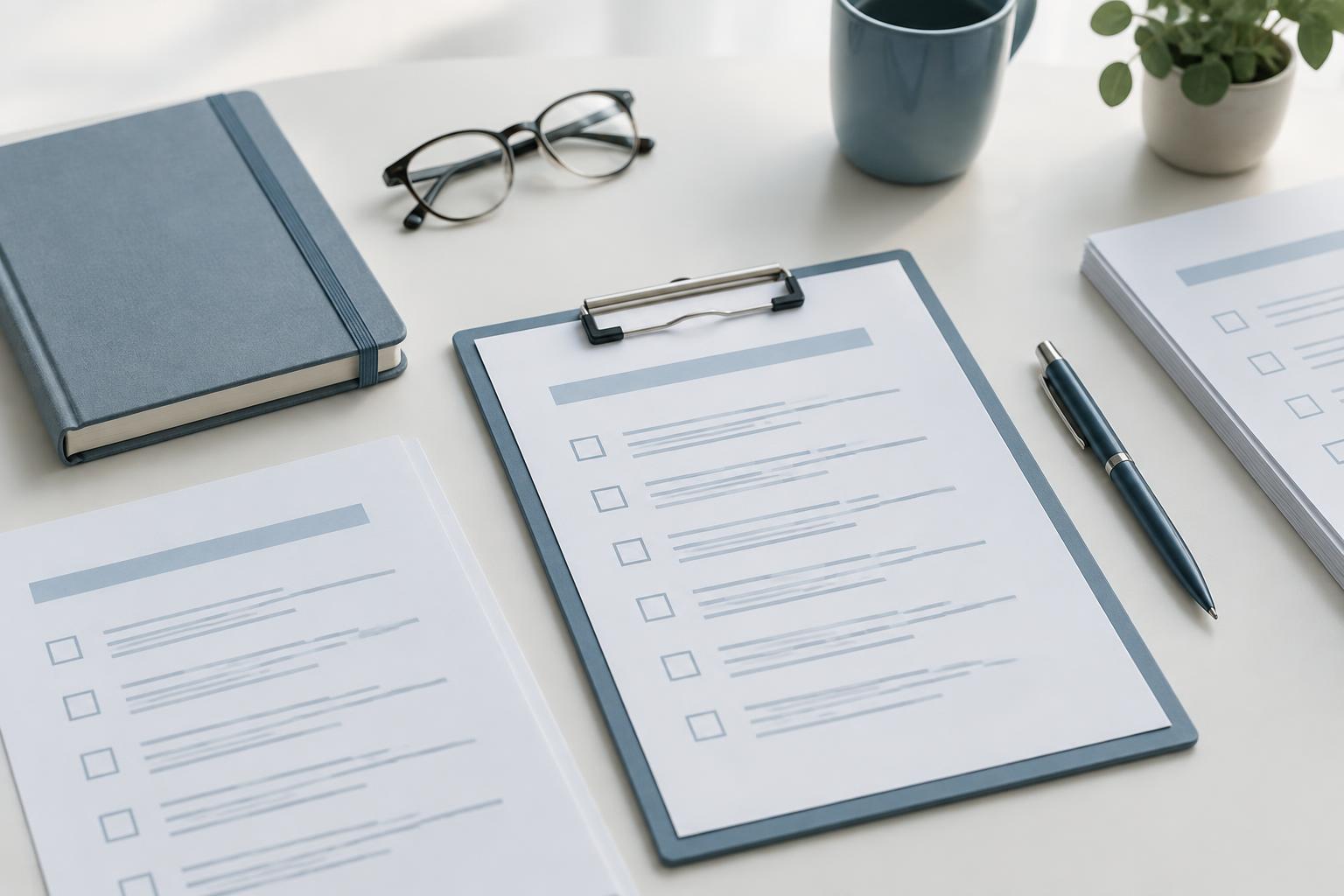
Checklist for Contracting or Reviewing the Service
| ☐ | Verification Item | Evidence / Document | Responsible Party | Date |
|---|---|---|---|---|
| ☐ | High-touch surfaces identified and mapped by area | Signed facility site map/list | ||
| ☐ | Clear scope matrix: cleaning vs. cleaning + disinfection, with assigned frequencies | Technical specifications annex | ||
| ☐ | Scope terminology clearly defined (clean, sanitize, disinfect) | Master contract terms | ||
| ☐ | Approved chemical master list with manufacturer and intended use | Vendor submittal list | ||
| ☐ | Spanish-language labels and SDS accessible on-site prior to service commencement | Physical binder; on-site inspection | ||
| ☐ | Written commitment to adhere to label dwell times; zero unapproved chemical mixing | Contractual clause or SLA | ||
| ☐ | Documented personnel training for each chemical handled | Training certificates (*constancias*) | ||
| ☐ | Operational service logs established (date, zone, chemical, technician) | Log sheet or digital format | ||
| ☐ | Emergency protocol for biohazard spills/incidents with identified reporting paths | Incident annex; see incidents guide | ||
| ☐ | Applicable sanitary registrations/notices confirmed with health authority or EHS | Documented compliance review | ||
| ☐ | Elimination of absolute microbiological guarantees in proposals and memos | Text and communication review | ||
| ☐ | Periodic quality audits conducted via sampling, with findings routed to supervisor | Quality supervision reports |
*Application: Review this checklist during vendor onboarding meetings and re-evaluate whenever there is a change in chemicals, operational scope, or assigned personnel.*
Next step
Select one restroom and five key high-touch points within your facility, complete the scope matrix and checklist alongside your occupational health and safety specialist, and formalize any necessary adjustments within your service contract or technical annex. To evaluate the overall quality of a cleaning proposal, review our institutional cleaning procurement guide; for regulatory requirements, visit our compliance section; and if you require a tailored commercial proposal, visit our quote request page.
Limpiar, sanitizar y desinfectar son decisiones distintas. La limpieza es la base; la desinfección se añade donde el riesgo y el uso lo justifican; y en todos los casos la etiqueta del producto, y no la promesa comercial, define cómo se usa y por cuánto tiempo. Lo que como contratante controlas es el alcance por escrito, la evidencia y la prudencia en lo que se promete.
Sources
- EPA, "What's the difference between products that disinfect, sanitize, and clean surfaces?"
- EPA, "Selected EPA-registered disinfectants"
- CDC, "Cleaning" (Guideline for Disinfection and Sterilization in Healthcare Facilities)
- COFEPRIS, comunicado sobre servicios de sanitización, 16-jun-2020
- Guía de autoevaluación de establecimientos de productos de aseo (Secretaría de Salud de Puebla)
Use this checklist in your next quote or renewal.
To get a quote from SELIMEX, use the quote page; for more information, see the compliance section.