

Summary
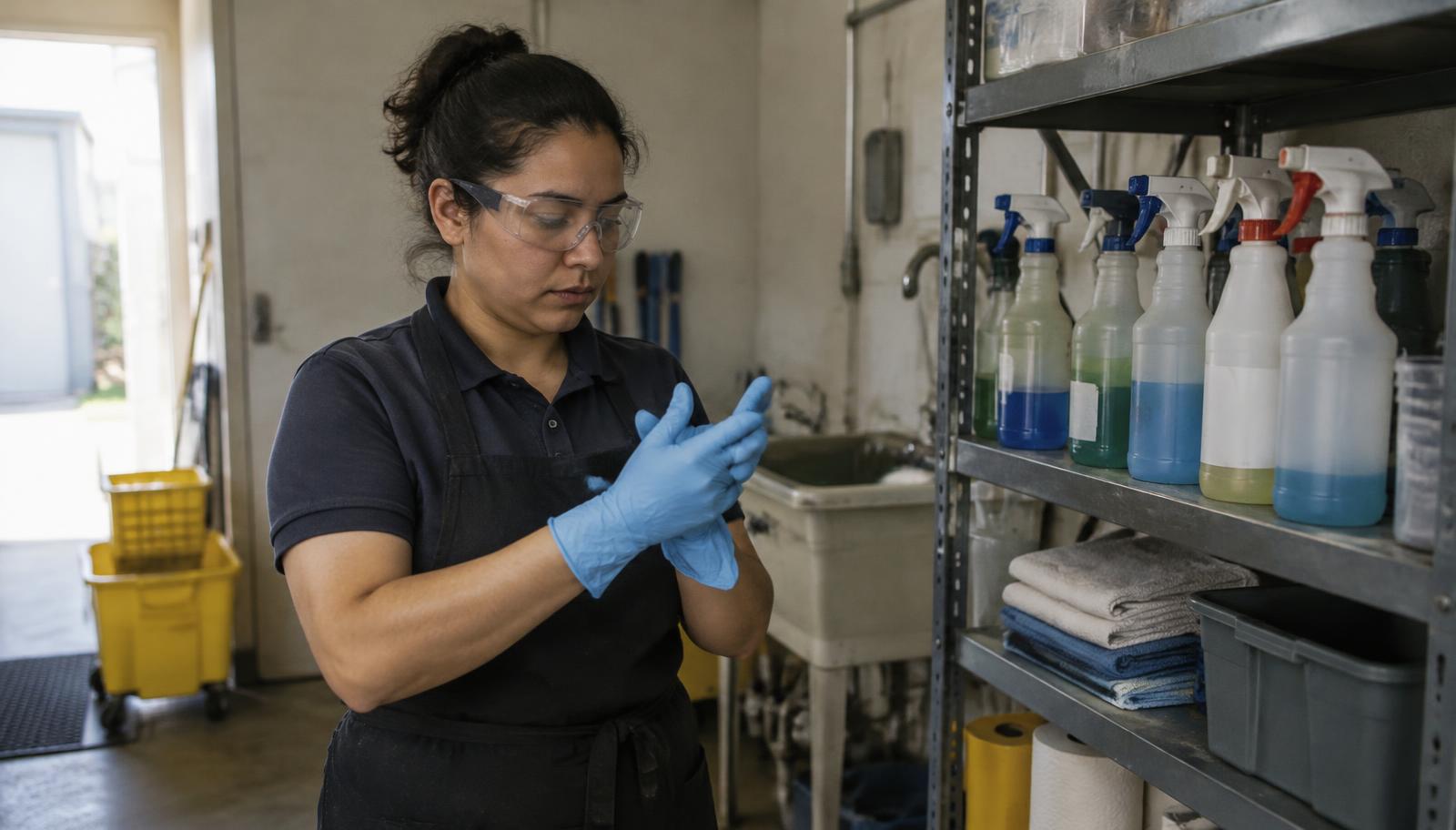
When you contract cleaning services, the safety of the personnel performing them is a shared responsibility, but not an identical one. The vendor, as the employer of its staff, provides protective equipment, trains them, and analyzes the hazards of each position. You, as the party responsible for the workplace, communicate site hazards, provide information on the substances handled there, and ensure that contractors comply with safety measures. Between the two lies a zone of best practices: requesting evidence, agreeing upon it in the contract, and reviewing it on a set schedule. This guide separates these three areas and includes a division-of-responsibilities table and a checklist.
The short answer
Require four things, in writing and with supporting evidence: (1) that the vendor has assessed the risks of each position and provides the corresponding PPE; (2) that its personnel are trained before starting and that records exist; (3) that SDSs for the products used are available on-site, in Spanish; and (4) that you have informed the vendor of your facility’s specific hazards and access rules. Agree on these points in the contract and at kickoff, and review the evidence on the same schedule as the rest of the vendor compliance file. Exact regulatory section numbers should be confirmed with your occupational health and safety specialist.
Three tiers: vendor legal obligations, client legal obligations, best practice
It is best not to conflate these levels, as each is enforced differently.
What regulations place on the vendor as the employer. The Federal Regulation on Occupational Safety and Health (*Reglamento Federal de Seguridad y Salud en el Trabajo*, published in the DOF on November 13, 2014) requires employers to provide workers with personal protective equipment according to the risks they are exposed to, to inform them of those risks, and to train and instruct them in risk prevention (Art. 7, Sections X, XI, and XII, according to the consulted text). The employment relationship of the cleaning staff is with the vendor; the client’s joint liability for unfulfilled labor obligations under Article 14 of the Federal Labor Law (*Ley Federal del Trabajo* or LFT) is an additional reason to verify, as covered in the guide on REPSE vendor verification.
What falls to the client at its workplace. The same Regulation requires the host employer to supervise that contractors comply with safety and health measures when working on its premises (Art. 7, Section XX, according to the consulted text), and standards regarding PPE and hazard communication include duties toward contractors, detailed below. In this context, the “client” is the entity operating the workplace where the service is provided.
What constitutes best control practices. Requesting copies of training certificates, PPE sign-off logs, training renewal dates, or periodic unsafe condition reports is not a statutory requirement mandated in that specific format. It is, however, a reasonable way to comply with the above duties and create an audit trail. If you want to require it, include it in the contract and do not frame it to the vendor as an explicit statutory mandate.
Personal protective equipment (PPE)
Mexican Official Standard NOM-017-STPS-2024, “Personal protective equipment: selection, use, and handling in workplaces,” was published in the DOF on March 28, 2025, is currently in force according to the official standards catalog, and superseded NOM-017-STPS-2008. Its first transitory article makes it enforceable six months after publication—meaning late September 2025; the official catalog indicates September 28, 2025. It applies to all workplaces where PPE is required.
According to the consulted text, the standard requires employers, among other duties, to:
- Analyze hazards by position and area and keep the assessment documented (Section 5.1). PPE is selected based on this assessment, not from a generic list. In the standard itself, PPE is treated as a transitional measure while other controls are implemented, or as a supplement when engineering and administrative controls are insufficient (5.2).
- Provide PPE that is properly sized and for personal use (5.2 and 5.3), and verify its certification against applicable standards or, in their absence, manufacturer technical specifications (5.4).
- Maintain written procedures for the use, inspection, replacement, cleaning, maintenance, storage, and final disposal of PPE, and keep records of these activities (5.6, 5.12).
- Train and instruct personnel through theoretical instruction and practical training prior to starting work, with refresher sessions at least every two years and documented records (5.9).
- Verify throughout the shift that the issued PPE is actually worn (5.10).
Which PPE corresponds to each task is determined by the vendor’s hazard assessment and, for each product, the safety data sheet (SDS). This guide does not list equipment by position: what you can request is the assessment, proof of issuance, and replacement logs. If the scope includes elevated work, consult the guide on cleaning work at heights.
Training
Three training areas intersect in a cleaning contract: PPE (PPE standard and Art. 51, Section X of the Regulation, according to the consulted text), workplace and task hazards (Art. 7, Section XII), and chemical substances (see next section). Ask the vendor for a simple matrix: who received what training, on what date, and supported by which certificate or attendance roster. For new or replacement staff, training must occur prior to their first shift; the issue of turnover is addressed in the guide on cleaning staff, training, and coverage.
A certificate alone does not prove that a worker knows how to perform tasks safely. For this reason, documentary evidence must be paired with on-site observation (see “Verifying without directing”).
Safety data sheets (SDS) and chemical products
Mexican Official Standard NOM-018-STPS-2015 (DOF October 9, 2015; in force according to the official catalog, with an effective enforcement date of October 9, 2018) governs the identification and communication of hazards from hazardous chemical substances. According to the consulted text, the employer must:
- maintain SDSs for substances and mixtures handled in the workplace and keep them permanently available to workers in the areas where they are handled (Sections 6.3 and 6.4);
- label tanks, containers, and storage areas (6.5);
- train and instruct personnel who handle them on the contents of the SDSs and hazard labeling, at least annually and whenever a new substance is introduced (6.7 and 11.1), maintaining written records (11.3);
- inform workers and contractors handling these substances about the elements of the SDS and warning labels (6.6).
The Federal Regulation adds that the employer must have SDSs available in Spanish (Art. 53, Section I, according to the consulted text).
For the client, the practical takeaway is straightforward: before approving any product, request its SDS in Spanish and verify that it will be physically accessible at the site of use. If the vendor supplies the product, the SDS is their responsibility; if you supply it, the information is yours and you must provide it to them. Which product to use, at what dilution, with what equipment, and how to respond to skin contact or a spill are governed by the SDS and your site specialist; this guide does not replace that information nor prescribe procedures. For spills, see the guide on cleaning service incident protocols; for industrial floor chemicals, see industrial floor deep cleaning methods.
Site conditions
The vendor is responsible for its personnel, but it does not control your facility. Responsibilities resting on your side include, according to the consulted texts:
- Communicating workplace hazards and safety measures to contractor personnel (NOM-017-STPS-2024, Section 5.8) along with information on chemical substances handled on-site (NOM-018-STPS-2015, 6.6).
- Posting signage in mandatory PPE zones, pursuant to NOM-026-STPS-2008 as referenced by NOM-017-STPS-2024 (5.11). The official catalog lists it as currently in force.
- Providing PPE for visitors accessing mandatory PPE areas, including vendor representatives (NOM-017-STPS-2024, 5.5): it is advisable to define in writing how this applies to cleaning crews.
- Access rules and restricted zones: work permits, authorized hours, areas with hazardous energy or chemicals, evacuation routes, and who grants or revokes clearance. This is operational control practice, not an exhaustive regulatory checklist.
- Reported unsafe conditions: a defined channel for the vendor to report damaged flooring, inadequate lighting, or unguarded machinery, and a designated person on your team to address them.
Verifying without directing
There is a fine line here. The Federal Labor Law (LFT, Art. 12) prohibits placing workers at the disposal of another party, and the premise of a specialized service under Mexican law is that the vendor organizes and directs its own personnel. If the client issues direct orders to vendor workers, the relationship begins to resemble an unlawful labor supply arrangement.
A practical rule of thumb, which should be validated by your legal counsel:
- Requirements and evidence are agreed upon in the contract and safety annex.
- Verification is conducted via sampling (walkthrough checklists, audit of training certificates, checking on-site SDS availability), without instructing individual workers.
- If an issue arises, it is reported to the vendor’s supervisor with a record of the finding, and the supervisor implements the correction. Work in your area should only be halted directly in cases of imminent hazard, and that rule should also be defined in writing beforehand.
This distinction also helps operational clarity: the vendor knows the standards against which it is evaluated, and your staff avoids assuming managerial authority over third-party personnel.
Division of responsibilities table
| Topic | Vendor (Employer of personnel) | Client (Workplace operator) | Best control practice |
|---|---|---|---|
| Hazard assessment by position | Conduct and document it (NOM-017-STPS-2024, 5.1) | Communicate facility hazards and site measures (5.8) | Request a copy of the hazard assessment applicable to the site |
| Worker PPE | Provide, replace, and keep logs (5.2, 5.12; Regulation Art. 7) | Provide PPE for visitors in mandatory zones (5.5) | Request PPE issuance and replacement logs |
| PPE and hazard training | Provide before start and refresh periodically; record it (5.9; Regulation Arts. 7 & 51) | Communicate site-specific hazards | Maintain training matrix with dates and certificates |
| Product SDSs | Maintain SDSs in Spanish and make them accessible to staff (NOM-018, 6.3–6.4; Regulation Art. 53) | Inform contractors regarding chemicals on-site (6.6) | Approve SDSs prior to first use and file copies |
| SDS training | Annual and upon introducing new products, with records (11.1, 11.3) | Does not direct personnel; audits evidence | On-site verification via spot checks |
| Safety signage | Label own containers and storage tanks | Post signage in mandatory PPE areas (NOM-017, 5.11) | Joint signage walkthrough during onboarding |
| Facility conditions | Report unsafe conditions (Regulation Art. 8, Section III, applies to workers) | Address reports and maintain the facility | Defined reporting channel and designated point of contact |
| PPE enforcement | Monitor throughout shifts (5.10) | Supervise contractor compliance with safety measures (Regulation Art. 7, Section XX) | Walkthrough checklist; findings routed to vendor supervisor |
| Facility access | Comply with facility access rules | Define and administer access control | Kickoff memo documenting access rules and imminent hazard stop-work policy |
*Section references correspond to the consulted texts; verify with an occupational health and safety specialist before citing them in contracts.*
Common mistakes
- Requesting "certificates" without inspecting the floor. Paperwork does not replace physical observation.
- Assuming PPE is identical for all positions. It must be determined by a hazard assessment, not habit.
- Approving a chemical without its SDS or with an SDS that is not accessible where the product is used.
- Failing to disclose facility-specific risks to the vendor. The vendor cannot mitigate hazards you do not disclose.
- Issuing direct orders to vendor cleaners. Route observations through their supervisor, with written documentation.
- Treating training as a one-time event. Staff rotates; training documentation must follow active personnel.
- Failing to assign an owner for reported unsafe conditions. Hazard reports get lost without clear accountability.
- Presenting an internal policy as a legal obligation. If you require it, specify it explicitly in the contract.
Warnings
This does not constitute legal or technical advice. Standards are updated over time: verify the current official text in the DOF or official catalog, and have an occupational health and safety specialist validate what applies to your workplace and contracted scopes.
>
No chemical handling procedures. This guide does not specify which products to use, how to dilute them, or how to handle them. Those parameters are governed by each product’s SDS and your site specialist.
>
Personal data protection. When handling employee rosters or named training certificates, confirm with your legal team what data you should retain, for what purpose, and for how long.
Verification checklist
| ☐ | Verification item | Evidence | Owner | Date |
|---|---|---|---|---|
| ☐ | Vendor maintains a hazard assessment by position or area applicable to the scope | Copy or certificate of the assessment | ||
| ☐ | Defined PPE corresponds to the hazard assessment and SDSs | PPE roster by job role | ||
| ☐ | PPE issuance and replacements are logged | Sign-off issuance log | ||
| ☐ | Initial hazard and PPE training completed before first shift | Certificates or dated rosters | ||
| ☐ | SDS and hazard labeling training documented | Certificates; date of last session | ||
| ☐ | Spanish-language SDS on file and approved for every chemical before use | Archived SDS files | ||
| ☐ | SDSs accessible in areas where chemicals are used | On-site physical check | ||
| ☐ | Chemical containers and secondary vessels properly labeled | Walkthrough with photos or notes | ||
| ☐ | Client disclosed site risks and access protocols to vendor | Signed kickoff memo | ||
| ☐ | Mandatory PPE areas clearly marked and visitor PPE protocol established | Facility walkthrough | ||
| ☐ | Established channel and designated owner for unsafe condition reports | Name and contact method | ||
| ☐ | Communication protocol defined: feedback to vendor supervisor; stop-work only for imminent hazards | Safety annex in contract | ||
| ☐ | Scheduled periodic compliance reviews established | Calendar recurrence |
*How to use: review this checklist in your kickoff meeting with Occupational Health and Safety, and update it whenever products, personnel, or designated work areas change.*
Next step
Select an active cleaning contract, review this checklist alongside your occupational health and safety specialist, and incorporate any missing requirements into the agreement or its safety annex. For broader regulatory topics, explore our compliance section, and if you require a formal service proposal, visit our request a quote page.
Cleaning staff safety rests on three clear decisions: the vendor fulfilling its duties as employer, you communicating site hazards and maintaining safe premises, and both parties agreeing on required documentation and audit methods. With this foundation, safety oversight becomes a repeatable process that does not depend on good intentions.
Sources
Use this checklist in your next quote or renewal.
To get a quote from SELIMEX, use the quote page; for more information, see the compliance section.