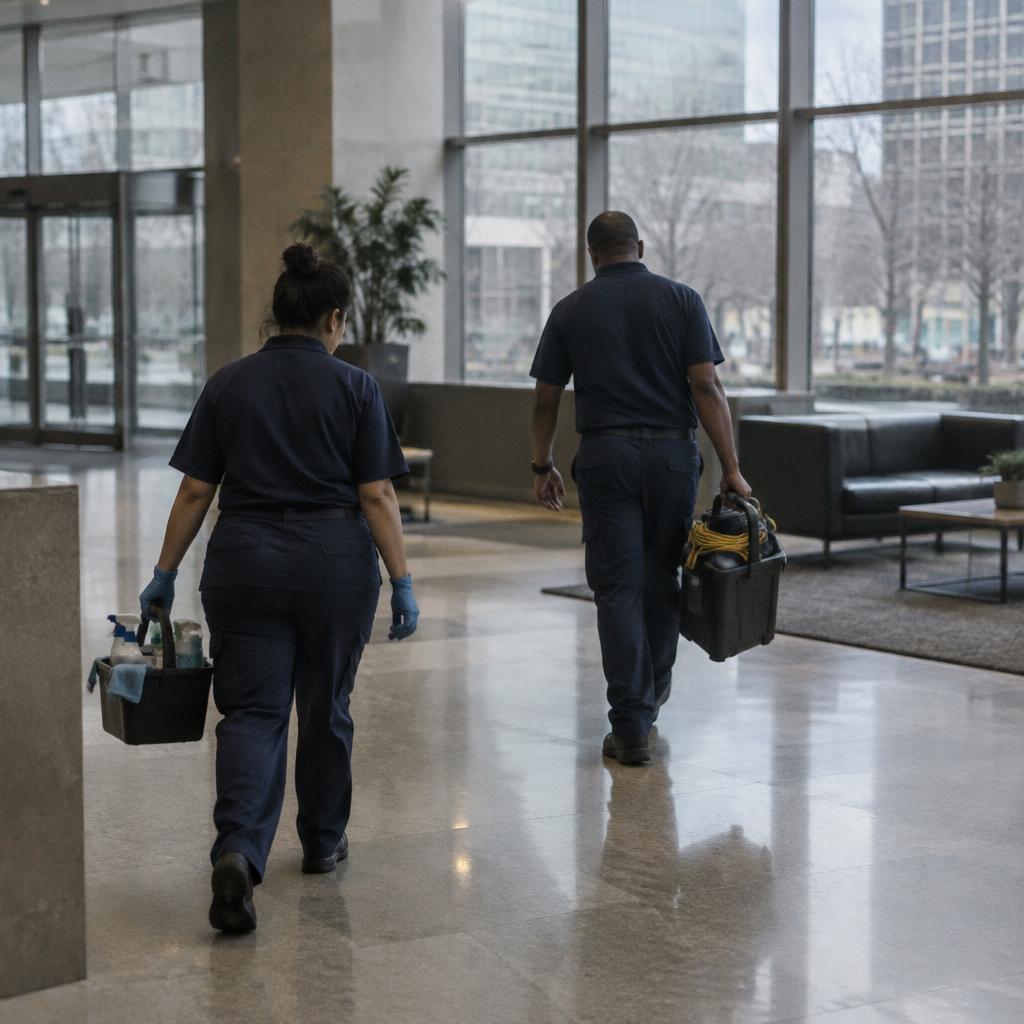


Summary
If your company or building’s cleaning is currently handled by in-house staff, or if you are considering it, chances are you have already noticed some of these symptoms: executive or operations leadership spending time covering absences, uncertainty about how much the service truly costs, quality that hinges on a single individual, or managing a non-core function that constantly drains attention. There is no one-size-fits-all model. This guide compares three options (in-house team, external contractor, and a hybrid model) across eight criteria, explains in practical terms what changed in Mexico with the 2021 reform, and closes with a diagnostic checklist for your specific case. It contains no rate quotes or arbitrary percentages.
The short answer
Neither model is inherently superior in the abstract. An in-house team provides direct operational control and fits well when cleaning is deeply intertwined with your specialized core processes; however, it requires you to directly manage human resources, substitute coverage, supplies, and technical training. An external contractor absorbs that administrative burden, requiring you instead to define the service clearly in writing and systematically audit deliverables and regulatory compliance. A hybrid model divides duties between the two, yet demands the strictest legal boundaries. The decision ultimately rests on three questions: what does each option truly cost today once all hidden expenses are tallied? What happens when workers call in sick? And do you want your leadership team spending valuable hours managing janitorial operations? If you switch models, involve your legal counsel beforehand, never after the fact.
How to know if it is time to review your model
These signs do not automatically prove you must switch; they simply indicate that an operational review is warranted:
- When someone calls in sick, service quality collapses and a site manager ends up stepping in to resolve it.
- You only see the raw payroll figure and have no clear visibility into the fully loaded service cost.
- Quality relies on a single individual who, if they resign, takes all site-specific operational knowledge with them.
- Certain tasks fall outside the team's skillset (deep restorative cleaning, specialty floor care, working at heights) and are improvised on the fly.
- Your operations have evolved (additional shifts, multiple facilities, expanded square footage) and the current team can no longer keep up.
- You currently use a vendor and are wondering whether bringing it in-house makes sense, or vice versa.
If you recognize two or three of these symptoms, conduct a structured comparison rather than reacting impulsively to the latest operational complaint.
Eight criteria for comparison
Management literature on service outsourcing versus in-house delivery consistently emphasizes that the decision goes far beyond headline costs: it requires assessing current performance, whether the vendor market offers superior capabilities, your internal capacity to supervise third parties (Taponen & Kauppi, 2020), and clearly distinguishing core competencies from non-core activities (*MIT Sloan Management Review* on strategic outsourcing). Applied to commercial cleaning:
- Total cost of ownership. It is never just base payroll: factor in employer social contributions, statutory benefits, substitute coverage, uniforms, chemicals and consumables, machinery maintenance and depreciation, safety training, direct supervision, and internal administrative overhead. The pricing guide outlines these cost line items; use them on both sides of your comparison.
- Operational continuity. What happens on a Monday morning with two unscheduled absences or a sudden resignation?
- Supervision. With in-house staff, you directly manage daily labor; with a contractor, you audit service deliverables and objective evidence.
- Training and supplies. Who designs training curricula, procures chemicals, controls dilution rates, and services floor machinery?
- Labor liabilities and social security burdens. With in-house staff, you are the legal employer; with a vendor, they act as the employer, though you retain the obligation to verify their statutory compliance.
- Flexibility. How easily can you add an evening shift, expand into an adjacent building, or support an unscheduled corporate event?
- Risk exposure. In an in-house model, you bear direct labor liabilities and operational disruptions; with a third party, the risk shifts to contractor default and vendor dependency.
- Core business focus. How much senior leadership bandwidth is consumed by running janitorial operations?
Decision matrix
This matrix does not declare a universal winner: it clarifies the operational trade-offs of each model and highlights the prerequisites that must be solved for it to succeed.
| Criterion | In-house team | External contractor | Hybrid model |
|---|---|---|---|
| Total cost | Dispersed budget line items that are rarely consolidated | A single transparent invoice line; the challenge is ensuring apples-to-apples scope comparisons | Sum of both budgets; must avoid duplicating supervisory layers or equipment |
| Continuidad | Fully dependent on your internal headcount reserves and coverage mechanisms | Governed by contractually enforced SLAs and vendor backfill capabilities | Depends on who is assigned to cover specific operational scopes |
| Supervisión | Direct supervisory management | Service-level auditing and documentary evidence | Dual oversight; carries high risk of blurred lines of command |
| Training and supplies | Developed and procured in-house | Handled entirely by vendor; you verify compliance | Divided based on assigned operational scopes |
| Labor liabilities and social security | You are the direct legal employer | Managed by vendor; you audit proof of compliance | Dual employment relationships to monitor |
| Flexibility | Adjusting headcount is slow and entails legal severance implications | Flexible adjustments governed directly by contract terms | Flexibility exists only within the outsourced scope |
| Risk | Direct labor liabilities and operational disruption fall on you | Vendor breach of contract and operational dependency | Both risk profiles, compounded by the legal exposure of mixed lines of command |
| Core business focus | Consumes significant executive and administrative time | Minimal day-to-day administration, focused purely on vendor verification | Moderate, requiring continuous cross-team coordination |
| Operational prerequisites | Dedicated manager, backfill pool, structured training program, coverages | Clearly defined scope, robust contract, verification protocols, SLAs/KPIs | Explicitly segregated duties and command lines, vetted by Legal |
*Every model functions effectively when the bottom row is strictly satisfied; each inevitably fails when those prerequisites are taken for granted.*
When each model makes sense
These are strategic guidelines, not rigid rules.
An in-house team typically makes sense when the scope is small or deeply integrated into proprietary manufacturing processes, you possess established HR capacity to manage frontline turnover, staff coverages, and safety protocols, and direct operational control outweighs budget flexibility.
An external contractor typically makes sense when you require uninterrupted daily coverage across multiple locations, need specialized methods or industrial floor equipment that do not justify capital expenditure, your leadership team cannot afford to manage cleaning operations, and you can document the service scope in writing and monitor it via performance KPIs.
If you have already gathered bids, this vendor proposal evaluation matrix provides a structured framework to normalize proposals before benchmarking them against your internal loaded cost.
The hybrid model
Maintaining an in-house core team for sensitive or proprietary areas while contracting out common areas, restrooms, or specialized deep cleaning is a common and viable strategy. The operational danger lies in supervisory command: if your internal facilities supervisor issues direct task assignments to both in-house staff and contractor personnel, the legal boundary between a third-party specialized service and illicit labor subcontracting collapses. A practical operating rule, which must be validated by your labor counsel: each team must have its own designated supervisor; your managers communicate strictly with the contractor's site lead, never directly directing the vendor's frontline workforce, and all operational zones and duties must be demarcated in writing (mandatory contract clauses).
What changed in Mexico since 2021
*This section outlines statutory criteria that must be formally confirmed by your legal counsel.*
The labor reform published in the Official Gazette of the Federation (DOF) on April 23, 2021, fundamentally overhauled the Federal Labor Law (LFT - *Ley Federal del Trabajo*). According to the text of the LFT (last cited statutory reform: May 14, 2026):
- Article 12: Prohibits general labor subcontracting (personnel outsourcing), defined as placing an entity's own workers at the disposal of another party.
- Article 13: Authorizes the subcontracting of specialized services or execution of specialized works, provided they do not form part of the corporate purpose (*objeto social*) or the primary economic activity (*actividad económica preponderante*) of the beneficiary, and the contractor is officially registered.
- Article 14: Mandates a written formal contract stipulating the specific specialized scope and the approximate number of assigned personnel; the contracting entity incurs joint and several liability (*responsabilidad solidaria*) if the contractor defaults on its labor obligations.
- Article 15: Requires contractors to register with the Ministry of Labor and Social Welfare (STPS - *Secretaría del Trabajo y Previsión Social*)—a status renewable every three years—and maintain inclusion in a publicly accessible registry (REPSE).
Key takeaways for your strategic decision:
- Contracting commercial cleaning is no longer "renting workers"; it is contracting a specialized deliverable. This is why formal contracts and service metrics matter, and why the hiring facility verifies results rather than directly directing third-party labor (staffing, training, and coverage).
- The legal boundary between the cleaning service, your corporate bylaws (*objeto social*), and your primary economic activity must be evaluated by your legal counsel, and reviewed by your tax advisors. This article does not state whether commercial cleaning constitutes a core activity for any specific company or sector: that determination depends strictly on each company's legal incorporation documents and tax filings.
- The vendor's specialized registration must be continuously validated (REPSE verification guide).
- There are strict associated tax ramifications. Article 15-D of the Federal Fiscal Code (CFF - *Código Fiscal de la Federación*, last cited reform: April 9, 2026) conditions the income-tax deductibility and VAT crediting of these contractor disbursements on strict compliance with the LFT framework and active registry status. Interpreting these provisions for your organization belongs to your tax department.
If you currently operate with an in-house cleaning team, this statutory framework does not by itself dictate that you must outsource; how it applies to your operating model must be evaluated by your labor attorney.
Pitfalls when migrating from one model to another
Transitioning an operation from an in-house workforce to a contractor—or insourcing an outsourced team—entails critical labor and operational consequences.
- Making decisions or notifying staff prior to consulting labor counsel. The formal process of terminating, transferring, or restructuring direct employment relationships, along with associated statutory severance liabilities, must be defined by your labor attorney.
- Assuming staff will "simply transfer" to the new vendor, or assuming they cannot. Article 41 of the LFT regulates employer substitution (*sustitución patronal*): by statutory definition, labor relationships remain unaffected when essential operational assets of an enterprise or establishment are transferred, with the outgoing employer remaining jointly liable alongside the incoming employer for six months following notification. Whether this scenario applies to shifting an in-house janitorial team to a contractor depends entirely on factual circumstances and must be analyzed by Legal.
- Overlooking tax restrictions. Article 15-D of the CFF establishes strict limitations regarding contractor billings involving personnel who previously worked directly for the hiring client; verify this with your corporate tax team prior to executing agreements.
- Comparing raw base payroll against an all-inclusive vendor invoice. Omitting loaded labor costs yields an invalid conclusion in either direction.
- Outsourcing without a documented statement of work. Map out physical areas, shift frequencies, security access, and critical production zones before tendering the service.
- Attempting an overnight cutover. A structured four-week service transition plan is equally essential when onboarding a first-time contractor.
- Co-managing staff post-transition, which immediately re-introduces the statutory risks of Article 12 (illicit labor subcontracting).
Disclaimers
This article does not constitute legal, labor, or tax advice. The LFT, CFF, and related administrative regulations are subject to ongoing statutory amendments, and their application depends on the specific operational facts of each corporate entity. Verify statutory currency through official government gazettes and consult your corporate legal and tax counsel, particularly prior to restructuring your workforce or terminating employment contracts.
>
No generic figures. This text intentionally omits arbitrary fee estimates, hypothetical percentage savings, or broad market rates. Valid decision-making data must be derived from your organization's actual fully loaded payroll costs and vetted written vendor bids.
>
No universal model endorsement. This guide provides an objective evaluation framework; it does not replace a customized operational and financial analysis of your facility.
Questions for your case
Work through these questions in writing alongside Operations, Procurement, and Legal. Any question left unanswered indicates an information gap that must be resolved prior to finalizing your operating model.
| ☐ | Question | Strategic insight revealed |
|---|---|---|
| ☐ | Do we know the full, true annual cost of our cleaning operation across all direct and indirect budget categories? | Confirms whether you can perform an accurate, apples-to-apples cost comparison |
| ☐ | What specific operational protocol triggers when two team members fail to show up on the same day, and who is forced to solve it? | Evaluates your true operational continuity and site resiliency |
| ☐ | Who inspects cleaning quality, how often, and what objective auditable records are maintained? | Determines whether quality is actively measured or merely assumed |
| ☐ | Who designs training protocols, procures industrial chemicals, manages safety stocks, and services equipment? | Quantifies the hidden internal administrative burden your organization carries |
| ☐ | Does our organization have the bandwidth, willingness, and HR capability to manage this frontline workforce over the coming year? | Identifies whether maintaining an in-house model is strategically sustainable |
| ☐ | Can our facility management team define scopes, frequencies, and acceptance criteria in an actionable written SLA? | Indicates whether your site is ready to successfully manage an external vendor |
| ☐ | Who inside our organization will audit the vendor's REPSE, IMSS compliance, and payroll records, and at what monthly frequency? | Establishes whether an outsourced model will receive adequate legal oversight |
| ☐ | What is our legal counsel's formal written opinion regarding the alignment of this specialized service with our *objeto social* and tax profile? | Resolves the foundational legal compliance question for specialized outsourcing |
| ☐ | In the event of a transition, have Legal and Tax vetted the regulatory and financial impacts on our current workforce? | Ensures workforce restructuring proceeds without unexpected statutory liabilities |
| ☐ | If adopting a hybrid structure, are operational zones, tasks, and distinct lines of supervision formalized in writing? | Prevents cross-contamination of supervisory commands and unlawful co-employment exposure |
*How to use: Bring this checklist directly into your internal executive alignment meeting.*
Siguiente paso
Work through the diagnostic checklist above and calculate your fully loaded current operating costs. If you decide to evaluate external contractor options, consult our guide to hiring commercial cleaning services, review our compliance and regulatory standards, and, if you require a formal specialized service proposal, visit our request a quote page.
Choosing between an in-house team and an external contractor is neither an operational trend nor a decision based purely on hourly rates: it is a strategic decision about which parts of your facility operations you want to manage directly, which deliverables you want to hold a third party accountable for via contract, and which regulatory liabilities you are equipped to control. In Mexico, post-2021 labor and tax legislation additionally requires that any outsourced service be clearly specialized, legally registered, and operationally separated from client management. Armed with comprehensive, fully loaded cost accounting and early legal counsel involvement, either model can operate successfully; lacking them, both inevitably fail.
Sources
- Ley Federal del Trabajo, arts. 12–15 y 41 (última reforma indicada: 14-05-2026)
- Código Fiscal de la Federación, art. 15-D (última reforma indicada: 09-04-2026)
- Taponen, S. & Kauppi, K. (2020). Service outsourcing decisions – a process framework. *Journal of Global Operations and Strategic Sourcing*, 13(2), 171–194
- Article "Strategic Outsourcing", MIT Sloan Management Review
Use this checklist in your next quote or renewal.
To get a quote from SELIMEX, use the quote page; for more information, see the compliance section.