

Summary
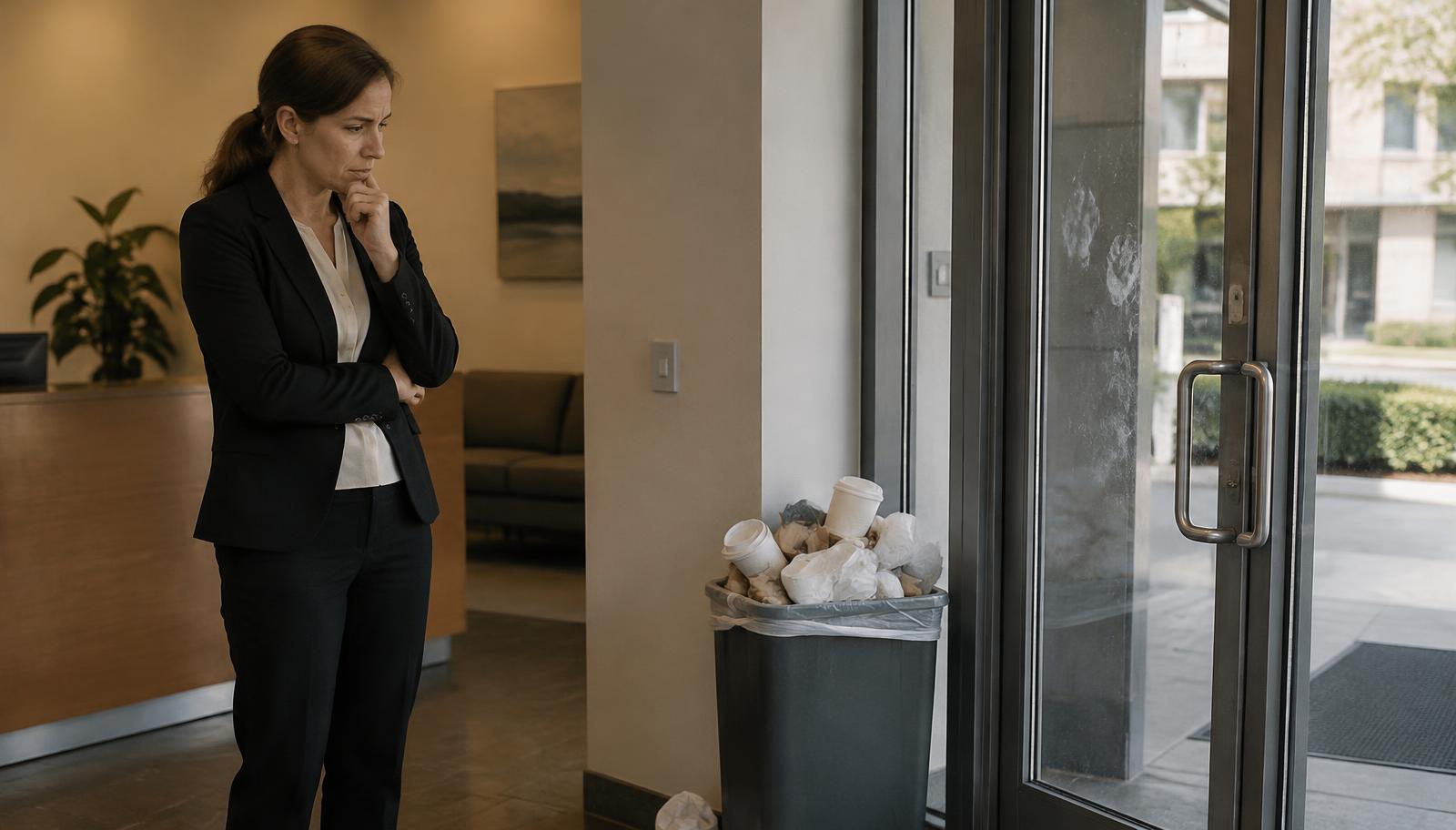
Almost no one decides to review their cleaning service on an ordinary Monday. What actually happens is far more subtle: a recurring complaint, a restroom that is "always forgotten," a new face every month, a report nobody remembers receiving, a higher invoice with zero changes in scope. None of these signs prove on their own that the vendor is bad; often, they simply indicate that the service was never clearly defined. This guide outlines seven signs, offers a ten-question self-assessment with indicative scoring, and explains how to proceed depending on the outcome: correct, renegotiate, or—only if truly necessary—request new quotes.
The short answer
If two or three signs from this guide appear simultaneously, or if one recurs over several months, it is worth reviewing the service. Reviewing does not mean switching providers: it means gathering evidence, speaking with the vendor using data, and choosing between three paths. Correct when clarity is missing (standards, reporting, meetings). Renegotiate when the scope or cost no longer matches what your facility actually needs. Request quotes when, after presenting evidence and offering a real opportunity to correct, the issue persists or the service no longer fits your operations. Start with the least expensive option: reaching an agreement on what "clean" means and how it is verified.
Seven signs worth watching
1. The same complaints, over and over. An isolated complaint is a normal part of any facility operation. What warrants attention is the recurring one: the same restroom, the same shift, the same type of deficiency. When a complaint repeats, it stops being an isolated incident and becomes an issue with the service schedule (this distinction is also detailed in the service incident protocol guide).
2. Areas or tasks that get "forgotten." Windows no one remembers ever being cleaned, storage rooms left out of the route, weekly tasks that quietly shift to monthly without notice. In most cases, these oversights point to an unwritten task list per area or a scope that no longer aligns with how the space is actually used.
3. Visible turnover. A different cleaner every month, no one knowing who the supervisor is, or new staff who do not know the access protocols or site rules. Turnover is not an infraction in itself, but it often foreshadows quality and continuity issues. Nor is it solved by policing individual workers: it requires a conversation with the vendor's account manager about their staffing coverage and training plan, as explained in the guide on cleaning staff, training, and coverage.
4. Documents that nobody reviews. There is a binder with vendor paperwork, but no one knows what date it carries or where the latest records are kept. A vendor file that isn't kept up-to-date fails right when you need it most (see living vendor compliance file).
5. Nonexistent or unread reports. If you ask what was completed last week and the answer is "we have to ask the supervisor," you lack a visibility mechanism. The reverse is also a red flag: reports that arrive punctually like clockwork, but that no one ever opens or reviews.
6. Debates over what "clean" actually means. Two people walk through the same area and reach opposite conclusions. Without shared, objective criteria, every walkthrough is merely an opinion, making disagreements feel like personal conflicts when they are actually just undefined standards.
7. Costs that rise without explanation. A price adjustment that cannot be tied to a change in scope, schedule, square footage, or contractual conditions. A rate increase is not automatically an alarm bell in itself; the real warning sign is the absence of a transparent breakdown you can review (to structure that conversation, see how commercial cleaning service pricing is structured).
Why they appear (and why it isn't always someone's fault)
It is worth examining the root causes, because the cause determines the solution. These signs rarely stem from a single factor:
- The service was never precisely defined. If the contract or scope of work does not specify what gets done, where, at what frequency, and how it is verified, each party fills the void with their own assumptions.
- The facility changed, but the service did not. New operating shifts, higher headcount, remodeled areas, or more intensive operations. A schedule drafted two years ago no longer reflects the current reality of the site.
- Supervision became subjective opinion. Without an inspection form or representative sampling, all that remains are complaints—which arrive late and are inherently negative.
- Sometimes, there genuinely is a vendor performance issue. It happens, which is why requesting new quotes is a valid path. However, that conclusion should be reached with documented evidence, not an accumulation of minor frustrations.
A conceptual framework: commercial cleaning technical standards agree that cleanability must be described, measured, and reviewed. The ISSA Clean Standard: K-12 combines sample-based inspection with corrective actions and is designed for schools. APPA, for instance, outlines five custodial cleaning levels for facilities, framing them as adaptable operational guidelines for each institution rather than mandatory regulations. You do not need to formally adopt them: the takeaway is the core principle of documenting the expected standard and auditing it consistently every time. The practical way to implement this is outlined in our guide to cleaning service supervision and KPIs.
10-question self-assessment
Before you start. This tool is a self-assessment exercise. It is not an industry standard, it is not statistically validated, it does not compare against sector averages, and it does not replace a formal audit or legal/technical counsel. Its purpose is to organize your existing observations and help you decide where to start. The scoring thresholds and ranges are indicative and editorially defined.
How to answer. Reflect on the last three months. For each question, mark 0 (does not occur), 1 (occurs occasionally or in a single area), or 2 (occurs frequently or across multiple areas). If you do not know, score it as a 1: not knowing is valuable data in itself.
| # | Question | 0 | 1 | 2 |
|---|---|---|---|---|
| 1 | Do service complaints recur in the same area, shift, or topic? | ☐ | ☐ | ☐ |
| 2 | Are areas or tasks missed and only addressed when someone complains? | ☐ | ☐ | ☐ |
| 3 | Is it difficult to verify what was done on a specific date (logbook missing or unread)? | ☐ | ☐ | ☐ |
| 4 | Does assigned staff or the supervisor change frequently, impacting service delivery? | ☐ | ☐ | ☐ |
| 5 | Do staff absences leave tasks unfinished, without advance notice or a coverage plan? | ☐ | ☐ | ☐ |
| 6 | Are the vendor's compliance documents unreviewed, outdated, or unaccounted for? | ☐ | ☐ | ☐ |
| 7 | Is a periodic performance report missing, or does it exist without anyone reading it? | ☐ | ☐ | ☐ |
| 8 | Are there frequent disagreements about what is "clean" due to a lack of written standards per area? | ☐ | ☐ | ☐ |
| 9 | Has the price increased without an explanation tied to changes in scope or terms? | ☐ | ☐ | ☐ |
| 10 | Do items agreed upon in meetings or emails resurface repeatedly without resolution? | ☐ | ☐ | ☐ |
Add up your score (0 to 20) and review the ranges:
| Points | Indicative interpretation | Suggested path |
|---|---|---|
| 0 to 5 | Minimal signs. The service is likely performing well; the main risk is relying solely on individual institutional memory | Document what works and establish a periodic review schedule |
| 6 to 11 | Moderate signs. Typically points to gaps in service definition, reporting, or follow-up | Correct first, establishing clear evidence and deadlines |
| 12 to 20 | Multiple or persistent signs | Correct and, in parallel, renegotiate or prepare to request quotes |
Secondary review, by question category. The total score matters less than where the points concentrate:
| If points concentrate in… | Questions | It usually indicates | Recommended path |
|---|---|---|---|
| Results and continuity | 1, 2, 4, 5 | A service falling short of expectations or lacking reliable staffing coverage | Corrective action plan with vendor; evaluate alternatives if it does not improve |
| Visibility and documentation | 3, 6, 7 | Lack of reporting mechanisms and document management controls | Correct: implement reports, site logs, and vendor compliance files |
| Criteria and follow-up | 8, 10 | Undefined standards and unresolved action items | Correct: establish standards per area and hold regular service meetings |
| Cost | 9 | Misalignment between scope and billing | Renegotiate based on current operational scope |
What to do based on the results
Correct: when clarity is what's missing
This is the most common path. It consists of putting in writing, together with the vendor, what was previously unstated:
- A task and frequency schedule per area, defining the expected outcome for each.
- A standardized sample-inspection checklist used consistently, detailing corrective actions, owners, and due dates.
- A concise, periodic service report and a recurring meeting to review it.
- A formal agreement for absence coverage and onboarding/induction procedures for new personnel.
- A compliance file review with clear verification dates.
After four to six weeks, retake this self-assessment and compare scores. If the symptoms decrease, the corrective plan worked; if not, you now have documented evidence for the next step. The step-by-step process is detailed in our guide on cleaning service supervision and indicators.
Renegotiate: when the scope or cost no longer matches
If your facility's operations changed (additional shifts, different floor area, new requirements) or there is a price increase you cannot justify, review the scope before discussing rates: what is currently covered, what is obsolete, and what is missing. Refer to the minimum commercial cleaning contract clauses to see what was originally agreed upon regarding rate adjustments, contract term, and service level agreements (SLAs). Effective renegotiation typically concludes with an updated addendum, not a dispute.
Request quotes: when corrective action falls short or the service no longer fits
Requesting proposals is not burning bridges; it is doing market research. Legitimate reasons include: persistent issues following a documented corrective plan, operational expansion that your current provider cannot handle, or an approaching contract renewal. To run an orderly process:
- Compile two to three months of documentation and clearly define your statement of work before soliciting proposals with a structured RFP.
- Evaluate bids using a structured scoring matrix rather than price alone: our guide to evaluating cleaning proposals provides a step-by-step methodology.
- If you choose to switch, plan the transition carefully. The guide on switching cleaning vendors in four weeks explains how to prevent service disruptions.
For a comprehensive overview of the procurement lifecycle, from initial scoping to renewal, see our complete guide to contracting commercial cleaning services.
Before deciding
Two critical precautions to keep in mind, regardless of the chosen path.
Review your contract first. Giving informal notice or terminating a contract without reviewing term lengths, notice periods, and transition obligations could compromise your legal position. This contract review should be performed by your legal team.
Verify without directing. Under the Mexican Federal Labor Law (*Ley Federal del Trabajo* or LFT, Art. 12), personnel subcontracting is prohibited, and specialized services require that the contractor manage, organize, and direct their own staff. Therefore, when reviewing the service, your role is to define expected outcomes, request objective evidence, and coordinate with the vendor's account manager—not to issue direct operational orders to their cleaners or dictate who works at your facility. Furthermore, Article 14 of the LFT establishes joint and several liability (*responsabilidad solidaria*) for the hiring company if the contractor fails to meet its labor, tax, or social security obligations. This is an additional reason to keep your vendor compliance verification up to date and consult your legal counsel with any questions. These notes represent general guidance, not formal legal advice.
Common mistakes
- Making decisions based on a single complaint. An isolated incident is data, not a verdict.
- Replacing a vendor without attempting a documented corrective plan. If the root issue is poor scope definition, the incoming vendor will inherit the exact same problem.
- Focusing exclusively on price. A low rate paired with an incomplete scope turns out expensive; an unusually high rate without transparent justification warrants inquiry as well.
- Giving direct instructions to the vendor's personnel. Channel all operational feedback through the assigned supervisor or account manager.
- Failing to re-measure. Without a follow-up assessment, you cannot determine if your interventions worked.
Warnings
This is neither legal advice nor an official audit. The self-assessment is an operational reflection tool; it does not measure statutory compliance, is not backed by statistical models, and does not benchmark your facility against others. The legal consequences of any contract decision depend on contractual terms and applicable law: consult your legal department.
>
No market benchmarks provided. This guide does not provide industry averages for complaint volumes, turnover rates, or pricing. Performance targets and acceptable thresholds must be established individually between each company and its vendor.
>
Personal data protection. If your review involves compiling staff rosters, access logs, or photographs of individuals, consult your legal counsel regarding data retention and privacy compliance.
>
Safety and security. Reviewing service quality never justifies entering restricted areas, operating specialized equipment without training, or bypassing facility health and safety protocols.
Checklist to prepare the review
| ☐ | Step | Evidence | Responsible Party | Date |
|---|---|---|---|---|
| ☐ | Complete the self-assessment with two or three stakeholders (Operations, Facility, Procurement) and compare results | Completed response sheets | ||
| ☐ | Gather complaints, reports, inspection logs, and meeting minutes from the last two to three months | Dated physical/digital folder | ||
| ☐ | Summarize current contract terms regarding scope, SLAs, rate adjustments, and termination notice | Clause summary memo | ||
| ☐ | Document the expected standard of clean for the 3 or 4 most critical areas | Written descriptions and photo standards | ||
| ☐ | Audit the dates and validity of the vendor's compliance documentation file | Dated document inventory checklist | ||
| ☐ | Request a vendor meeting with a structured agenda: observed signs, evidence, corrective agreements, and deadlines | Meeting minutes | ||
| ☐ | Agree on a corrective action plan specifying owners and target completion dates | Corrective action plan | ||
| ☐ | Retake the self-assessment after 4 to 6 weeks | Second response sheet | ||
| ☐ | If deficiencies persist: define updated scope and prepare an RFP | Written scope of work |
*Usage note: this is a practical working template, not a mandatory procedure. Adapt it to your facility's scale.*
Next step
Complete the self-assessment today alongside a colleague from your operations team and compare your scores: the differences in perception are often as insightful as the total score. If the discussion points toward remediation, start with our cleaning service supervision guide. If it highlights the need to explore other options, review our cleaning proposal evaluation matrix or consult the comprehensive commercial cleaning procurement guide. For regulatory and statutory topics, visit our compliance section, and if you are ready to request a proposal, use our quote request page.
Reviewing a cleaning service does not mean distrusting your vendor: it means applying the same operational scrutiny you would to any other critical business process. The signs outlined in this guide are common, and in the vast majority of cases, entirely fixable. Most can be resolved by documenting expectations and auditing performance consistently; others call for renegotiating terms; only a few require going to market for new bids. The key is to arrive at that decision methodically, armed with objective evidence rather than frustration.
Sources
Use this checklist in your next quote or renewal.
To get a quote from SELIMEX, use the quote page; for more information, see the compliance section.