Summary
If you have ever paid "extra" for something you thought was included, or argued over whether a "dirty" restroom was the contractor's responsibility, the issue was almost never bad faith: the scope of work was simply not written with enough detail. This guide explains, in plain language, the difference between routine, deep, and specialized cleaning; what gets left out most often (high-reach glass, waste, furniture, supplies, "no-man's-land" areas); and how to write a scope of work using a five-column table. It includes a ten-question self-assessment and a checklist. It contains no pricing or "market standard" frequencies.
The Short Answer
An institutional cleaning service includes what is written down, and only that. For something to be written usefully, it requires five data points: what is done, where, how often, who provides what is needed (labor, supplies, equipment), and how it is verified. Divide the work into three categories: routine (day-to-day upkeep), periodic or deep (performed at set intervals), and specialized or event-driven (requiring specific methods, equipment, or permits). What does not fit into any of these three is what ends up being disputed later.
Self-Assessment: Is Your Scope of Work Clear?
Answer yes or no. Every "no" represents an area where you currently depend on someone's subjective interpretation.
- Can you show, on a single sheet, which areas are cleaned and at what frequency?
- Do you know which tasks are daily and which are weekly, monthly, or on an event basis?
- Is it written down who cleans the windows and how often, including those not reachable from the floor?
- Is it specified who removes waste to the final disposal point (not just to the trash bin) and what types are handled?
- Is it clear whether furniture is cleaned (desks with items on them, filing cabinets, cabinet interiors)?
- Do you know who provides paper, soap, trash liners, and chemicals, and what happens if they run out?
- Is there a list of areas that are *not* cleaned (storage rooms, technical/mechanical rooms, third-party kitchens)?
- Do you know what is billed separately and how it is quoted?
- Is there a way to verify compliance that does not depend on the personal opinion of someone walking down the hall?
- Could a new team member read the scope of work and understand what to expect?
If you answered "no" to three or more, a dispute is likely already brewing. The good news is that it can be resolved in a single document.
Three Types of Cleaning, Three Types of Conversations
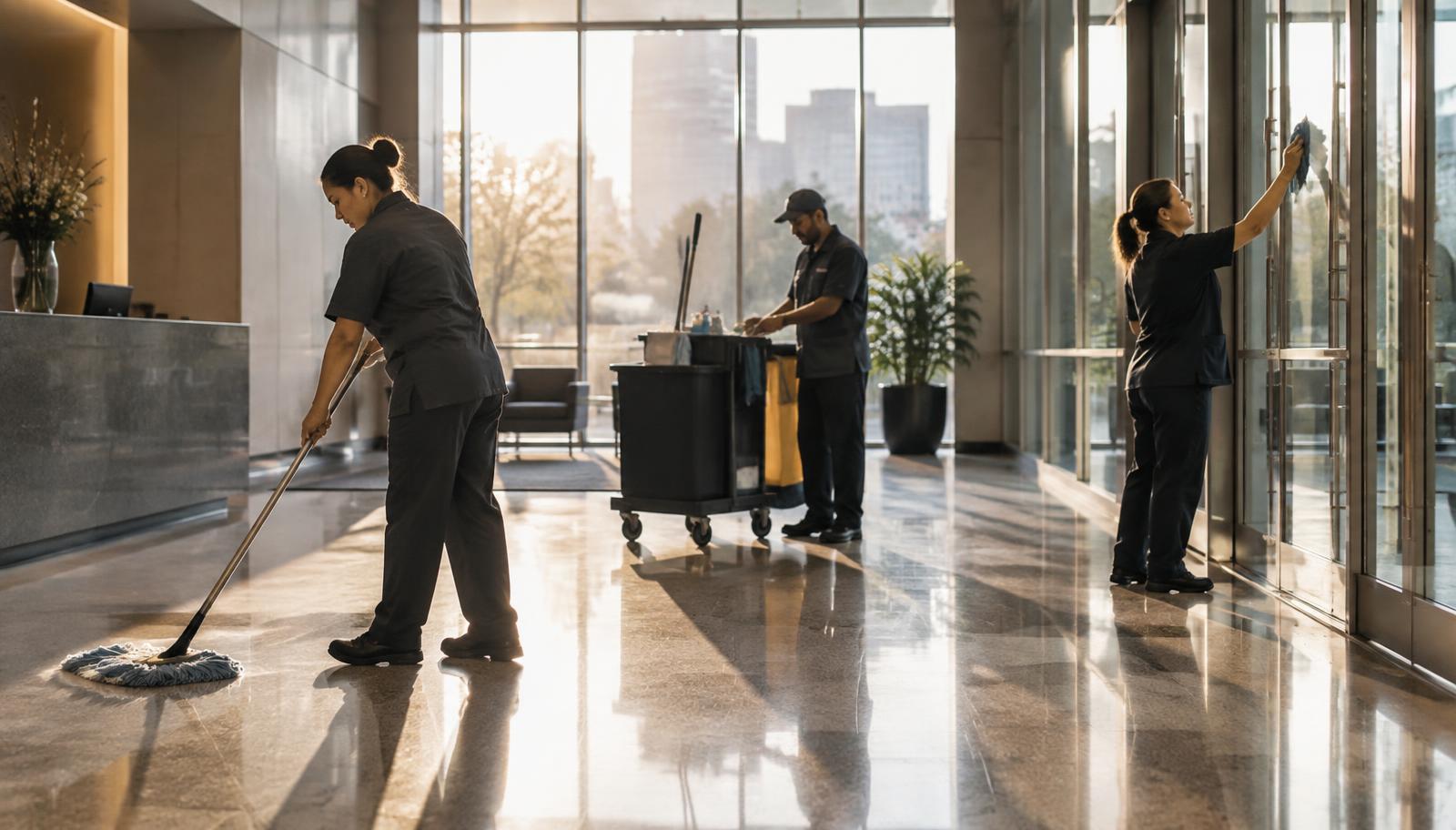
Routine. This is the work that keeps the facility functional every day or several times a week: emptying trash bins, sweeping or vacuuming, mopping, wiping high-touch surfaces, and servicing restrooms and common areas. What matters most here is defining the *standard*: what "clean" means in a restroom or a hallway, and how it is inspected.
Deep (periodic). This is the work that does not need to happen daily, but becomes obvious when neglected: floor scrubbing, carpet extraction, cleaning vents or reachable light fixtures, wall spot cleaning, and cleaning behind and beneath movable furniture. Here, what must be defined is the *frequency and notification process*: how often, during what hours, which areas must be cleared, and how sign-off occurs. For carpets, see our guide on method and frequency; for industrial facilities and concrete slabs, see our guide on deep cleaning methods.
Specialized or event-based. Work that requires equipment, training, or certifications outside the baseline contract: high-reach glass and facade cleaning, post-construction cleanup, floor restoration treatments, cleanroom/process areas, or restricted-access zones. Here, what must be defined is the *entire standalone service*: dedicated scope, separate quote, designated safety lead, and formal deliverables. For working at heights, the guide on work at heights outlines what to demand from a provider.
A common point of confusion deserves clarification: cleaning is not disinfecting. Cleaning removes dirt and organic matter; disinfecting applies a chemical agent to kill or inactivate microorganisms. The U.S. General Services Administration (GSA) national custodial specification defines them along these lines: cleaning physically removes dirt and impurities using detergent and water; disinfecting destroys or inactivates most infectious germs on inanimate surfaces. If you require disinfection, it must be explicitly written as a task with its own frequency and designated areas; it cannot be assumed under "general cleaning." Which product to use and how to apply it is determined by the Safety Data Sheet (SDS) and your safety specialist, not by this guide.
What Gets Left Out Most Often When Left Undefined
The following table does not describe what is "standard" in the market; it highlights the areas where ambiguity frequently leads to disputes. Use it as a checklist when building your own scope of work.
| Topic | Why It Gets Left Undefined | What to Put in Writing |
|---|---|---|
| Windows and architectural glass | "Glass" can mean interior reach, exterior street-level, or the entire facade | Which ones (interior, exterior, skylights), reachable from where, frequency, and if working at heights, who executes it (see work at heights) |
| Waste | Assuming "taking out the trash" covers everything, though waste streams differ (general trash, recyclables, regulated waste) | Which types are removed, to where (floor container, yard/dock, central compactor), how often, and who contracts the final hauling from the property |
| Furniture and personal belongings | Deciding whether to wipe desks with paperwork, cabinet interiors, or computer workstations | Which surfaces are cleaned, what is left untouched (electronic equipment, documents), and who is responsible for clearing desks |
| Supplies and consumables | "Supplies included" might mean chemicals only, or paper, soap, and trash liners as well | Itemized list by category and responsible party; see cleaning supplies and consumables |
| "No-man's-land" areas | Rooftops, fire exit stairwells, mechanical/electrical rooms, storage closets, parking decks, third-party kitchens | Explicit list of included and excluded areas, supported by a floor plan or sketch |
| Equipment and dispensers | Equipment ownership and repair responsibilities are unstated | Ownership, maintenance responsibilities, and terms of removal at contract end |
| After-hours services | Events, tenant moves, pipe leaks, emergency post-incident cleanup | How they are requested, how they are quoted, and guaranteed response times |
| Holidays and coverage | Service continuity is assumed without defining operational mechanics | Which public holidays service is provided on and how vendor personnel absences are backfilled |
| Post-construction or maintenance turnover | Often confused with baseline routine cleaning | Standalone service with its own scope of work and clear turnover conditions for the space |
| Shared common areas | In multi-tenant buildings, boundaries between private and common maintenance are rarely defined | Who is responsible for each zone (see common areas) |
How to Write a Clear Scope of Work
A scope of work should be written as a table, not as a narrative paragraph. Each line item must answer five questions:
| Area | Task | Frequency | Responsible Party for Supplies & Equipment | Verification Method |
|---|---|---|---|---|
| Ground floor restrooms | Clean floors, fixtures, and mirrors; restock consumables | Daily, during agreed-upon hours | Per supplies schedule | Signed log sheet and sampling walkthrough |
| Corridors and entrances | Vacuum or mop | Daily | Vendor | Visual inspection walkthrough |
| Office carpet | Deep extraction cleaning | Per agreed-upon calendar schedule | Vendor | Recorded service date and visual inspection |
| Exterior glass | Window cleaning | Per agreed-upon calendar schedule, dedicated scope if at heights | Vendor, under height-work safety procedure | Service sign-off report |
*This table is a formatting template. Actual frequencies must be determined by each facility; they are not a universal recommendation or standard.*
Four practical principles will keep this table effective:
- Describe outcomes and frequencies, not headcount. A well-written scope specifies what condition an area must be in and how often; managing staff deployment is the vendor's operational responsibility. This approach also protects your labor compliance: the contract must be for a service, not for the provision of personnel (under Mexican labor law, Article 12 of the Federal Labor Law—*Ley Federal del Trabajo* or LFT—prohibits labor subcontracting/personnel supply).
- Separate recurring tasks from extraordinary ones. Everything in the base contract must carry a fixed price and frequency. Anything outside it should be categorized as an additional service, with a defined request and quoting process.
- Include an explicit list of exclusions. What is not listed as excluded can be assumed to be included, and vice versa. Writing down both prevents conflicting interpretations.
- Attach a floor plan. A schematic of the facility floor plan with color-coded boundaries resolves jurisdictional disputes that text cannot.
Once drafted this way, the scope serves three subsequent operational purposes: soliciting bids on an identical baseline (see the request for proposal (RFP) guide), understanding price composition (pricing line items), and attaching it as a binding exhibit to the agreement. Mexican labor law (LFT, Art. 14) mandates that contracts for specialized services must be in writing and clearly state the specific scope of the services and the approximate headcount involved; a detailed scope of work gives legal substance to that statutory requirement. Integrating these terms into agreements is covered in our cleaning service contract guide, and monthly monitoring is detailed in supervision and KPIs.
Example of How a Scope of Work Is Structured
To see how large public organizations manage this, the U.S. General Services Administration (GSA) National Custodial Specification (dated January 27, 2026) organizes operations into interior, exterior, supplementary, and "above-standard" services, which are ordered and priced separately. It assigns frequencies per task (daily, weekly, monthly, quarterly, annual), explicitly lists exclusions such as tenant storage lockers, private executive kitchens, or firing range maintenance, and specifies exactly who hauls waste, who supplies liners, and that movable office furniture and personal property are not to be moved or dusted. For exterior window washing, it requires an approved, written safety plan before work begins. It also requires the vendor to submit a complete chemical list with corresponding SDS for approval prior to use.
While that is a U.S. federal document designed for government properties, it illustrates proper operational structure: a rigorous scope does not settle for "general cleaning," but instead names areas, frequencies, equipment ownership, and exclusions.
A similar logic exists in educational facilities: the APPA (Association of Physical Plant Administrators) outlines five visual appearance levels (ranging from "Orderly Spotlessness" to "Unkempt Neglect") to help facility owners and service providers agree on expected outcomes. These visual standards align service expectations, but they serve to complement—not replace—a detailed area-and-frequency table.
Common Mistakes
- Writing "general cleaning" without specifying areas or frequencies. Each party will interpret this differently.
- Confusing cleaning with sanitizing or disinfecting. If you require disinfection, list it explicitly as a separate task.
- Failing to document exclusions. Unstated assumptions lead to contractual disputes.
- Assuming routine pricing includes high-reach glass, post-construction cleanup, or floor restoration. These are specialty services requiring separate scoping.
- Not specifying the final disposal point for waste. "Taking out the trash" does not clarify who transports waste to the central compactor or manages municipal pickup.
- Leaving shared tenant spaces unassigned. In multi-tenant buildings, physical boundaries must be identified on a layout plan.
- Leaving supplies and machinery out of the scope table. This is the single most common cause of unexpected extra charges.
- Failing to define inspection and sign-off methods. Without objective validation criteria, "clean" remains a matter of opinion.
- Copying a scope of work from a different facility. A distribution center, an office suite, and an industrial plant have entirely different operational needs.
Disclaimers
This is not legal or technical advice. This guide outlines operational criteria for drafting scopes of work; contractual terms must be drafted and approved by your legal department. Referenced standards and statutes are updated periodically: verify the current version directly with official regulatory bodies.
>
No market benchmarks or standardized frequencies provided. Frequencies cited here serve solely as formatting examples; the appropriate schedule for your facility depends on occupancy, traffic levels, and your specific operational standards.
>
Safety. High-angle exterior window cleaning, chemical management, and hazardous industrial areas must comply with official safety data sheets, applicable occupational safety standards (such as Mexican STPS/NOM regulations), and certified safety oversight. This guide does not specify safety procedures or chemical formulations.
Scope of Work Checklist
| ☐ | Verification Item | Evidence |
|---|---|---|
| ☐ | List of included and excluded areas, supported by a floor plan | Facility map or contract exhibit |
| ☐ | For each area: task, frequency, and expected cleanliness standard | Scope-of-work matrix |
| ☐ | Clear division between routine, periodic/deep, and specialized tasks | Three distinct sections in contract exhibit |
| ☐ | Disinfection tasks (if required): specific areas, frequencies, and chemicals | Dedicated line items |
| ☐ | Glass cleaning: interior, exterior, and heights, with assigned responsibilities | Line item and, for heights, dedicated safety plan |
| ☐ | Waste handling: waste streams, final disposal point, and pickup frequency | Scope-of-work line item |
| ☐ | Furniture and personal belongings: clear rules on what is cleaned and what is left untouched | Written protocol |
| ☐ | Supplies, dispensers, and machinery: responsible party designated for each | Supplies schedule (see consumables guide) |
| ☐ | Extraordinary services: request procedure, SLA/response times, and quoting mechanism | Written procedure exhibit |
| ☐ | Holiday coverage and backfill protocol for personnel absences | Dedicated contract clause |
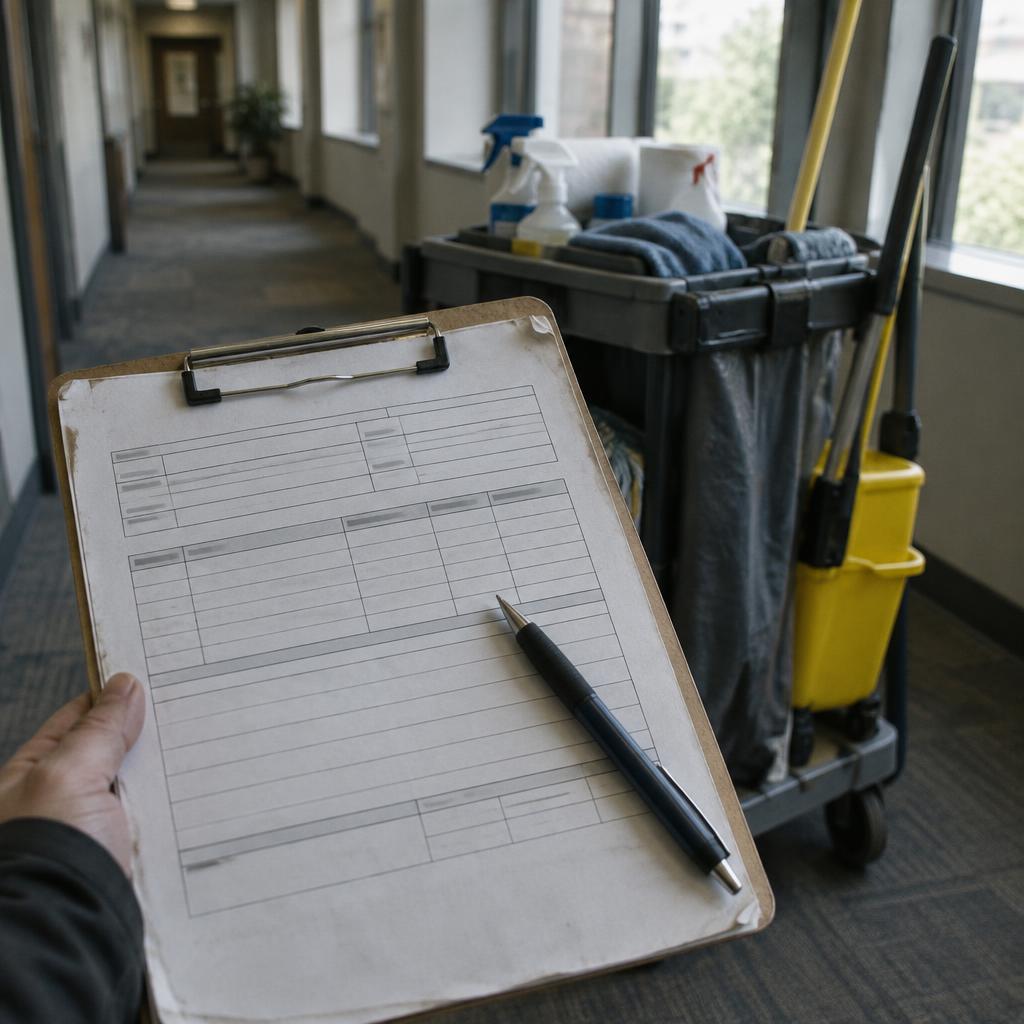
| ☐ | Verification method for each task (sign-off logs, walkthroughs, inspection forms) | Quality audit format |
| ☐ | Scope of work attached to both the RFP and the signed service contract | Executed legal exhibit |
| ☐ | Scheduled periodic review of the scope (e.g., triggered by changes in building occupancy) | Calendar reminder |
*How to use: Complete this checklist with your Operations team before soliciting proposals, and review it with Legal when drafting the final service agreement.*
Next Steps
Complete the self-assessment with your operations team, turn any "no" answers into clear line items within your scope table, and attach it to your next request for proposal (RFP). When reviewing competing bids, our proposal evaluation matrix will help you compare them objectively on an equal footing; for a comprehensive overview of the procurement lifecycle, read our guide to hiring commercial cleaning services. For regulatory and labor compliance, visit our compliance section, and to request a tailored service proposal, visit our quote page.
A successful cleaning program begins with a clear, well-structured document. When the scope of work defines areas, tasks, frequencies, responsibilities, and verification methods, vendor proposals become directly comparable, contracts gain legal clarity, and monthly friction is resolved by consulting a simple table. When it doesn't, the true cost is not the cleaning itself—it is the lost time spent arguing over what was supposed to be done.
Sources
Use this checklist in your next quote or renewal.
To get a quote from SELIMEX, use the quote page; for more information, see the compliance section.