

Summary
In a cleaning proposal, "supplies included" can mean very different things: just the chemicals, trash liners as well, or also restroom paper and soap. If it is not clearly written down, the discrepancy later surfaces as an extra charge or an out-of-stock situation. This guide provides a scope matrix, a usage control framework, a method to compare proposals with and without supplies, and what to request on Safety Data Sheets (SDSs / *Hojas de Datos de Seguridad*, HDS). It does not include specific consumption benchmarks or pricing figures.
The Short Answer
Define in your requirements document, before requesting quotes, who provides each category of supply and who is responsible for inventory replenishment. Require every proposal to list supplies on their own line item, with an itemized inventory of what is included, and to specify what happens if consumption exceeds projections: a cap, an agreed unit price, and an approval workflow. Compare proposals only after normalizing them to the exact same baseline. And before authorizing any chemical product, demand its SDS in Spanish. General line items and pricing questions can be found in the guide on cleaning service pricing breakdown; this article focuses exclusively on supplies and consumables.
What Supplies Are and Why It Pays to Separate Them
We define supplies as the materials consumed or worn out while delivering the service. They fall into four groups, and each is controlled differently:
- Cleaning chemicals. Consumed through use and strictly require an SDS.
- Cleaning gear subject to wear and tear. Microfiber cloths, dust mops, wet mops, abrasive pads, sponges, brushes, trash liners. These are replaced due to wear or hygiene, not direct consumption.
- Restroom and hygiene consumables for building occupants. Toilet paper, paper towels, hand soap, and occasionally air fresheners or hand sanitizer. Their consumption depends far more on the building's occupant traffic than on the service provider.
- Equipment and accessories. Janitorial carts, mop buckets, auto-scrubbers, vacuums, dispensers. They are not consumed, but they are frequently confused with supplies, and scopes often fail to clarify who owns them or who replaces them.
Chemical and tool consumption depends largely on how the cleaning crew works; paper and soap consumption depends on foot traffic, which the facility manager understands best. Therefore, a single usage cap cannot work across all categories. Personal protective equipment (PPE) is excluded here: it is the employer's direct legal obligation to its workers (see cleaning staff health and safety).
Scope Matrix: Included, Client-Provided, Quoted Separately
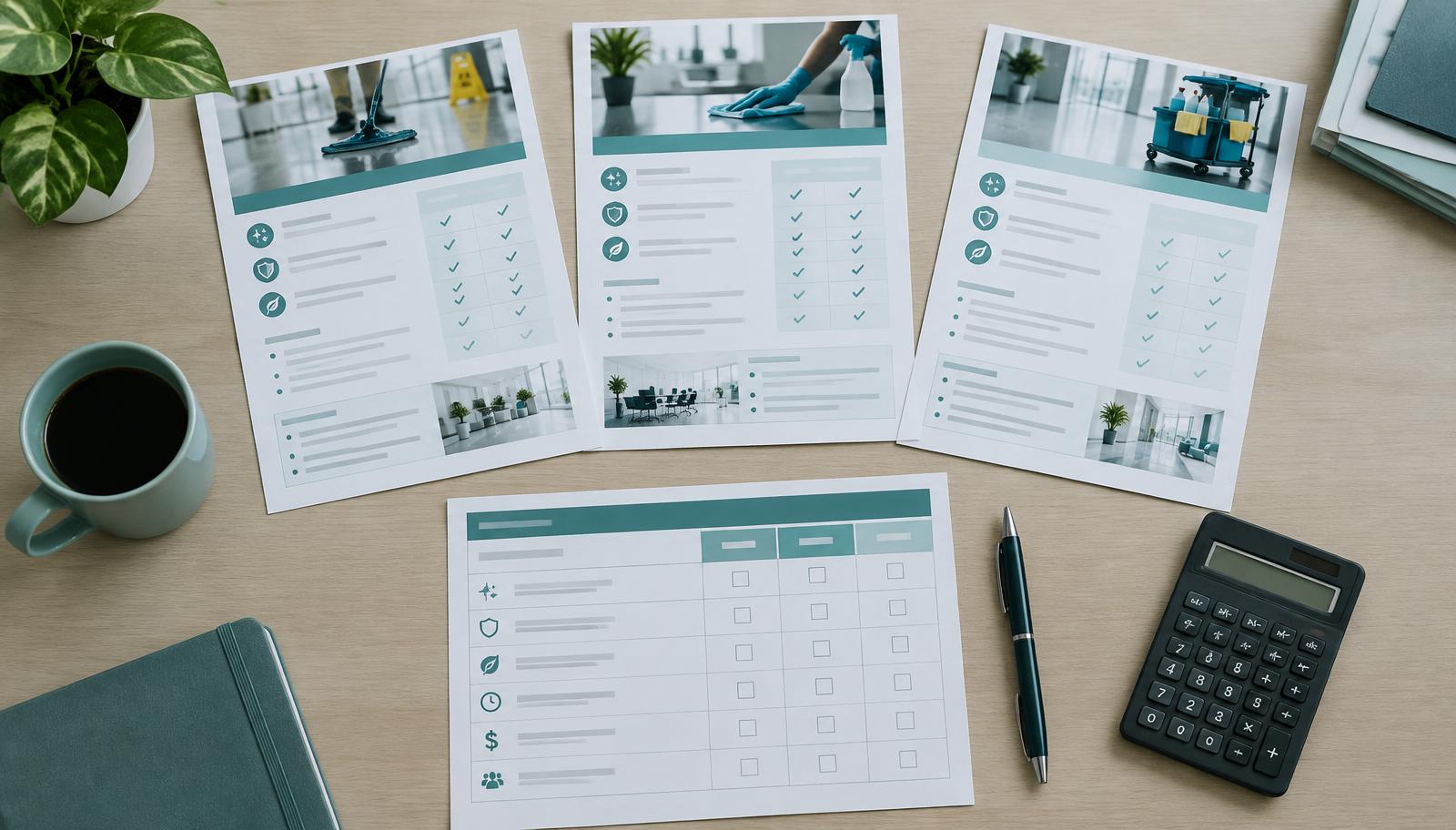
This table does not define what is "standard" in the market; it is a decision-making template. Check one column per line item.
| Item | Included in base price | Client-provided | Quoted separately | What to document in writing |
|---|---|---|---|---|
| General-purpose cleaning chemicals | ☐ | ☐ | ☐ | Product list, brand or approved equal, approved SDSs |
| Disinfectants and specialized chemicals | ☐ | ☐ | ☐ | Who selects them, who approves them, restricted use in defined areas |
| Specialty floor products or treatments | ☐ | ☐ | ☐ | Extra service with dedicated scope; see industrial floors |
| Trash liners | ☐ | ☐ | ☐ | Agreed gauges or types, replacement frequency per route |
| Microfibers, dust mops, wet mops, pads | ☐ | ☐ | ☐ | Replacement criteria (wear vs. hygiene schedule) |
| Toilet paper and paper towels | ☐ | ☐ | ☐ | Brand or technical spec, roll/pack size, cap per billing period |
| Hand soap, hand sanitizer | ☐ | ☐ | ☐ | Formulation type, packaging size, dispenser compatibility |
| Air fresheners, sanitary disposal bags | ☐ | ☐ | ☐ | Explicitly requested or not; never assume |
| Dispensers (paper, soap) | ☐ | ☐ | ☐ | Ownership, installation, maintenance, and end-of-contract removal |
| Minor equipment (carts, buckets, vacuums) | ☐ | ☐ | ☐ | Ownership, maintenance, and replacement terms |
| Machinery (auto-scrubbers, burnishers) | ☐ | ☐ | ☐ | Owned or leased; repair responsibility; see pricing |
| Consumables for periodic/deep services | ☐ | ☐ | ☐ | Quoted alongside the specialized service, not in base fee |
| On-site storage or janitorial closet | ☐ | ☐ | ☐ | Who provides the space, who holds keys, who conducts inventory |
Three golden rules. If the client provides an item, on-time replenishment is their responsibility, and the contractor must notify them before stock runs out. If provided by the contractor, the contract must establish a minimum specification or "approved equal" clause to prevent silent product downgrades. Finally, anything not explicitly checked in a column is not included.
How to Agree on Usage Control
Usage control is not about mistrust: it is about knowing, with hard data, whether budgeted consumption matches real-world operations. It consists of four elements.
1. Baseline and maximum consumption caps. The baseline is established from your purchasing history, vendor proposals, or an initial ramp-up period where usage is recorded without penalties. This guide does not suggest arbitrary quantities. Agree on caps by category (e.g., paper cases per period) rather than an aggregate dollar amount, which hides where budget overruns actually occurred.
2. Supply logbook and inventory tracking. The contractor records deliveries, restocks, and ending inventory per period, and you cross-reference this against site observations. The cleanest approach is a simple log: date, item, replenished quantity, starting and ending stock, and sign-offs. If the client provides any items, maintain your own receiving log to reconcile figures. The data must be recorded in real time, not retroactively estimated at month-end. The guide on supervision and KPIs already incorporates "supplies and significant usage" into periodic reporting.
3. Unit pricing and variance rules. If the base price includes supplies up to a cap, define in the contract what happens when that threshold is crossed: who authorizes additional consumption, at what pre-agreed unit price it will be billed, and what supporting documentation is required. A pre-negotiated unit price schedule prevents bargaining over the cost of individual paper cases when restrooms are already empty. Also establish what happens if consumption falls below the cap: downward adjustments or fixed pricing are both valid commercial models, but must be agreed in writing. Your tax department should validate how surplus supplies are billed.
4. Investigate root causes before assigning blame. High consumption can stem from increased building occupancy, dispenser retrofits, lower-yield product dilutions, theft, or over-frequent replacement. Review trends periodically (monthly at contract launch) and understand the operational cause before renegotiating prices.
Verifying Without Directing
Usage control must be performed on documentation and inventory balances, not by managing contractor personnel. The Mexican Federal Labor Law (LFT - *Ley Federal del Trabajo*) prohibits personnel subcontracting (Article 12) and only permits specialized services that comply with Article 13; the compliant legal structure requires that the contractor directly manages and directs its own workforce (consult the current text at diputados.gob.mx). In practice: establish the governing rules in the service agreement, review the logbook, conduct sample inventory counts, and communicate discrepancies strictly to the contractor's site supervisor, never to individual cleaning technicians. Legal counsel should validate this operational boundary.
Comparing Proposals With and Without Supplies
A proposal "without supplies" is not inherently cheaper, nor is one "with supplies" automatically more expensive: they simply represent two distinct operational scopes. To compare them:
- Issue the exact same scope of work and requirements document to all bidders, clearly detailing which supply categories must be quoted and with what minimum technical specifications. The guide on preparing a cleaning request for quotation (RFQ) explains how to structure it.
- Require supplies to be an itemized line item, accompanied by a product list, consumption caps, and unit prices for overages. If a bidder submits a single lump-sum figure, require them to unbundle it or disclose what it covers.
- Normalize everything to the same baseline. If one proposal includes paper and soap while another excludes them, add your internal procurement cost to the latter—using your historical purchase records, not hypothetical market estimates.
- Compare total cost of ownership over the period, not just the monthly base fee: baseline cap plus unit prices for projected overages, plus internal carrying costs for purchasing, warehousing, and stocking items left under your management.
- Ask about supply chain continuity. How are stockouts prevented during personnel substitutions, vendor transitions, or occupancy spikes?
The scoring matrix for proposals is available in the guide on evaluating cleaning proposals, which already incorporates "training, safety, and supplies" as evaluation criteria.
By way of example, Public Works and Government Services Canada's national janitorial strategy (PWGSC, November 2011) established routine cleaning as a firm monthly rate while billing occasional or emergency work as "actual material cost plus markup." While this is a foreign public-sector precedent and dated, rather than a standard for Mexican private facilities, it illustrates how base services and non-routine supply usage can be structured under distinct commercial mechanisms.
What to Request on SDSs
Official Mexican Standard NOM-018-STPS-2015 remains in force according to the official national standards catalog (published in the Official Gazette of the Federation, DOF, October 9, 2015; effective as of October 9, 2018). Under the standard, employers must maintain Safety Data Sheets (SDSs / HDS) for all hazardous substances and mixtures handled at the workplace (Section 6.3), keep them permanently available to workers (6.4), label containers and storage areas (6.5), inform employees and contractors who handle them (6.6), and provide formal, documented safety training (6.7, 11.1, and 11.3). The SDS must be compiled or provided in Spanish (Section 9.1, subsection b). Furthermore, Mexico's Federal Regulation on Occupational Safety and Health (DOF, November 13, 2014) specifies in Article 53, Section I, that employers must maintain Spanish-language SDSs for all hazardous chemical substances used. The allocation of regulatory responsibilities is detailed in our guide on cleaning staff health and safety.
Key operational safeguards to demand (as best practices, beyond the regulatory baseline):
- A Spanish-language SDS for every single chemical product, submitted prior to initial use. No SDS, no authorization to enter the facility.
- An authorized chemical list displaying the revision number or date of each SDS, along with a contractual rule requiring written advance notice and client approval before introducing any new chemical or brand.
- Physical SDSs available on-site, stationed directly where chemicals are stored and dispensed, not merely in the contractor's corporate archive.
- SDSs must contain all 16 standardized GHS sections. NOM-018 lists them in Section 9.2: ranging from product and manufacturer identification to toxicological data, handling and storage, exposure controls/personal protection, and disposal considerations. If a section is missing or the sheet does not match the product label, reject it.
- Contractor risk assessments that incorporate SDS directives. This guide does not instruct how to use or store specific chemicals: those parameters are governed by the SDS, the manufacturer, and your safety professional.
- Clear responsibility for who provides the SDS when products are client-supplied. If you supply the product, you must furnish the safety documentation: hand it over to the contractor and confirm their staff receives it. NOM-018 does not specify who must author the SDS; consult your health and safety specialist.
- Documented training records for personnel handling chemical products, complete with training dates and curriculum.
- In the event of a spill or exposure, rely immediately on the SDS and your incident reporting protocol; never improvise emergency response.
If a new product is introduced to cut costs but arrives without an approved SDS, the cost savings are voided by compliance liability.
Common Mistakes
- Writing "supplies included" without an itemized list. This is the number-one driver of contract disputes.
- Failing to separate restroom consumables from cleaning chemicals. Restroom usage is driven by occupants; it must be contracted under distinct rules.
- Setting an aggregate dollar cap. This obscures which specific product category drove the budget variance.
- Setting a consumption cap without historical data. Without baseline purchasing data or a trial calibration period, the cap is pure guesswork.
- Leaving ownership of dispensers and equipment undefined. Facilities only discover this oversight when the contract ends and equipment is stripped.
- Tolerating unannounced chemical brand substitutions. Without a vetted SDS, no product should enter the site.
- Comparing lump-sum bids with mismatched supply scopes. Always normalize proposals to a common baseline.
- Managing contractor personnel instead of tracking documentation. Audit logs and inventory balances, and route operational feedback exclusively through the contractor's site supervisor.
- Presenting internal facility rules as statutory legal requirements. Operational preferences that are not mandated by law must be secured through clear contractual clauses.
Disclaimers
This article does not constitute legal, tax, or chemical engineering advice. Mexican standards are updated periodically: verify active versions in the DOF or the national regulatory catalog, and have an occupational health and safety specialist confirm what applies to your facility.
>
No consumption benchmarks or unit costs. This guide deliberately excludes consumption ratios and pricing figures. Caps and unit rates must be derived from your facility's internal purchasing logs or formal written bids.
>
No chemical handling procedures. Chemical selection, storage protocols, and first-aid measures are dictated exclusively by the product's SDS, manufacturer guidelines, and your designated safety engineer.
>
Tax and fiscal considerations. The invoicing structure for excess consumables or client-supplied materials must be validated by your corporate tax counsel.
Usage Control Checklist
| ☐ | Control Measure | Supporting Evidence | Responsible Party | Frequency |
|---|---|---|---|---|
| ☐ | Scope matrix completed and annexed to contract (Included / Client / Separate) | Signed contract exhibit | Procurement | Contract signing |
| ☐ | Supplies quoted on a dedicated line item, with itemized inventory | Formal proposal | Procurement | Bidding stage |
| ☐ | Baseline defined (historical records or agreed ramp-up calibration period) | Baseline log | Operations | Project kickoff |
| ☐ | Category-specific caps and overage rules established (approver, unit rates) | Contract clause/exhibit | Procurement / Legal | Contract signing |
| ☐ | Negotiated unit price schedule executed | Pricing exhibit | Procurement / Finance | Contract signing; annual review |
| ☐ | Logbook tracking deliveries, restocks, and ending inventory | Signed stock logs | Contractor | Per agreed billing period |
| ☐ | Client receiving logs maintained (for any client-provided supplies) | Facility stock log | Warehouse / Facilities | Per agreed billing period |
| ☐ | Sample inventory cycle counts conducted | Audit worksheet | Facility Manager | Per agreed billing period |
| ☐ | Master chemical list with approved Spanish SDSs and revision dates | Archived SDS binder | EHS / Safety Dept. | Product approval & changes |
| ☐ | Written advance notice required for chemical or brand substitutions | Email or change order | Contractor | Prior to any change |
| ☐ | SDSs accessible directly inside chemical dispensing/storage rooms | Physical site audit | EHS / Safety Dept. | Routine walkthroughs |
| ☐ | Equipment and dispenser ownership, condition, and maintenance logged | Asset inventory | Facilities | Kickoff and contract close |
| ☐ | Variance analysis review (occupancy shifts, yield, shrinkage, restock rates) | Meeting minutes | Joint review committee | Monthly at contract launch |
| ☐ | Overage billing reconciliation against signed delivery logs | Invoices vs. logs | Finance / Accounts Payable | Each billing cycle |
| ☐ | Escalation rule: variances addressed strictly with contractor supervisor | Safety exhibit / contract | Facility Manager | Ongoing |
*How to use: Bring this checklist to your vendor kickoff meeting and refine it with your legal and EHS teams before incorporating it into your service agreement.*
Next Steps
Take the scope matrix, populate it with your facility's historical usage, and attach it to your next cleaning service RFQ. If you need an end-to-end procurement roadmap, explore our guide to hiring commercial cleaning services; for regulatory compliance frameworks, visit our compliance section; and if you need a specialized service proposal, visit our quote request page.
Cleaning supplies are often treated as a minor line item during contract negotiations, only to become a major source of friction during daily operations. Controlling them requires four advance decisions: which party supplies each category, what usage caps and overage unit rates apply, what documentation verifies consumption, and which specific products are approved with an active SDS. With those controls in place, evaluating proposals with and without supplies ceases to be an apples-to-oranges pricing dispute and becomes a straightforward operational scope decision.
Sources
Use this checklist in your next quote or renewal.
To get a quote from SELIMEX, use the quote page; for more information, see the compliance section.