

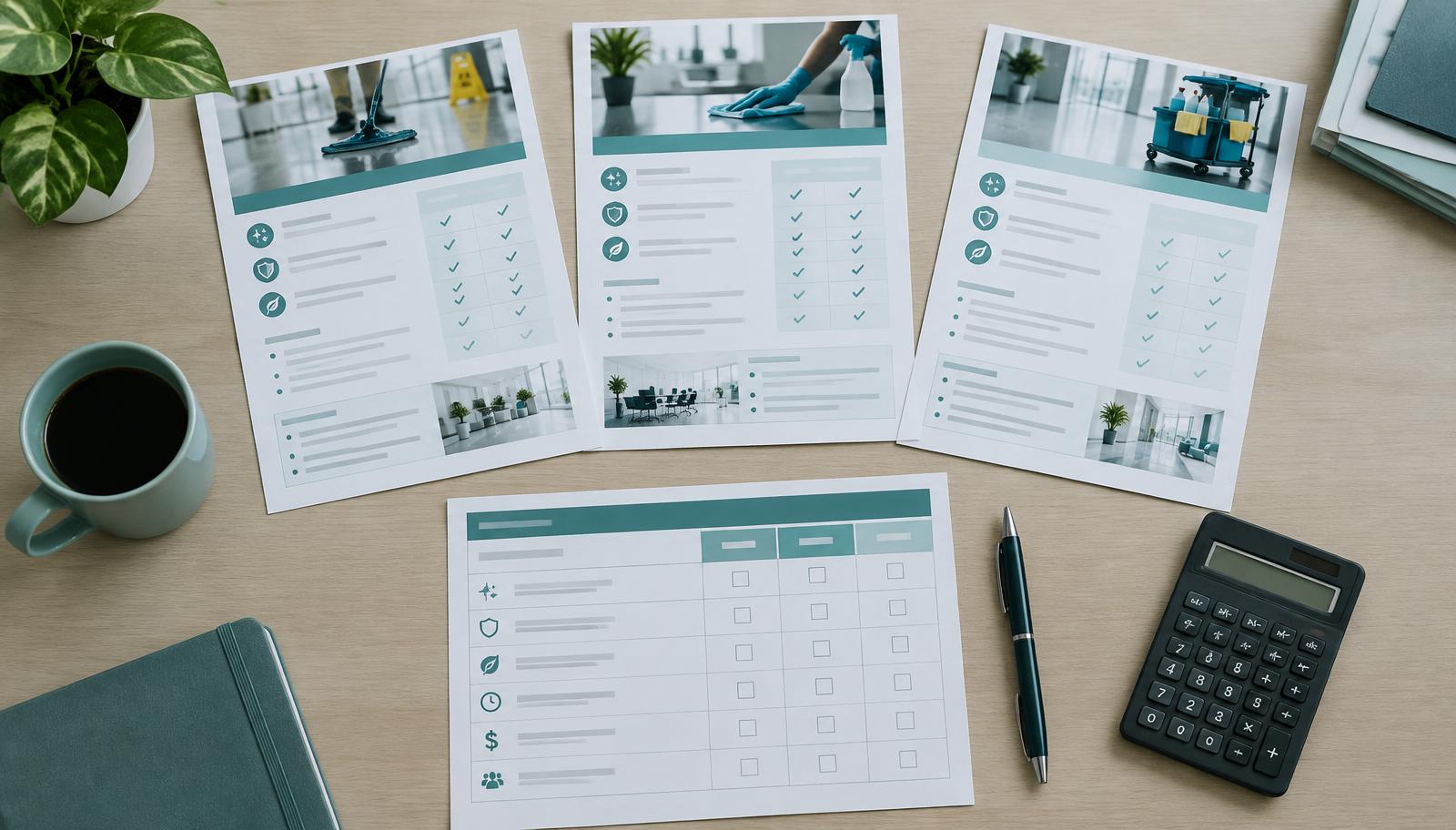
Summary
When you have several proposals on the table, the risk is not a lack of information but comparing it poorly: comparing apples to oranges, letting the lowest total win by default, or choosing based on likability. A structured method separates three questions: Does it meet the minimum requirements? (a yes-or-no compliance screen), How does it compare on quality and scope? (scoring with weights set before opening prices), and What does an equivalent scope cost? (normalized price). This guide explains each step, why the order matters, and includes an editable matrix for your next decision.
The Short Answer
Define the criteria and their weights before reviewing prices. First eliminate any proposal that does not meet the minimum compliance requirements. Then score the remaining proposals on quality and scope, and only then introduce price, converted to a common basis. Document the scores and rationale: if someone asks why a proposal won, the answer should be in writing.
Before Scoring: Make Sure Proposals Are Comparable
A matrix only helps if the proposals are comparable. Check three things before you begin.
The same requirements document. Every proposal should address the same areas, square footage, schedules, frequencies, responsibility for supplies, and extra services. If each provider interpreted a different scope, first request written clarification; the guide to preparing a request for quotation explains how to avoid this.
The same price breakdown. Do not compare totals until every proposal uses the same line items (labor and associated costs, supervision, supplies, equipment, protection, administration, and taxes). The guide on what makes up the price includes the table.
Who evaluates. Ideally, involve Procurement, Operations or Facilities (the people who experience the service), and Legal or whoever reviews documents for the compliance screen. Evaluating as a group reduces the influence of any one person's opinion.
Step 1: Compliance Screen (Yes or No)
Some requirements are not scored; they are either met or not. If a proposal fails them, it should not enter the comparison. Giving it “a few points” for compliance and letting it compete on price is the costliest mistake in this process.
Examples of screening requirements to adapt with your legal team:
- Current registration in the specialized services registry. The STPS public registry lets you search for a provider by name, RFC, or folio and shows registration validity and authorized services; if there is no active registration, the system returns no results. Full verification is covered in the guide to checking REPSE registration.
- Up-to-date compliance documentation, with issue dates, according to the review schedule in the provider documentation file.
- Acceptance of the contract’s minimum terms (for example, periodic document submission and verifiable service levels), as covered in the guide to contract clauses.
- Insurance coverage or other requirements in your risk policy.
The reason for insisting on this screen is contractual: under Article 14 of the Federal Labor Law, parties engaging specialized services are jointly and severally liable if the contractor fails to meet its labor obligations to the workers involved. Your legal team determines how this applies to your company.
Step 2: Score Quality and Scope
For proposals that passed the screen, score non-price criteria. Here is a starting list to adapt to your facility:
| Criterion | What to assess | Evidence to request |
|---|---|---|
| Scope and understanding of the service | Did they understand areas, frequencies, and schedules? Do they propose an area-by-area program? | Written work plan |
| Operating plan and supervision | Staffing, shifts, dedicated or shared supervisor, absence coverage | Site organization chart and coverage plan |
| Reporting and quality control | What is reported, how often, and how it is measured | Reporting and inspection forms (see the supervision guide) |
| Training, safety, and supplies | Orientation, chemical handling, PPE, safety data sheets | Training descriptions; safety data sheets |
| Transition and launch | Plan for the first few weeks | Timeline (see the transition guide) |
| Verifiable references | Clients at comparable facilities who agree to be contacted | Reference contacts you can call |
Two rules for using the matrix. Score the evidence, not the presentation: a polished proposal without support should not outscore a plain, verifiable one. Also set a minimum technical threshold: the United Nations Procurement Division’s reference material (2009) describes opening financial proposals only for those who pass a technical minimum in complex procurements (it mentions a typical threshold of around 60% of technical points). This is a practice used by international organizations, not a requirement for a private company; the figure is a starting point, not a rule.
Step 3: Normalize Price and Decide
Once all proposals have the same breakdown, convert prices to a common basis (monthly, with or without VAT, with or without supplies). Then score price using a simple, known formula: the lowest offer gets the maximum price points, and the others receive points in inverse proportion to their price, as described in the same UN document.
*Illustrative numerical example (not representative of market prices):* if the lowest proposal costs 100 units and another costs 125, the second receives 100/125 = 80% of the price points.
Then add quality and scope points + price points, each with its assigned weight. This total ranks the proposals; the final decision also includes what the matrix cannot capture, such as risks identified during an interview or site visit, and should be documented.
A warning from the UN material itself: weighting takes time, can count the same factor twice, and depends on subjective decisions about scores and weights. The matrix structures the discussion; it does not replace it.
How to Set Weights Without Bias
- Before opening prices. If you already know the totals, you may unconsciously adjust weights to favor your preferred provider.
- Weights that reflect complexity. The same material says that the more complex the requirement, the less price should weigh, and notes that price for services often accounts for 15% to 50%. This is a reference range from 2009 international procurement; set it with your team based on how much of the risk lies in service quality.
- A small number of criteria. Use 5 to 8; more criteria dilute the score and make double-counting easier.
- A scoring scale with descriptors. For example, 0 = no response; 1 = response without evidence; 2 = response with partial evidence; 3 = response with verifiable evidence.
- Independent scores. Each evaluator scores separately, then differences are reconciled.
Alternative Methods
| Method | When it makes sense | Advantage | Limitation |
|---|---|---|---|
| Lowest compliant price | Scope is very clear and easy to verify | Simple | Ignores quality; only works when the scope is well defined |
| Weighted matrix (this guide) | Services with variable quality and ongoing operations | Structures discussion; creates a record | Requires time and discipline to set weights |
| Matrix with interview or site visit | Large or critical operations | Verifies what was promised | More costly for everyone |
| Pilot contract | When choosing between two capable providers | Real-world evidence | Requires a clear, short contract reviewed by Legal |
Common Mistakes
- Comparing totals without normalizing scope.
- Setting weights after seeing prices.
- Scoring compliance instead of screening for it. A provider without current registration should not compete on price.
- Awarding points for presentation. Rewarding document design rather than evidence.
- Failing to document. Without a score record, the decision cannot be explained or repeated.
- Ignoring total cost. A low price can become expensive due to extra charges, turnover, or service gaps; price is not the same as total cost, as the UN material notes.
- Deciding without speaking to references.
Cautions
Evaluation Matrix
Part A · Compliance screen (yes / no)
| Requirement | Provider A | Provider B | Provider C |
|---|---|---|---|
| Current registry entry and authorized service | ☐ | ☐ | ☐ |
| Up-to-date compliance documentation (with dates) | ☐ | ☐ | ☐ |
| Accepts document submission schedule in the contract | ☐ | ☐ | ☐ |
| Insurance / requirements in your risk policy | ☐ | ☐ | ☐ |
| Passes the screen? |
Part B · Quality and scope (weights set by your team before opening prices; total weights = 100)
| Criterion | Weight | Provider A (0–3) | Provider B (0–3) | Provider C (0–3) | Evidence / comment |
|---|---|---|---|---|---|
| Scope and understanding of the service | |||||
| Operating plan and supervision | |||||
| Reporting and quality control | |||||
| Training, safety, and supplies | |||||
| Transition and launch | |||||
| Verifiable references | |||||
| Quality score (score ÷ 3 × weight, summed) |
Part C · Normalized price
| Item | Provider A | Provider B | Provider C |
|---|---|---|---|
| Comparable monthly price (same basis: VAT, supplies, scope) | |||
| Price points (lowest price ÷ provider price × price weight) | |||
| Total score (quality + price) | |||
| Risks or notes outside the matrix |
*How to use: complete it as a team, set weights before opening prices, keep the evidence, and file the matrix with the decision.*
Conclusion
Comparing proposals means structuring a decision, not automating it. The compliance screen protects your company, scoring makes quality visible, and normalized pricing prevents misleading comparisons. With weights set in advance and a record of why each proposal won, the decision can withstand internal review and makes renewal or a future provider change easier.
Next Step
Use your current proposals or the next round of quotes, set weights with your team before opening prices, and complete the matrix. For compliance topics, visit the compliance section; if you need to request a quote, you can do so on the quote page.
Sources
Bring this matrix to your next purchasing decision.
To get a quote from SELIMEX, use the quote page; for more information, see the compliance section.