
Summary
"Monday through Friday cleaning" sounds like a complete instruction, but it leaves the most critical factors undefined: during which window each task takes place, who performs it, and how often it recurs by area. This guide does not re-examine day versus night cleaning (that is covered in our guide on daytime vs. night cleaning); it assumes you already have a general schedule in mind and helps you build the operational framework: four shift models, two ways to organize vendor staffing, a baseline frequency table by area, and a format to write your scope of work so it describes outcomes and windows rather than direct employee instructions.
The short answer
Define the service across three layers: window (when the vendor can access each zone), outcome (how the area must look and be stocked upon opening or during the day), and frequency (how often each task repeats). Then let the vendor determine staffing levels, job roles, and task sequencing. For a typical Monday-to-Friday office, the standard approach combines a short, repeatable routine (restrooms, break rooms, high-touch points, restocking supplies) with weekly and monthly tasks scheduled during low-occupancy windows. The frequencies outlined below serve as an editorial baseline: adjust them according to foot-traffic density, flooring types, and area sensitivity.
Four shift models for a standard workweek
Shift models are distinguished by the window in which the primary workload falls. None is universally better; each solves a different operational challenge.
| Model | Typical window (example, subject to operational validation) | What it solves | What must be defined |
|---|---|---|---|
| A. Morning opening | Before employees arrive until the start of the workday | Office is ready at opening; direct contact with the facility manager | Hard completion deadline per zone; protocol if staff arrive early |
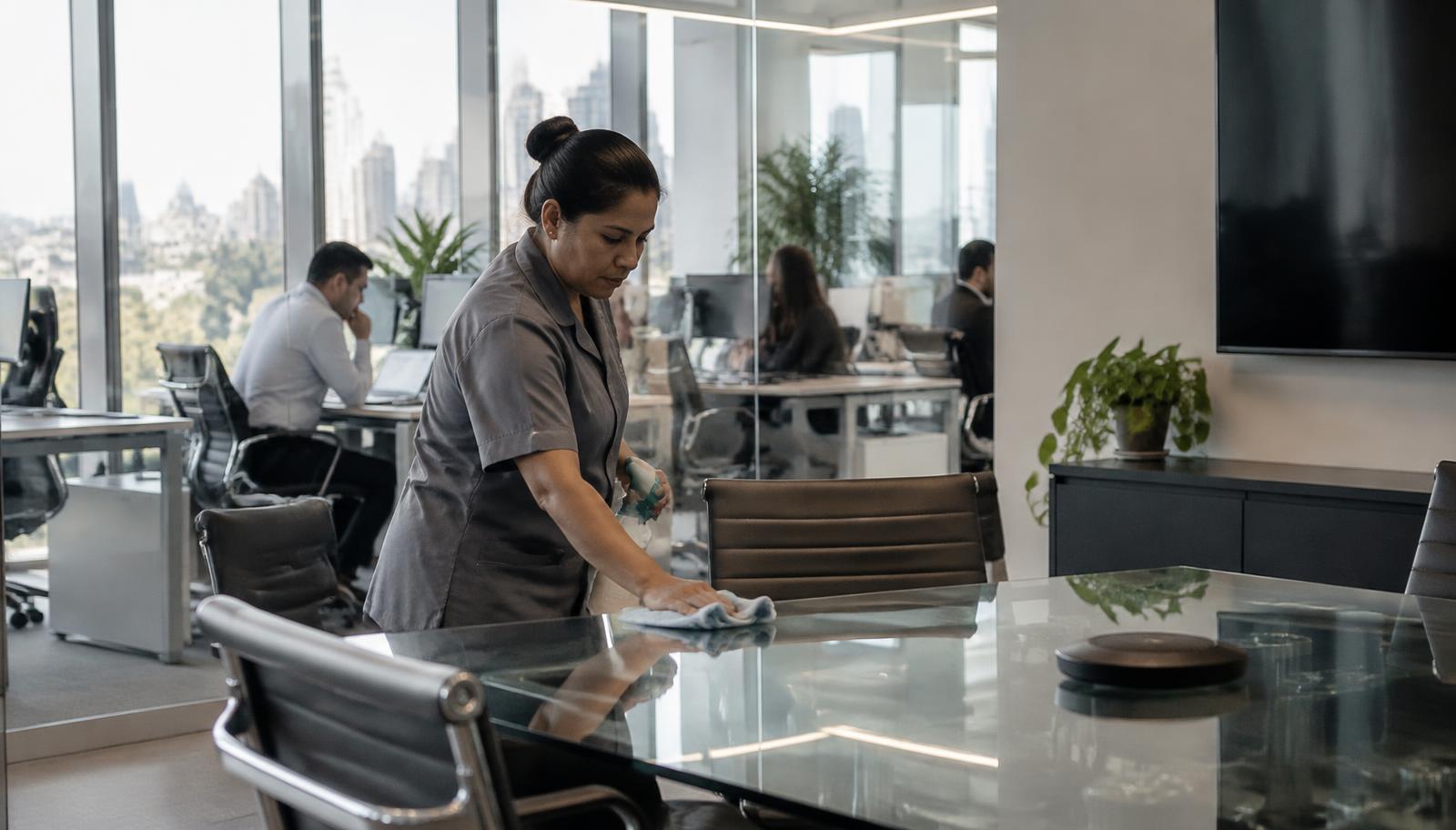
| B. Daytime with rounds | Regular business hours, via continuous presence or scheduled rounds | Restrooms and break rooms serviced during peak use; rapid spill response | Round zones and schedules; noise rules and privacy protocols in occupied areas |
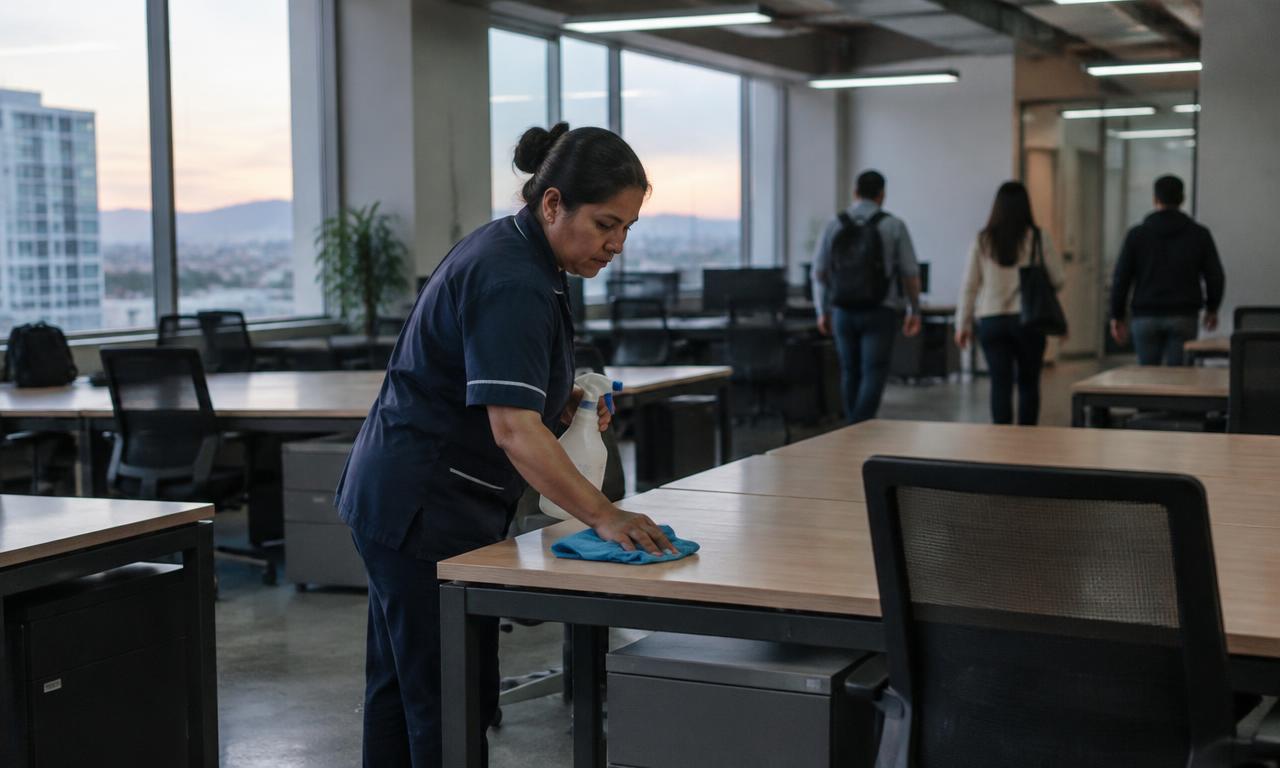
| C. Evening | Late afternoon through early post-close hours | Capitalizes on low occupancy without running into late-night hours; allows next-day delivery | Staff departure times; building access and lock-up procedures |
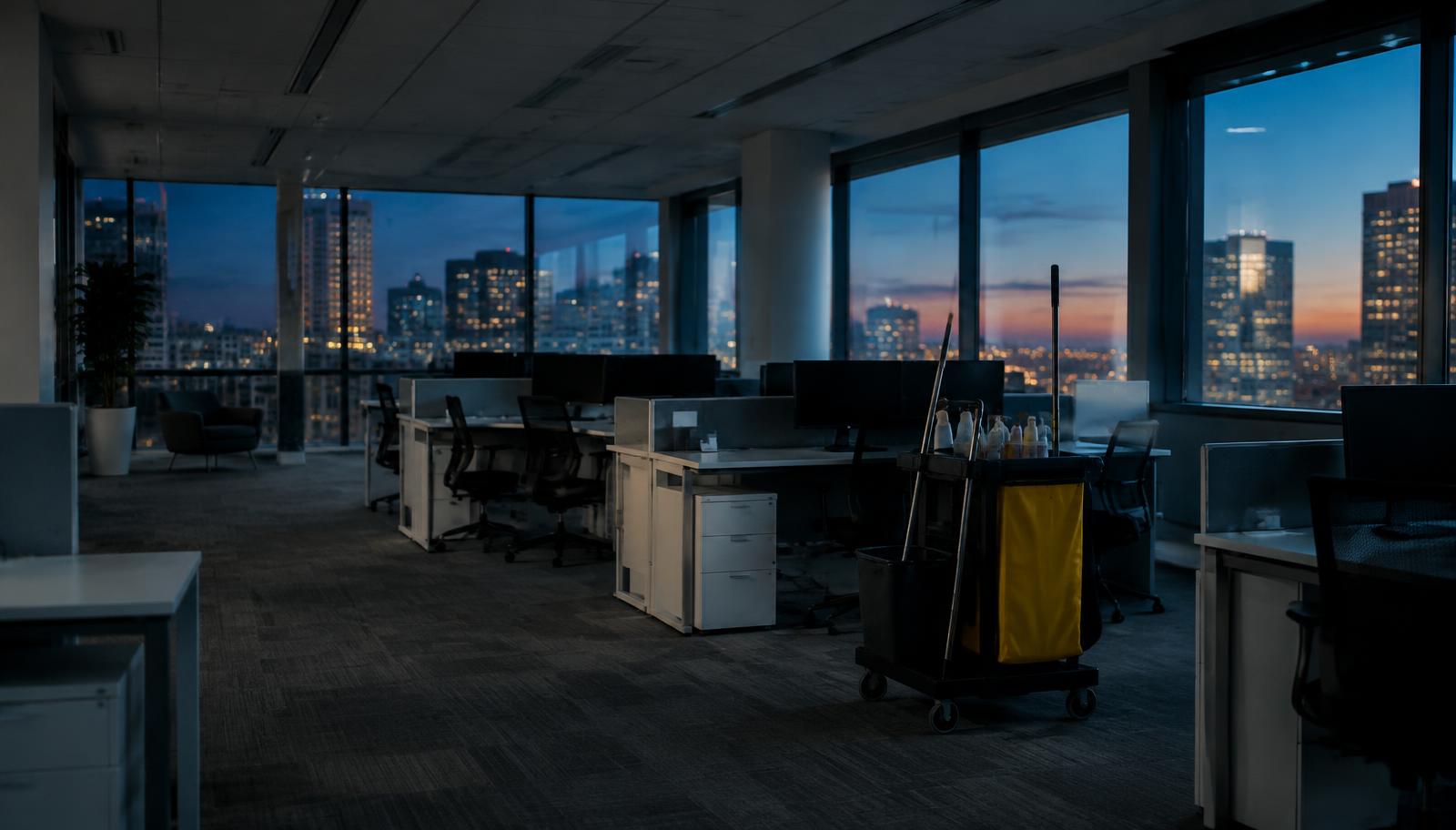
| D. Night | Fully outside standard office hours | Wet, noisy, or extensive floor-care tasks requiring clear areas | Access control, keys/badges, emergency communication protocols |
Mexico's Federal Labor Law (LFT—*Ley Federal del Trabajo*) defines the day shift between 6:00 and 20:00 hours, the night shift between 20:00 and 6:00, and a mixed shift as one combining both periods; if the night portion reaches three and a half hours or more, it is legally classified as a night shift (Art. 60). Maximum daily limits are eight hours for day shifts, seven for night shifts, and seven and a half for mixed shifts (Art. 61), with an ordinary statutory workweek capped at forty hours (Art. 59, per the consulted statutory text). This means an evening schedule extending past 20:00 may alter the legal classification of the contractor's staff shifts. You do not need to calculate this yourself: ask the vendor how they structure their shifts to cover your window, and verify the current legal timeline for workweek reductions with your corporate legal department.
Common combinations. Many office facilities implement a hybrid of these four: for example, a short daytime round (B) for restrooms and break rooms, paired with a primary evening or night workload (C or D) for floors, workstations, and interior glass. To make an informed choice, categorize each task as either compatible with occupants or requiring an empty area, as detailed in our guide on day versus night scheduling.
Dedicated staff or mobile crew: what changes
Vendors typically organize their labor in one of two ways. Both are vendor-level operational decisions; the contracting facility defines the required service and verifies the end result.
Dedicated on-site staff. One or more contractor employees are permanently assigned to your facility. Advantages: they get to know the building, occupants, and routines; communication with the facility manager is faster; and the learning curve is minimal. Risks: high vulnerability to absenteeism and vacations; the contractor must maintain a verified replacement plan (see our guide on staffing, training, and coverage).
Mobile crew. A vendor team arrives within a designated window, divides tasks among its members, and departs upon completion. Advantages: completes heavy workloads quickly (floor care, weekly/monthly projects) and easily absorbs individual absences. Risks: less site familiarity, rotating personnel that may raise security concerns for occupants, and heavier reliance on a strict written work plan. A 2014 CleanLink article on a hospital setting highlighted "team cleaning"—three staff members with specialized roles versus the traditional zone-based model—showing operational efficiency gains while noting that occupants must be informed of the shift. While that case comes from another sector, country, and year, use it as a conceptual illustration of the model, not as a direct cost-savings benchmark.
The hybrid model is the corporate standard: dedicated on-site personnel for daily operational routines, supplemented by a scheduled mobile crew for periodic deep-cleaning tasks. How the vendor configures this staffing mix remains entirely their responsibility.
Key legal consideration. Article 12 of Mexico's Federal Labor Law (LFT) strictly prohibits labor subcontracting, and Article 13 allows only the contracting of specialized services; Article 14 mandates a written contract and establishes joint liability for the client if the contractor defaults on its labor or tax obligations. Consequently, your contract and scope of work must refer strictly to services, deliverables, and operational windows—never to "assigned personnel," specific headcount, or client-directed shifts. Who performs the work, on what individual schedule, and under what internal role is decided solely by the vendor. Always confirm this structure with your legal counsel.
Frequencies by area: daily, weekly, and monthly
There is no universal frequency table for commercial offices. Recognized industry standards define service levels, not rigid schedules: APPA, for instance, establishes five custodial cleaning tiers ranging from "orderly spotlessness" to "unkept neglect," tying them to restroom inspections and response times (as described by Michigan Tech Facilities, which adopts those standards) rather than an arbitrary count of passes per week. Similarly, Green Seal (GS-42, Edition 2.3) requires contractors to maintain a written cleaning plan for each facility—reviewed annually, with schedules updated at least semi-annually—that remains accessible to staff and clients alike.
Using these operational standards as a baseline, the following is an editorial starting framework (not a formal regulation or a specific SELIMEX commercial proposal). Tailor it to your facility's occupancy, flooring materials, clean-desk policies, and secure zones:
| Area / Task | Daily | Weekly | Monthly or Periodic |
|---|---|---|---|
| Restrooms | Clean toilets, urinals, sinks, and floors; restock paper, soap, and towels; empty trash receptacles | Detail inspection and cleaning (mirrors, partitions, grout lines) | Scheduled deep scrub and descaling |
| High-touch points (door handles, switches, elevator buttons, handrails) | Clean surfaces | Audit to ensure comprehensive coverage | Adjust targeted list based on reported incidents |
| Break rooms, kitchenettes, coffee stations | Clean surfaces, empty trash, restock paper goods | Interior wipe-down of refrigerators and microwaves (if specified in scope) | Appliance deep clean and degreasing |
| Open-plan work areas | Empty wastebaskets; wipe clear desk surfaces; sweep or vacuum high-traffic corridors | Full vacuuming or damp mopping; low-surface dusting | High dusting (vents, overhead fixtures, ledges) |
| Conference rooms | Reset and wipe surfaces after use or at day's close | Inspect furniture, sanitize conference tables and screens | Upholstery spot treatment and deep cleaning |
| Lobby and reception | Maintain floors, clean glass entrance doors, wipe reception counter | Polish architectural metals and architectural details | Specialized floor maintenance per manufacturer specs |
| Stairwells and corridors | Sweep and damp mop | Dust handrails, door frames, and baseboards | Interior perimeter glass, baseboard scrub |
| Carpeted areas | Daily routine vacuuming | Deep vacuuming across high-traffic lanes | Hot-water extraction or low-moisture care per method and frequency |
| Interior glass and partitions | Spot clean fingerprints and smudges on touchpoints | Frame inspection and edge cleaning | Full-panel double-sided wash |
| Sensitive zones (executive offices, archives, server rooms) | Access restricted; perform only per protocol | Per protocol | Per protocol; see sensitive areas |
For restrooms and high-touch surfaces, the clearest technical benchmark is the U.S. CDC guidance for community buildings (last updated April 5, 2021): under normal conditions, cleaning once per day is typically sufficient, and high-touch surfaces should be cleaned at least daily; high-risk shared spaces may warrant increased frequency. This guidance explicitly excludes healthcare, food processing, and industrial facilities, and reflects U.S. parameters from 2021: use it as an operational benchmark, not as a statutory mandate in Mexico.
Monthly and periodic frequencies (window washing, carpet extraction, floor stripping and waxing) are the most easily overlooked because their absence is not immediately visible on any given day. Require your scope of work to include an annual master calendar specifying the planned week or window for each periodic task, verified by completion sign-offs.
Cleaning is not disinfecting: where frequency increases
The CDC clearly distinguishes between cleaning (removing dirt and impurities using water and detergent) and disinfecting (using chemicals to kill remaining pathogens), recommending disinfection specifically under elevated risk conditions, not as an unvarying daily routine. For your scope of work, translate this by requiring daily cleaning for restrooms and high-touch points, while explicitly defining the triggers for disinfection (such as a documented viral outbreak on-site or seasonal respiratory spikes). The criteria, chemicals, and handling protocols must be defined alongside your safety specialist and the safety data sheets (SDS) of each product; this distinction is analyzed in our guide on cleaning vs. disinfection for restrooms and high-touch surfaces.
How to write it into the scope of work
An enforceable, verifiable scope of work contains four core components per area: access window, task and frequency, quality outcome standard, and verification evidence. Frame specifications around deliverables, never as direct instructions to contractor personnel.
- Instead of "the assigned custodian will clean the restroom at 10:00 and 14:00," specify: "3rd-floor restrooms: deliver clean and fully stocked by 9:00; perform restocking inspection round between 13:00 and 14:00; acceptance criteria: no visible soil/trash, soap and paper dispensers fully stocked."
- Instead of "the client's supervisor will assign tasks each morning," specify: "Ad-hoc operational requests shall be directed to the vendor's account manager via [communication channel], with a response time of [X] hours."
- Establish access windows by zone (e.g., conference rooms available for servicing after 18:00) and define protocols for occupied rooms: reschedule within the workweek, log the exception, and notify the facility manager.
- Set observable quality standards (surfaces free of visible dust, floors free of spills/scuffs, consumables restocked) and determine audit methods: joint walkthrough forms, random sampling, or digital logs; review our guide on service supervision and performance metrics.
- Clarify what constitutes a consumable and who supplies it (toilet paper, hand soap, can liners), an issue explored in depth in our guide on supplies and consumables.
- Include an explicit clause for the periodic review of the cleaning plan and frequencies—mirroring Green Seal GS-42 recommendations—and integrate these points into your master agreement using standard essential contract clauses.
The client defines requirements, operational windows, and standards; the contractor determines staffing counts, personnel allocation, and coverage strategies. When urgent tasks arise, the client coordinates through the vendor's management channel, never by issuing direct orders to contract cleaners.
What to do with Fridays and Mondays
These two days create the greatest operational disruption in a Monday-to-Friday schedule. Friday concentrates peak trash removal and weekend shutdown preparation; Monday requires building recovery following two unserviced days. Three key operational decisions: (1) establish whether Friday requires an intensive final pass across break rooms and waste disposal before lock-up; (2) specify Monday morning pre-opening priorities (ensuring restrooms are stocked and break rooms are cleared of any weekend residue); and (3) formalize coverage for statutory holidays and long holiday weekends, detailing whether shifts are rescheduled or deducted. If weekend or Sunday work is required to handle these prep cycles, keep in mind that Mexican labor law stipulates a minimum 25% premium for Sunday work (LFT Art. 71, per the consulted statutory text), which must be transparently budgeted in the commercial proposal. Learn more about analyzing fee structures in our guide on commercial cleaning pricing.
Common mistakes
- Specifying "Monday to Friday cleaning" without access windows or outcome metrics. Leads to immediate disputes on the first service complaint.
- Copying a frequency matrix from another facility. Foot-traffic patterns, flooring finishes, and clean-desk rules differ entirely across buildings.
- Omitting weekly and monthly project work. If it is not formally scheduled on a calendar, it will not be executed.
- Describing individual personnel instead of the specialized service (e.g., "the assigned day-porter," "John's shift"). This conflates operational roles and creates labor liability under LFT Article 12.
- Failing to mandate a substitute coverage plan. A single-cleaner scope collapses as soon as that individual calls in sick.
- Failing to distinguish between cleaning and disinfecting. Leads to paying for unnecessary chemical applications or omitting needed sanitation.
- Leaving statutory holidays and long holiday weekends undefined.
- Never auditing the cleaning plan. Facility needs shift continuously alongside office occupancy trends and business cycles.
Advertencias
This is not legal or technical consulting. Frequencies provided represent an editorial starting framework. The organization of shifts, work hours, and statutory rest days for vendor personnel is governed by Mexico's Federal Labor Law (LFT) and the negotiated contract; always validate your scope with your legal department before signing.
>
No chemical handling procedures. This guide does not prescribe specific chemicals, dilution rates, or chemical mixtures; those parameters are strictly governed by each manufacturer's Safety Data Sheet (SDS) and qualified environmental health and safety specialists.
>
External technical references. Quoted technical standards originate from foreign organizations and specific dates; treat them as conceptual operational criteria, not as statutory Mexican requirements.
Practical resource: scope-of-work template by area
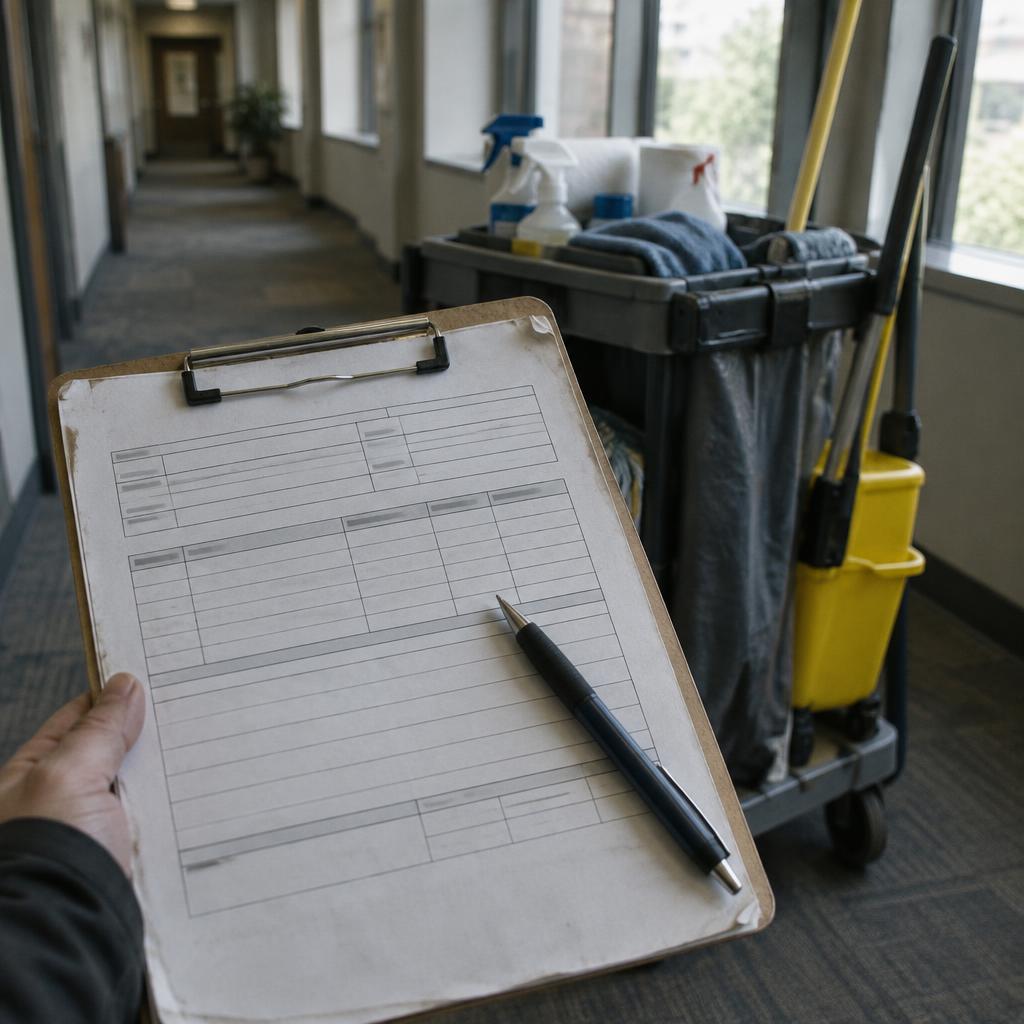
Use one row per functional area. Complete this form before requesting proposals and attach it to your Request for Quotation (RFQ) or master services agreement.
| Zone / Area | Access Window | Daily Tasks | Weekly Tasks | Monthly / Periodic Tasks (and Target Week) | Outcome Standard | Verification Method | Consumables: Responsible Party | Protocol If Occupied |
|---|---|---|---|---|---|---|---|---|
| Restrooms (Floor __) | ||||||||
| Break Room / Kitchenette | ||||||||
| Open Workstations | ||||||||
| Conference Rooms | ||||||||
| Lobby & Reception | ||||||||
| Stairwells & Hallways | ||||||||
| Sensitive Areas |
Before issuing, verify that:
- Every zone has an assigned access window and an observable quality standard.
- A formal annual calendar exists for all periodic project work.
- The scope clearly distinguishes cleaning from disinfection, establishing triggers for each.
- No instructions target individual vendor workers; a single management communication channel is defined.
- Protocols for coverage, paid holidays, and holiday weekends are established.
- A scheduled review date is set to re-evaluate the service plan and task frequencies.
*Application: bring this completed matrix to your scope-clarification walk with each bidder to compare proposals on an objective, equal basis.*
Next steps
Complete the template by zone with your facility management team, delineating routine daily maintenance from periodic project work. Then review our guide to procuring commercial cleaning services, explore our sector-specific approach for corporate offices, or consult our compliance resources. Once your scope of work is defined, request a customized proposal on our quote page.
A well-crafted Monday-to-Friday office cleaning scope does not mandate headcount or hours: it defines where, when, what outcome is required, and how that outcome is verified. By establishing access windows per zone, frequencies matched to actual space utilization, and a calendar for periodic tasks, the contractor retains the operational flexibility to manage shifts and labor efficiently, while you maintain the structure needed to verify results without directing personnel.
Sources
- Ley Federal del Trabajo (Cámara de Diputados)
- CDC, Cleaning and Disinfecting Guidance (OSHA archived copy, updated Apr 5, 2021)
- Michigan Tech Facilities, APPA Custodial Operational Service Levels
- Green Seal, GS-42 Standard for Commercial Cleaning Services
- CleanLink, "A Team Cleaning Approach To Efficiency" (Feb 14, 2014)
Use this checklist in your next quote or renewal.
To get a quote from SELIMEX, use the quote page; for more information, see the compliance section.