

Introduction
*Areas, duration, success criteria agreed in writing, and evidence: how to evaluate a provider without turning the pilot into an informal arrangement.*
Summary
A pilot lets you see how a cleaning provider works before signing a long-term contract. It works when it has clear boundaries: defined areas, a limited duration, written success criteria signed before the first shift, evidence collected consistently every day, and a designated evaluator. It fails when it becomes a period without a contract, when the provider’s staff receive direct instructions from the client, or when it is extended indefinitely instead of reaching a decision. The provider must submit the same compliance documentation it would submit for a contract. This guide explains how to design the pilot, what it should not be, what buyers typically require for safety, and how to transition to a contract, and includes a success criteria template.
The short answer
Design the pilot as a small-scale, real service, with a one- or two-page document that establishes four things before you start: which areas and tasks are included, how long it will last, how success will be measured, and what happens when it ends. Ask the provider for the same compliance documentation you would request for the final contract. Evaluate using evidence (documented walkthroughs, records, incidents) and communicate findings to the provider’s supervisor, not its staff. At the end, decide based on the agreed criteria: contract, adjustment, or exit. If there will be payments or invoicing during the pilot, request a legal and tax review before starting.
What a pilot is for (and what it is not)
A pilot reduces a specific uncertainty: whether the provider can deliver at your facility what it promised in its proposal. A comparison matrix lets you compare documents; the pilot lets you observe execution, communication, punctuality, supply replenishment, and incident handling in your actual operation.
It does not replace document verification. Good service during the pilot does not fix an incomplete documentation file or replace the contract, which defines scope, responsibilities, and penalties. Consider a pilot when the service is large or sensitive, when changing providers, or when the proposal depends on assumptions (productivity, staffing, schedules) that can only be confirmed on site.
How to design it
Areas. Choose a representative set, not the easiest or the most difficult. A good mix includes a high-traffic area, a sensitive-use area (restrooms, dining areas, restricted-access areas, depending on your operation), and an area with a special surface, if you have one. Define their boundaries, with tasks and frequencies for each area drawn from the scope you have already shared.
Duration. There is no legally or regulatorily prescribed duration for a pilot; it is your decision. As an editorial recommendation, it should cover at least one full cycle of the least frequent tasks (for example, if there are weekly or monthly tasks, the pilot should include them once) and be short enough to remain clearly defined. Put the start and end dates in writing, and set a date for the decision meeting.
Baseline. As an editorial recommendation, record the condition of the areas during the preceding week (or with the current provider), using the same form you will use during the pilot. Without a baseline, “better than before” is an opinion.
Financial terms. Decide before starting whether the pilot will be paid for, provided at no charge, or credited against the future contract, and what will be invoiced; this has labor and tax implications (see “Warnings”).
Written success criteria
The criteria are what distinguish a pilot from a subjective trial. They must be agreed and signed before the first shift, and must be observable:
- Schedule compliance: scheduled tasks completed in the agreed area and time slot, as recorded on the walkthrough form.
- Verifiable quality: results in each area assessed against a defined standard (for example, an acceptance checklist for each area), rather than “it looks clean.”
- Punctuality and coverage: shift start times, presence of the agreed staffing complement, and management of absences and replacements.
- Supplies and equipment: uninterrupted availability and replenishment, as proposed.
- Safety: evidence of PPE, training, and safety data sheets submitted before starting, and no unreported incidents.
- Communication: response time to observations and quality of periodic reporting.
- Documentation: complete and timely submission of the documents requested for the file.
For each criterion, define the minimum required to continue and, where appropriate, an early-exit threshold. These thresholds are your organization’s criteria; there are no official figures for “good performance” in cleaning. For monitoring indicators, review the guide to service supervision.
Evidence and who evaluates it
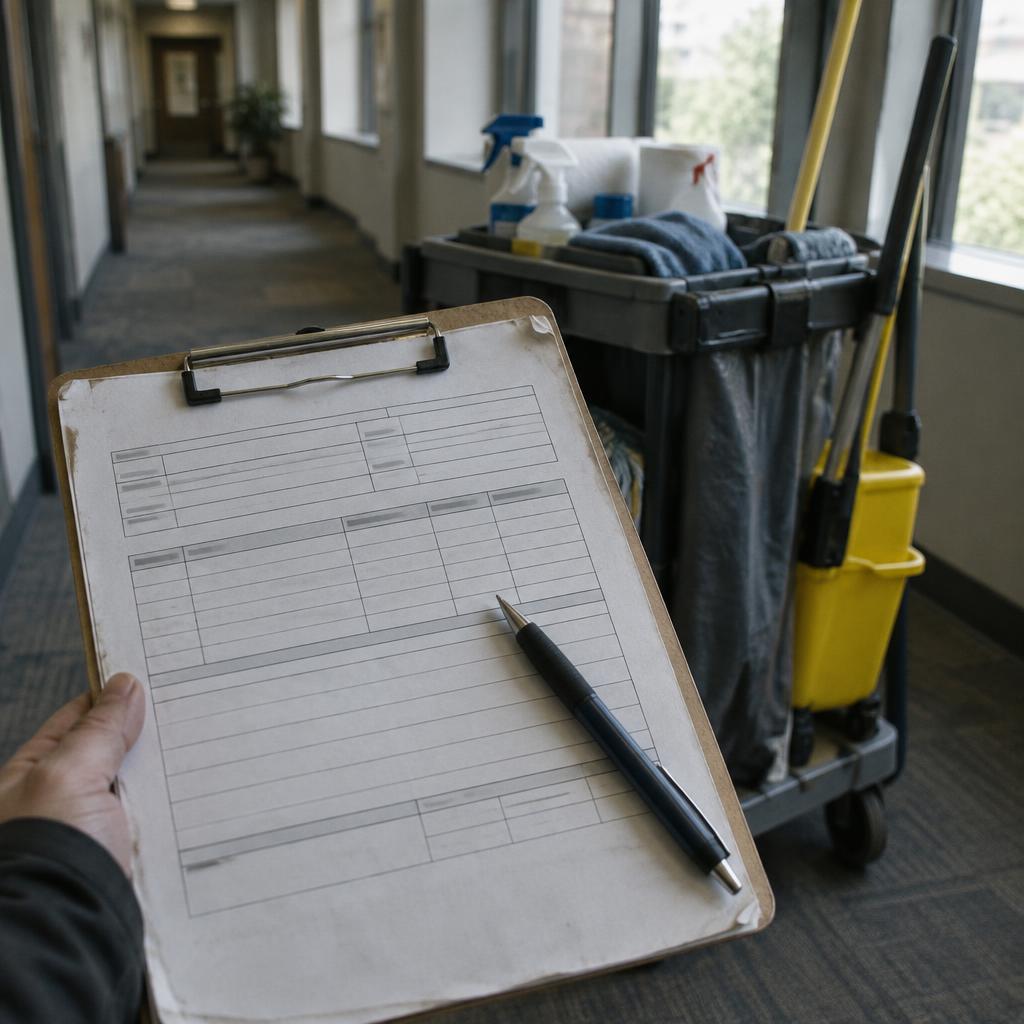
Evidence must be collected in the same way every day of the pilot: a walkthrough form with date, time, and area; before-and-after reference photographs for each area, with applicable privacy precautions; incident and consumption records; an attendance list or staffing report provided by the provider; and copies of relevant communications.
Designate a lead evaluator and a backup, preferably from Operations or Facilities, and a second person (Procurement, Health and Safety, or Legal) to review the closeout. Two rules help: the evaluator should not be the person managing the commercial relationship with the provider, and observations should be recorded the same day. A brief weekly meeting with the provider’s supervisor prevents surprises at the final meeting.
What a pilot should not be
A period without a contract. Calling it a “trial” does not mean there is no legal relationship. People are working at your facility, and incidents may occur. A signed document is advisable, even if brief: scope, dates, responsibilities, safety, and exit terms. If it is a short-term contract, the same considerations apply as for a long-term one; review the minimum clauses.
Staff placed at the client’s disposal. If, during the pilot, your team gives direct orders to the provider’s staff, reassigns their daily tasks, or sets their schedules, the arrangement resembles making workers available to another party, which the Ley Federal del Trabajo (Art. 12) prohibits. The pilot is not an exception to that rule. Review with your legal team how to communicate observations: the usual approach is through the provider’s supervisor.
A permanent substitute for a contract. A pilot renewed without a decision ends up becoming a service without contractual clauses. Set an end date and define in writing what happens if no decision is reached: the service is suspended, extended once with a documented reason, or moved to a contract.
An unequal comparison. If you evaluate more than one provider, use the same scope and evidence, and define who bears which costs.
Safety and compliance: what is requested
A pilot involves people at your facility, so Procurement and Health and Safety typically ask the provider for the same documentation as for a contract. This is a control practice, not an exhaustive list prescribed by regulation, and should be adapted to your sector:
- Provider file: tax and legal details, and the documents you already request in the documentation file.
- REPSE: the provider must be listed in the specialized services registry (repse.stps.gob.mx) for the service it will provide; see the guide to REPSE verification.
- IMSS and social security obligations: the personnel who will attend must be registered, with evidence in the form specified by your procurement or legal team; see more in the same guide.
- PPE, training, and safety data sheets: applicable risk assessment, equipment issuance, initial training, and safety data sheets for authorized products, as detailed in the guide to staff health and safety.
- Access and site rules: who enters, at what times, through which entrance, and with what identification, and whom to notify of an unsafe condition.
- Insurance or guarantees: if your policy requires them for any contractor, apply the same requirements to the pilot.
A provider that fails to submit its documentation on time during the pilot gives you relevant information for your decision.
The legal balance: agree and verify, do not direct
The practical approach, which your legal team must validate, has three parts. First, agree in writing on the criteria, evidence, and communication channels. Second, verify results through walkthroughs, record reviews, and meetings with the provider’s supervisor. Third, when something does not comply, communicate it to the supervisor and keep a record; the provider is responsible for organizing its staff and correcting the issue.
This is consistent with the framework for specialized services under the LFT (Arts. 12–15): the provider delivers a service, directs its people, and is responsible for them. The written contract specifying its purpose and the approximate number of workers (Art. 14), and the provider’s registration in the STPS registry (Art. 15), are part of that framework and must also be in place for a pilot. If there are payments or invoicing during the pilot, consult your legal and tax teams about the applicable treatment and supporting documentation; this guide does not resolve that issue.
From pilot to contract
At the end, hold a decision meeting using the signed criteria, consolidated evidence, and a score for each criterion. There are three possible outcomes: proceed to a contract, proceed to a contract with adjustments (specific conditions and a review date), or do not continue.
To proceed to a contract, incorporate what you learned: the pilot criteria become service levels, and the findings become clauses (reporting, replenishment, replacement staffing, safety, exit terms). If several providers participated, use your evaluation matrix with pilot evidence as one column, not the only one. If the new provider is replacing an existing one, the formal launch can follow the four-week transition guide. Once the service is underway, schedule the periodic audit using the same forms.
If you do not continue, document the closeout: return of access credentials, removal of equipment and products, and written confirmation that nothing remains outstanding.
Common mistakes
- Starting without written criteria. The evaluation becomes a debate about perceptions.
- Choosing only the easiest area (or the most difficult) and generalizing.
- Having no baseline. Without one, there is no way to compare.
- Directing the provider’s staff to make sure the pilot “goes well.”
- Skipping compliance documentation because it is a trial.
- Evaluating without daily evidence. Memories of the last week carry more weight than they should.
- Extending the pilot without a decision. Every undocumented extension weakens your position.
- Failing to define the financial treatment (payment, credit, invoice) before starting.
Warnings
This is not legal, labor, or tax advice. The relationship between the contracting party and the provider, the treatment of payments or invoicing during a pilot, and the supporting documents must be reviewed with your legal and tax teams before starting.
Time frames and thresholds. The pilot duration and the thresholds in the template are editorial recommendations: adapt them to your service and internal policy.
Personal data. If you receive staff lists, photographs, or records containing names, define with your legal team what you will retain, for what purpose, and for how long.
Pilot success criteria template
Complete it and have both parties sign it before the first shift. The scale (1 to 3) and thresholds are editorial recommendations: replace them with those of your organization.
Pilot details: provider · site and areas included · start and end dates · decision meeting date · lead evaluator and backup · agreed financial treatment (reviewed by legal/tax teams) · document governing the pilot.
| # | Criterion | How it is measured | Evidence | Minimum to continue | Early exit if… | Result (1-3) |
|---|---|---|---|---|---|---|
| 1 | Schedule compliance | Tasks completed / tasks scheduled, by area | Daily walkthrough form | (define) | (define) | |
| 2 | Quality by area | Acceptance checklist for each area | Walkthrough with reference photos | (define) | (define) | |
| 3 | Punctuality and coverage | Shift start times and agreed staffing | Provider’s attendance record | (define) | (define) | |
| 4 | Supplies and equipment | Replenishment without shortages | Consumption and shortage records | (define) | (define) | |
| 5 | Safety | PPE, training, and safety data sheets documented; incidents reported | Safety file; incident reports | Complete documentation before the first shift | Unreported incident | |
| 6 | Communication | Response to observations and periodic reporting | Observation log | (define) | (define) | |
| 7 | Documentation | REPSE, provider file, IMSS, and access documentation submitted on time | Documentation file checklist | Complete before starting | Unresolved critical omission |
Scale: 1 = does not meet requirements · 2 = meets requirements with observations · 3 = meets requirements.
Decision rule (editorial): proceed to a contract if all mandatory criteria meet the minimum; proceed with adjustments if there are observations with a plan and a deadline; do not continue if an early-exit condition is triggered or an observation recurs without correction. Define which criteria are mandatory and which are weighted.
Communication rules: observations are delivered to the provider’s supervisor and recorded; only an imminent risk justifies stopping an activity in your area, and that rule is put in writing beforehand.
Signatures: contracting party · provider · date.
Conclusion and next step
A well-run pilot is short, has clear boundaries, and leads to a decision based on written criteria. A poorly run one is an improvised contract with someone else’s staff under your direction. The difference lies in the document prepared beforehand, the same compliance documentation you would request for a contract, and the discipline of communicating with the provider’s supervisor rather than directing its people.
Next step: complete the template with your operations team, validate the payment arrangement and the document governing the pilot with Legal, and use it to prepare the request for quotation. For compliance matters, consult the compliance section and, if you need a proposal, use the quotation page.
Sources
Use this checklist in your next quote or renewal.
To get a quote from SELIMEX, use the quote page; for more information, see the compliance section.