Summary
A hotel is not cleaned like an office: guests are present, occupancy fluctuates daily, shifts run 24 hours a day, and different areas have widely differing requirements. Before requesting a quote, it is best to divide the property into five distinct operational areas, decide which will be handled by in-house hotel staff and which will be outsourced, and review with your Legal department how this aligns with REPSE specialized services registration and the hotel's core business activity. Next come the operational ground rules: occupancy peaks, scheduling windows, discretion, brand standards, lost and found, and incident reporting. A decision-making table is included at the end.
The short answer
Request quotes broken down by operational area, not as a blanket "entire hotel" service. For each area, define what is being contracted, during what time windows, against what quality standard, and with what objective evidence. Before outsourcing any task, confirm with your legal counsel which responsibilities can be legally contracted as specialized services and which form part of the hotel’s corporate purpose and primary economic activity under Mexican labor law, as this determines the legal contracting structure and documentation required from the vendor. Finally, explicitly include in the contract the operational details that most frequently fail when left unwritten: occupancy-adjusted scheduling, guest privacy and confidentiality, lost-and-found chain of custody, and incident reporting.
Five areas, five distinct services
Lumping everything under "hotel cleaning" is the primary source of confusion in RFP processes: each area involves a different operational rhythm, risk profile, and verification method.
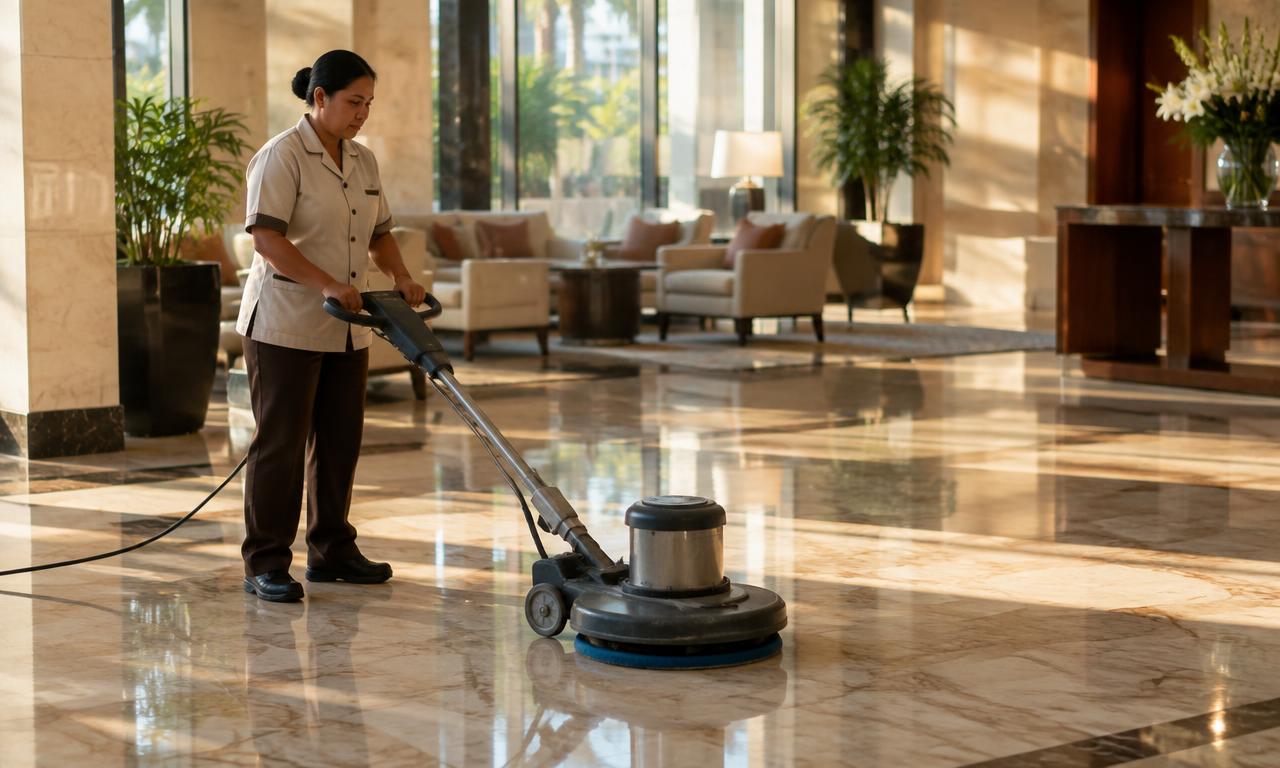
Public areas (lobby, corridors, elevators, public restrooms, event and banquet rooms, gym, pool deck, and outdoor common spaces). These areas create the guest's first impression and must be cleaned while guests are present. Critical factors include scheduled frequency intervals, rapid response times for spills or out-of-order restrooms, and spotless staff presentation. Restrooms and high-touch surfaces require a specific sanitation methodology; see cleaning vs. disinfection.
Back of house (administrative offices, employee locker rooms and dining areas, storerooms, service hallways, loading docks, mechanical rooms). Guests never see these areas, which makes them prone to neglect. Here, criteria resemble office or industrial plant cleaning rather than hospitality suites: restricted access protocols, shared service corridors with delivery drivers and maintenance staff, and mechanical zones requiring specific entry permits. For controlled-access environments, see sensitive areas.
Laundry and linens. It is essential to distinguish between two scopes that are frequently confused: cleaning the *laundry facility itself* (floors, trench drains, lint buildup removal, moisture-prone zones) and the *linen and laundry service* (collection, sorting, washing, ironing, folding, and delivery of bed linens and towels). These are entirely separate services requiring different equipment, chemicals, and labor profiles. If an RFP simply lists "laundry," clarify which scope is intended. Confirm with your operations leadership how and under what contractual terms each should be handled.
Kitchens and food prep areas. This is the operational area carrying the highest sanitary and regulatory exposure. Official Mexican Standard NOM-251-SSA1-2009 (hygiene practices for processing food, beverages, or food supplements) was published in the Official Gazette of the Federation (DOF) in 2010 and remains in full effect. Among other mandates, it specifies that cleaning and sanitizing agents must be applied strictly according to manufacturer instructions or validated procedures ensuring their efficacy (clauses 5.9.8 and 5.9.9), and that detergents and sanitizing chemicals must be stored in a dedicated, clearly demarcated area separate from food handling spaces (clause 5.4.2). Whether and how this standard applies to your hotel's kitchens must be determined by your designated sanitary compliance officer, who should also demarcate where third-party vendor duties end and the culinary team's sanitation duties begin.
Guest rooms. The operational core of housekeeping: linen changes, bathroom sanitization, replenishment of guest amenities, reporting missing fixtures or damage, and room release for turnover. This scope is characterized by cyclical workflows (checkout cleans, stayover refreshes, and deep cleans) measured strictly against brand standards. This is also where staff discretion and lost-and-found management carry the highest liability.
In-house housekeeping vs. external contractor: why REPSE and core business activity matter
Many hotels maintain an in-house room attendant staff while contracting third-party vendors for public areas, back of house, deep cleaning cycles, specialized floor care, high-altitude window washing, or seasonal occupancy surges. This division should never be based solely on labor costs; it involves both legal compliance and operational control.
The legal foundation lies in the Federal Labor Law (*Ley Federal del Trabajo* or LFT). Under current statutory provisions:
- Article 12 strictly prohibits the subcontracting of personnel (placing workers under the direction of another entity).
- Article 13 permits the subcontracting of specialized services or works that do not form part of the corporate purpose (*objeto social*) or the primary economic activity (*actividad económica preponderante*) of the beneficiary, provided the contractor is registered in the public registry.
- Article 14 requires a formal written contract specifying the specialized service to be performed and the approximate number of assigned workers, and establishes joint liability (*responsabilidad solidaria*) for the hiring company if the contractor defaults on its employment and social security obligations.
- Article 15 mandates contractor registration before the Ministry of Labor and Social Welfare (STPS) through the public REPSE portal, searchable at repse.stps.gob.mx.
For a detailed review of these requirements, see what REPSE is and how to verify a contractor.
What cannot be generalized here is how these statutory rules apply to an individual hotel. The legal consideration is clear: a hotel’s primary economic activity centers on lodging and associated hospitality services. Determining which cleaning duties are inseparable from that core activity and which qualify as distinct, outsourceable specialized services is a legal assessment that depends on your company's tax ID registration, corporate bylaws, and operational workflows. Review this directly with your corporate legal team before defining your sourcing model, bringing an itemized task list by area and schedule. Furthermore, validating an active REPSE registration does not replace reviewing the service agreement and verifying contractor compliance with IMSS (Social Security) and tax obligations (see the contractor compliance file).
The operational consideration centers on chain of command. When in-house staff and contractor personnel operate alongside one another, the property must clearly delineate management lines. Contractor employees must receive direct operational instructions exclusively from the contractor’s on-site supervisor; hotel management sets the quality standard and verifies the final output. See in-house staff vs. external contractor and staffing agency vs. cleaning company.
Occupancy peaks and service time windows
Cleaning labor demand in a hotel is dynamic: it fluctuates according to departures, arrivals, banquets, and seasonal travel. Three operational measures prevent common service failures:
- Variable, pre-negotiated staffing models. If the outsourced scope includes guest rooms or event spaces, establish a clear protocol for scaling headcount up or down based on projected occupancy: required advance notice, agreed staffing tiers, and defined management sign-offs. Without this rule, staffing adjustments become an ad-hoc dispute during every high-occupancy weekend.
- Zoned operational windows. Checkouts and arrivals dictate the housekeeping schedule; peak lobby traffic, breakfast hours, and evening events dictate public area schedules. Detail what tasks must occur during each window and identify disruptive activities that must never take place in front of guests (e.g., loud machinery, heavy equipment staging, strong chemical odors). For a broader operational review of shifts, see day shift vs. night shift.
- Relief staff and absenteeism coverage. Require the contractor to outline its absenteeism backup plan and replacement onboarding process; see staffing, training, and coverage.
Staffing ratios per room and standard task times vary by hotel property type and brand tier: there is no universal baseline. Require the contractor to present its labor assumptions and cross-check them with your Executive Housekeeper.
Guest discretion
Cleaning personnel access private guest areas and come into direct proximity with personal belongings. Operational discretion must be formalized and documented:
- Contractual confidentiality clauses covering room contents, guest identities, and guest habits, backed by signed acknowledgment forms proving the cleaning staff has been trained on these expectations.
- Room entry protocols: mandatory door-knock and verbal announcements, procedures if a guest is inside or requests privacy, and strict handling of "Do Not Disturb" (DND) indicators.
- Keycard, physical key, and master access logs, clearly designating who is authorized to grant access to a guest room.
- A single point of contact within hotel management to receive guest feedback or complaints and route them directly to the contractor’s supervisor.
Staff rosters, identification documents, and access badges contain personal data under data privacy laws: coordinate with your legal counsel on data retention policies. For protocol guidelines regarding occupied areas, see sensitive areas and occupant interaction.
Brand standards
Most properties operate under internal brand standards or corporate franchise operational manuals (room cleaning sequence, final quality checklists, bed presentation, amenity placement). These requirements impact the contract in three practical ways:
- Brand standards must be documented in writing and delivered to the contractor prior to service rollout. A contractor cannot be held accountable to unwritten operational expectations.
- Distinguish between standard verification and direct operational management. Agreeing on expected deliverables and inspecting rooms using a checklist is quality verification; directing individual vendor cleaners on the floor constitutes unlawful labor subcontracting. The contractor’s supervisor must manage and organize their staff.
- Clarify who conducts brand compliance training and manages quality audits. If the franchise brand conducts third-party audits (e.g., QA inspections), establish contractually how audit findings will be remediated and within what timeframe. See supervision and KPIs.
Brand compliance rules and third-party contractor restrictions vary by hospitality flag; verify these policies with your brand representative and legal counsel.
Lost and found
Unattended items left behind by guests represent a recurring liability. Establish a minimum written protocol, verified with your Legal and Security departments:
- Action upon discovery: Do not move items in a way that alters their context, do not open closed bags or compartments, and notify the vendor supervisor and hotel management immediately.
- Logging requirements: Item description, exact location, date, time, identity of the finder, and recipient within the hotel, confirmed via a signed chain-of-custody log.
- Chain of custody: The item must transfer immediately from the cleaner to the vendor supervisor, and directly to the hotel’s designated department (front desk, housekeeping, or security). Vendor staff must never store guest property in vendor supply closets or lockers.
- Valuables and cash: High-value items require an enhanced protocol, including dual-custody verification, an immediate supervisor witness, and express logging.
- Liability: Contractual allocation of responsibility if an item reported by a guest goes missing while in the cleaning staff's operational area; this clause must be drafted by legal counsel.
Incidents
In a hotel environment, incidents frequently involve guests directly: slip-and-fall events, lobby spills, damaged luggage or belongings, sensitive discoveries, or formal service complaints. Ensure the contract establishes:
- Clear definitions of what constitutes an incident and who determines severity levels.
- Reporting channels and escalation timelines (emergency points of contact, daytime vs. nighttime escalation).
- A standardized incident report template documenting objective facts, timelines, and physical evidence, excluding subjective opinions.
- Inter-departmental coordination with hotel security and front desk whenever a guest is involved.
- Follow-up procedures, corrective action tracking, and evidence submission.
For a comprehensive guide, see incident reporting protocol. For occupational safety and vendor PPE compliance, see what to require from the contractor, and for chemical management and paper products, see cleaning supplies and consumables.
Common mistakes
- Requesting a quote for "the hotel" as a single service. Each area has distinct operational hours, risks, and compliance standards.
- Conflating laundry facility cleaning with linen washing services. These are distinct service scopes with different labor and equipment requirements.
- Deciding what to outsource based solely on labor pricing, without prior legal and tax review.
- Assuming a valid REPSE registration settles all labor risk. REPSE is an initial regulatory filter, not a substitute for ongoing contract oversight.
- Failing to define dynamic occupancy adjustments in writing, forcing reactive negotiations during seasonal peaks.
- Supplying brand standard manuals only after the contract has begun.
- Operating without a formal lost-and-found protocol, leading to confusion when a guest files a missing-property claim.
- Giving direct operational orders to vendor cleaners instead of routing directives through the contractor’s designated supervisor.
Advertencias
This article does not constitute legal, sanitary, or hospitality management advice. How Articles 12 through 15 of the Federal Labor Law apply to your specific hotel, which food-safety standards govern your kitchens, and what restrictions your franchise agreement imposes must be reviewed by your legal counsel, sanitary compliance officer, and corporate operations team.
>
No chemical handling procedures included. This guide does not dictate specific chemical applications or safety handling procedures; these must align with the manufacturer's technical data sheets, safety data sheets (SDS), and recommendations from a certified chemical specialist.
>
Personal data protection. Lost-and-found logs, security access registers, and vendor personnel files contain personally identifiable information; maintain and retain these records in strict compliance with applicable data privacy laws.
Decision table for defining scope
| Operational Area | Questions to Address | Who Performs It Today? | To Be Outsourced? | Question for Legal / Specialist | Required Evidence |
|---|---|---|---|---|---|
| Public areas | Interval frequencies, rapid spill response, guest-facing zones | Does it fall outside the hotel's core business activity? | Area inspection logs, response time metrics | ||
| Back of house | Access restrictions, service corridors, work permits | Facility access conditions and liabilities | Signed entry logs, badge access tracking | ||
| Laundry (facility) | Wet areas, trench drain sanitation, lint accumulation removal | Environmental, health, and safety compliance | Preventive sanitation checklists | ||
| Linens (service) | Facility housekeeping vs. full linen handling and processing | Separate service contract and legal classification? | Dedicated service contract, written SLA | ||
| Kitchens | Clear demarcation between third-party scope and culinary team | Sanitary compliance officer / applicable health standards | Chemical spec sheets, documented sanitation logs | ||
| Guest rooms | Turnover cycles (checkout, stayover, deep clean), brand standards, missing item logs | Core business activity assessment? Franchise QA standard limits? | Final room inspection checklists, internal QA audit scores | ||
| Discretion & privacy | Confidentiality terms, room access protocols, "Do Not Disturb" rules | Legal nondisclosure language and privacy compliance | Signed employee acknowledgment records | ||
| Lost and found | Logging standards, custody transfer, high-value asset handling | Contractual liability and indemnification terms | Signed chain-of-custody receipt | ||
| Incidents | Severity classification, escalation timelines, root-cause tracking | Contractual liability terms | Formal incident report package |
*How to use: Complete this table jointly with Hotel Operations, Executive Housekeeping, Procurement, and Legal prior to releasing an RFP; it serves as a core technical exhibit for your contract.*
Next step
Complete the decision table with your leadership team and submit the questions in the legal column to your corporate counsel. Once the operational scope is defined, consult our guide to hiring commercial cleaning services, review our compliance requirements, and, if you need an operational proposal, submit your details through our quote request page.
Sourcing hotel cleaning services effectively begins by dividing the facility into discrete functional scopes and confirming with your legal team which tasks can be legally outsourced as specialized services under Mexican law. It continues by establishing concrete, written operational rules for occupancy shifts and brand standards, and is sustained through verifiable daily execution logs. Every distinct zone requires a designated owner, an explicit scope of work, and an objective method of quality verification.
Sources
Use this checklist in your next quote or renewal.
To get a quote from SELIMEX, use the quote page; for more information, see the compliance section.